The days of old
p. 53 · Read in the full issue
Books
By Michael Field
WHEN Samoan men and women want to argue about who is entitled to hold this or that chiefly title the spoils can go to the side which has managed to obtain a dog-eared, photocopied edition of a book written nearly a century ago by a
German Imperial Navy doctor.
Those who cannot get a pirated copy fly to New Zealand where they pour over it in a reference library. Now, in what is likely to be a crucial, democratising event in Samoan culture, a new, English translation edition of volume one of Augustin Kramer’s The Samoa Islands , first published as Die Samoa Inseln in 1902, has been republished. The first volume deals with the constitution, pedigrees and traditions of Samoa, while volume two deals with material culture.
Malama Meleisea, director of Pacific Studies at Auckland University, says the publication is important because of the way his work is used in the Lands and Titles Court which adjudicates chiefly disputes. “Having sat through a lot of lands and titles cases any mention of this book by a German doctor, people would sit up and react, ‘oh yes, we’ve heard that’.
“It will have a tremendous effect now that it is freely available on the Lands and Titles Court situation. To some extent it will demystify the Kramer thing in the minds of Samoan people.”
Meleisea says much of Kramer’s material is still useful. “One of the best things about it is that he tired to avoid putting any of his own interpretations on the material he collected.”
Kramer was born in Chile in 1865 and grew up in Stuttgart. For family reasons he trained as a medical doctor but his heart was in wider sciences than that. For that reason he joined the German navy as a surgeon-major, then a globe span ning superpower, believing he could duplicate the celebrated naval travels of Charles Darwin.
In Hawaii he perceived Polynesians to be on the edge of extinction and so decided to record everything possible there was to know of them. Samoans were chosen, perhaps because they were less near the edge and because Germany was in effective control of what is today Western Samoa.
“It will take only a few decades till the South Seas isn’t that peculiar area any more, separated from the world and civilisation ... all the natives become Christians and more and more of their originality is vanishing day by day.”
Kramer felt Samoans were at an early stage of humanity while the superior
Germans, he believed, had a duty to record the fate of indigenous peoples. In the preface to his book he says he did not regret the time, effort and sacrifice because it would “contribute directly or indirectly to the preservation of the cultural heritage of the slowly dying-out peoples of the Pacific in the evening of their unique culture and philosophy of life”. He said some old men from pagan times were still alive but overall he felt European science had missed the oppor tunity to record the original Samoan culture. “I hope that our sons won’t damn us for not leaving systematic reports about Samoan culture but only some dispersed notes.”
In 1893 Kramer got himself posted to a navy cruiser Bussard based in Apia. He observed and recorded what he could of Samoan culture, although critics of his work note he was never very systematic about it. He would simply collect information and would not try to put it into any kind of context. At one point he rented an Apia house where he admired the “charming character of the Samoans and their cleanliness and the dark skin of the slender-waisted girls”.
Much of his time he tried to collect as many human bones as he could to send back to Germany, along with Samoan handicraft. He knew enough of Samoa to appreciate the highly structured nature of the society around him. Matai or chiefs came in varying grades and ranks and genealogy, involving centuries, and this was crucial to arguments over succession and land rights. These are encompassed in the fa’alupega or ceremonial greetings and gafa, genealogical pedigrees, oral treasures which define a Samoan. In
1897 Kramer obtained a notebook in which a missionary had written down extensive fa’alupega. The missionary did not want him to have it, but money changed hands and Kramer spent a night copying the notebook’s contents.
“If I could find out the political organisation of Samoa this will be a very valuable aid. When I held this notebook with the meaningful writing in my hand, I knew that I must not give it back without having exploited it.”
Other fa’alupega came into his pos session in equally haphazard ways, and intriguingly this collection today has become one of the main authoritative guides, Samoa’s answer to Burke’s Peer age. Whether it is right or wrong now seems almost not to matter and most miss the irony of modern, independent Samoa’s political structures being de fined by a colonial German who believed he was writing a eulogy for the race. At the time of his work a power struggle, occasionally flaring into civil war, was underway with Germany, Britain and the United States backing chiefs for what the colonialists liked to call “kingship”.
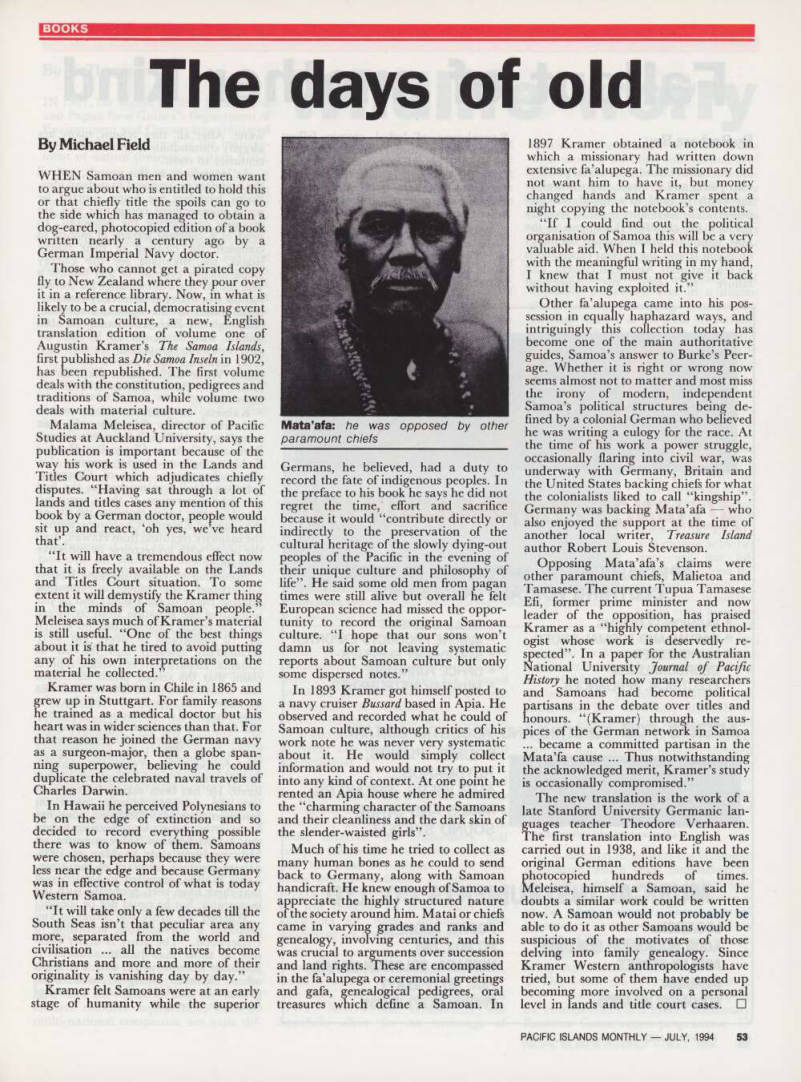
Germany was backing Mata’afa who also enjoyed the support at the time of another local writer, Treasure Island author Robert Louis Stevenson.
Opposing Mata’afa’s claims were other paramount chiefs, Malietoa and Tamasese. The current Tupua Tamasese Efi, former prime minister and now leader of the opposition, has praised Kramer as a “highly competent ethnol ogist whose work is deservedly re spected”. In a paper for the Australian National University Journal of Pacific History he noted how many researchers and Samoans had become political partisans in the debate over titles and honours. “(Kramer) through the aus pices of the German network in Samoa ... became a committed partisan in the Mata’fa cause ... Thus notwithstanding the acknowledged merit, Kramer’s study is occasionally compromised.”
The new translation is the work of a late Stanford University Germanic lan guages teacher Theodore Verhaaren.
The first translation into English was carried out in 1938, and like it and the original German editions have been photocopied hundreds of times.
Meleisea, himself a Samoan, said he doubts a similar work could be written now. A Samoan would not probably be able to do it as other Samoans would be suspicious of the motivates of those delving into family genealogy. Since Kramer Western anthropologists have tried, but some of them have ended up becoming more involved on a personal level in lands and title court cases. □
Mata’afa: he was opposed by other paramount chiefs