Managing our resources
p. 28 · Read in the full issue
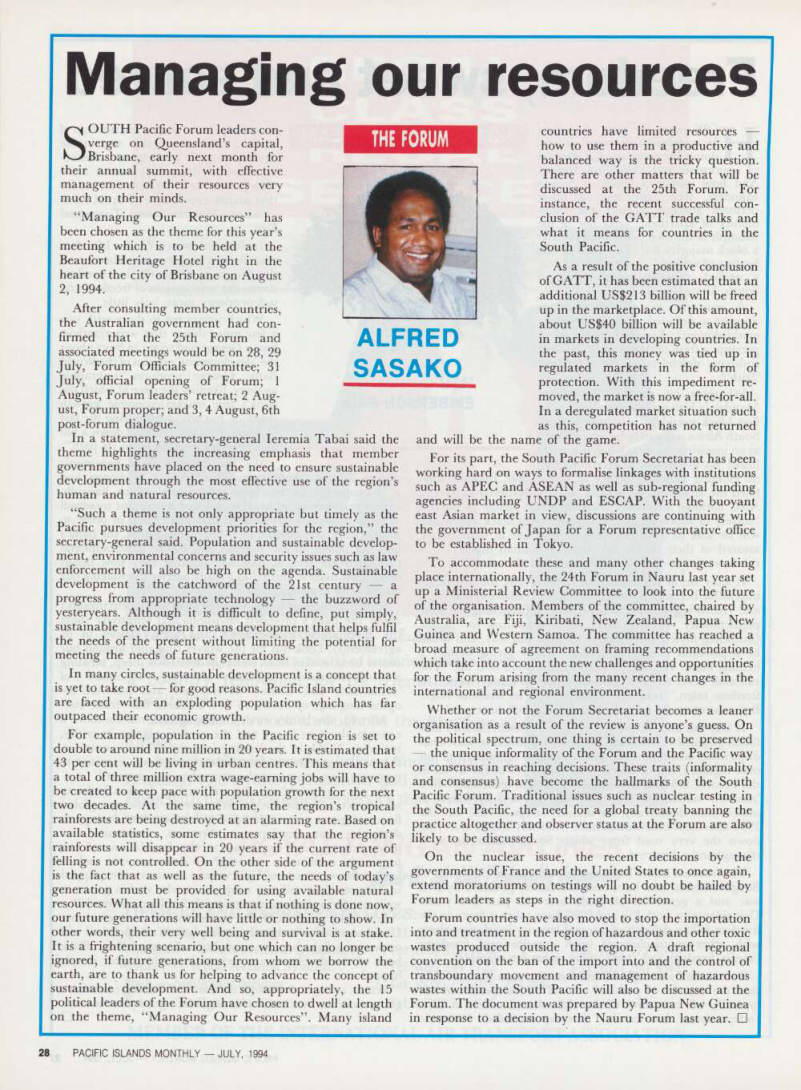
SOUTH Pacific Forum leaders con verge on Queensland’s capital, Brisbane, early next month for their annual summit, with effective management of their resources very much on their minds.
“Managing Our Resources” has been chosen as the theme for this year’s meeting which is to be held at the Beaufort Heritage Hotel right in the heart of the city of Brisbane on August 2, 1994.
After consulting member countries, the Australian government had con firmed that the 25th Forum and associated meetings would be on 28, 29 July, Forum Officials Committee; 31 July, official opening of Forum; 1 August, Forum leaders’ retreat; 2 Aug ust, Forum proper; and 3, 4 August, 6th post-forum dialogue.
In a statement, secretary-general leremia Tabai said the theme highlights the increasing emphasis that member governments have placed on the need to ensure sustainable development through the most effective use of the region’s human and natural resources.
“Such a theme is not only appropriate but timely as the Pacific pursues development priorities for the region,” the
secretary-general said. Population and sustainable develop
ment, environmental concerns and security issues such as law enforcement will also be high on the agenda. Sustainable development is the catchword of the 21st century a progress from appropriate technology the buzzword of yesteryears. Although it is difficult to define, put simply, sustainable development means development that helps fulfil the needs of the present without limiting the potential for meeting the needs of future generations.
In many circles, sustainable development is a concept that is yet to take root for good reasons. Pacific Island countries are faced with an exploding population which has far
outpaced their economic growth.
For example, population in the Pacific region is set to double to around nine million in 20 years. It is estimated that 43 per cent will be living in urban centres. This means that a total of three million extra wage-earning jobs will have to be created to keep pace with population growth for the next two decades. At the same time, the region’s tropical rainforests are being destroyed at an alarming rate. Based on available statistics, some estimates say that the region’s rainforests will disappear in 20 years if the current rate of felling is not controlled. On the other side of the argument is the fact that as well as the future, the needs of today’s generation must be provided for using available natural resources. What all this means is that if nothing is done now, our future generations will have little or nothing to show. In other words, their very well being and survival is at stake.
It is a frightening scenario, but one which can no longer be ignored, if future generations, from whom we borrow the earth, are to thank us for helping to advance the concept of sustainable development. And so, appropriately, the 15 political leaders of the Forum have chosen to dwell at length on the theme, “Managing Our Resources”. Many island
countries have limited resources how to use them in a productive and balanced way is the tricky question.
There are other matters that will be discussed at the 25th Forum. For instance, the recent successful con clusion of the GATT trade talks and what it means for countries in the South Pacific.
As a result of the positive conclusion of GATT, it has been estimated that an additional US$2l3 billion will be freed up in the marketplace. Of this amount, about US$4O billipn will be available in markets in developing countries. In the past, this money was tied up in regulated markets in the form of protection. With this impediment re moved, the market is now a free-for-all.
In a deregulated market situation such as this, competition has not returned
and will be the name of the game.
For its part, the South Pacific Forum Secretariat has been working hard on ways to formalise linkages with institutions such as APEC and ASEAN as well as sub-regional funding agencies including UNDP and ESCAP. With the buoyant east Asian market in view, discussions are continuing with the government of Japan for a Forum representative office to be established in Tokyo.
To accommodate these and many other changes taking place internationally, the 24th Forum in Nauru last year set up a Ministerial Review Committee to look into the future of the organisation. Members of the committee, chaired by Australia, are Fiji, Kiribati, New Zealand, Papua New Guinea and Western Samoa. The committee has reached a broad measure of agreement on framing recommendations which take into account the new challenges and opportunities for the Forum arising from the many recent changes in the international and regional environment.
Whether or not the Forum Secretariat becomes a leaner organisation as a result of the review is anyone’s guess. On the political spectrum, one thing is certain to be preserved the unique informality of the Forum and the Pacific way or consensus in reaching decisions. These traits (informality and consensus) have become the hallmarks of the South Pacific Forum. Traditional issues such as nuclear testing in the South Pacific, the need for a global treaty banning the practice altogether and observer status at the Forum are also likely to be discussed.
On the nuclear issue, the recent decisions by the governments of France and the United States to once again, extend moratoriums on testings will no doubt be hailed by Forum leaders as steps in the right direction.
Forum countries have also moved to stop the importation into and treatment in the region of hazardous and other toxic wastes produced outside the region. A draft regional convention on the ban of the import into and the control of transboundary movement and management of hazardous wastes within the South Pacific will also be discussed at the Forum. The document was prepared by Papua New Guinea in response to a decision by the Nauru Forum last year. □