warning
Environment
Greenhouse warning
THE Pacific nation of the Marshall Islands has received a chilling warning of what may happen if sea levels rise as a result of global warming.
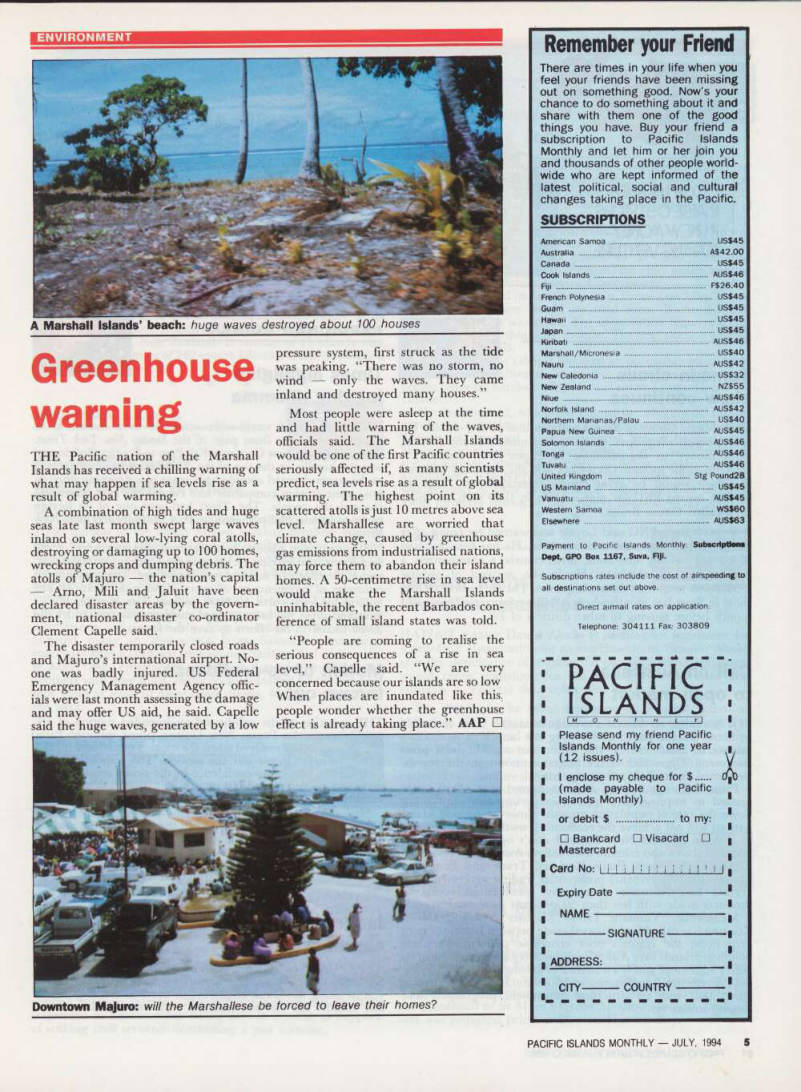
A combination of high tides and huge seas late last month swept large waves inland on several low-lying coral atolls, destroying or damaging up to 100 homes, wrecking crops and dumping debris. The atolls of Majuro the nation’s capital Arno, Mili and Jaluit have been declared disaster areas by the govern ment, national disaster co-ordinator Clement Capelle said.
The disaster temporarily closed roads and Majuro’s international airport. No one was badly injured. US Federal Emergency Management Agency offic ials were last month assessing the damage and may offer US aid, he said. Capelle said the huge waves, generated by a low
pressure system, first struck as the tide was peaking. “There was no storm, no wind only the waves. They came inland and destroyed many houses.”
Most people were asleep at the time and had little warning of the waves, officials said. The Marshall Islands would be one of the first Pacific countries seriously affected if, as many scientists predict, sea levels rise as a result of global
warming. The highest point on its
scattered atolls is just 10 metres above sea level. Marshallese are worried that
climate change, caused by greenhouse
gas emissions from industrialised nations, may force them to abandon their island homes. A 50-centimetre rise in sea level would make the Marshall Islands uninhabitable, the recent Barbados con ference of small island states was told.
“People are coming to realise the serious consequences of a rise in sea level,” Capelle said. “We are very concerned because our islands are so low When places are inundated like this, people wonder whether the greenhouse
effect is already taking place.”
Aap
A Marshall Islands’ beach: huge waves destroyed about 100 houses
Downtown Majuro: will the Marshallese be forced to leave their homes?