Tahiti boasts proud soccer tradition
pp. 60-61 · Read in the full issue
Sport
By Atama Raganivatu
ON the face of it, the recent South Pacific Mini Games in Port Vila was disappoint ing for French Polynesia. Its tally of 30 medals languished well behind the totals achieved by the region’s other major powers Fiji, New Caledonia and Papua New Guinea which won 56, 40 and 37 respectively. However, the games produced far more smiles than frowns in Papeete, for Tahiti won the soccer tournament by beating arch rival Fiji 3-0 in the final.
Soccer has long been the great sporting passion of Tahitians. The sport was well established at informal levels even before an administrating body was constituted and an organised competition, the Coupe de Polynesie, launched in 1938 (curiously, the same year also saw the start of the Fiji Football Association and its Inter Districts Championship). The Tahitian League Championship com menced immediately after World War Two a full 32 years ahead of its Fijian counterpart.
For a quarter of a century, Tahitian soccer cruised along in blissful solitude.
Geographical isolation severly restricted international contacts until 1963 and the advent of the South Pacific Games. The first games, in Suva, brought an immense shock to Tahiti. It finished third, behind winners New Caledonia and Fiji. This inaugural tournament set the tone for the next seven, with the francophone teams vying for the gold medals and Fiji the most tenacious of those following in their wakes.
The 1966 event in Noumea ended with Tahiti winning its initial title by defeat ing the hosts. Three years later, the New Caledonians gained revenge at Port Moresby. Tahiti appeared set to redress the balance when staging the fourth SPG in 1971. During warm up matches, the Tahitians claimed their biggest scalp by defeating a Welsh FA XI composed of full time British professionals 1-0 and twice beat Chile’s touring national ama teur selection. But, at the games, Tahiti could do no better than finish third behind New Caledonia and New Hebrides (now Vanuatu). This initiated a total metamorphosis of the local association, the Ligue Regionale de Football de Polynesie Francaise.
Under the visionary leadership of LRFPF president Napoleon bpitz, Tahitian soccer progressed rapidly over the next 20 years. The most important move was the introduction of semi professionalism. This not only attracted prominent players from New Zealand, Vanuatu and New Caledonia; consider ably enhancing the standard of domestic
fare, but also promoted greater responsibility amongst local players. Tahitian soccer has, by and large, been free of the disciplinary problems which bedevil the strictly amateur set up in Fiji. When their incomes are likely to be affected, players usually refrain from missing practices, breaking curfew when in training camps or embarking upon shoplifting sprees while on overseas tours - breaches of , . c t • i T 7- • . conduct for which Fijian internationals are currently serving suspensions.
Spitz remains a dominant figure today to the extent that the administrative body’s official address includes the line “for the attention of M Napoleon Spitz”!
Tahiti was extremely lucky to also have,
for almost two decades, the services of a player who was just as influential on the pitch as Napoleon Spitz was offit. For 10 successive seasons, Erroll Bennett was the Tahitian league s leading goal scorer and his club, Central Sport, maintained a near stranglehold upon domestic trophies throughout the 1970 sand we '' llo the Jl ext . decade. Spearheade by Bennett Tahiti claimed a hat trick of South Pacific Games successes between an( 1933. It was also runner up at the oceania Cup tourna ments of and 1980 (which featured both Australia and New Zealand). There was absolutely no dissent when, in 1985, The Fiji Times dubbed Bennett “The King of South Pacific Soccer”.
Yad Singh
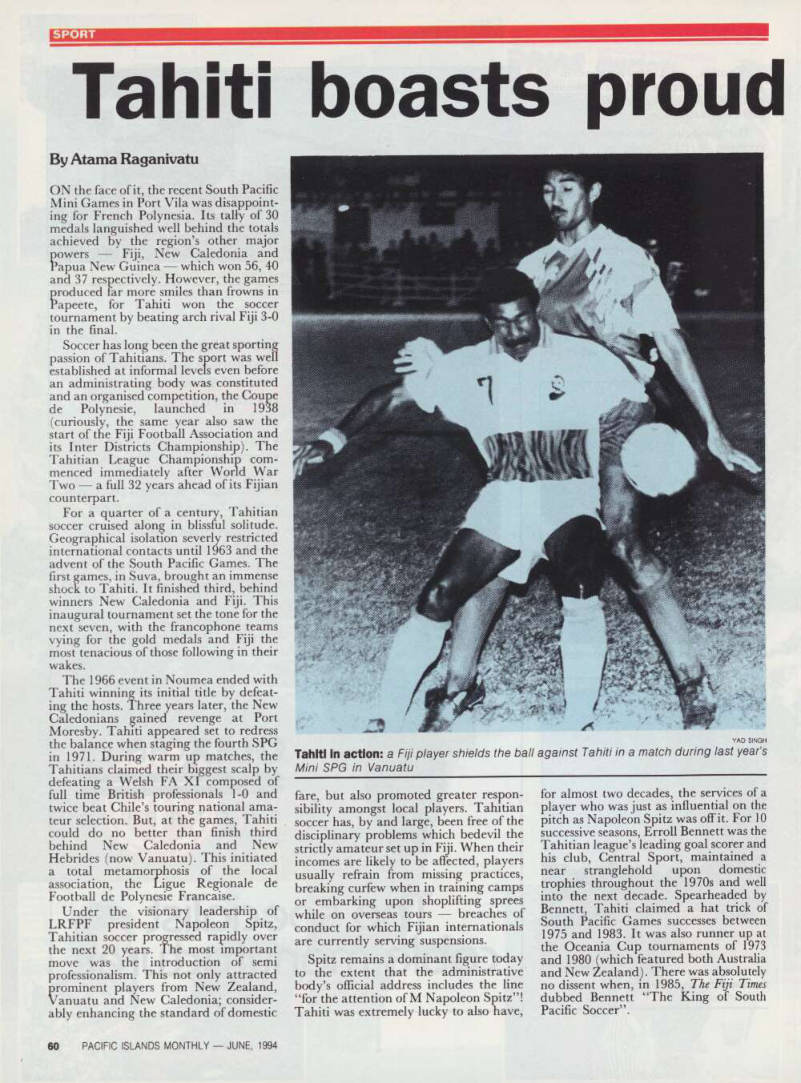
Tahiti in action: a Fiji player shields the ball against Tahiti in a match during last year's Mini SPG in Vanuatu
Such was Bennett’s standing that when he joined the Church of Jesus Christ of Latter Day Saints in 1977, the Tahitian League switched its fixtures from Sun days to mid week dates and prevented his retirement due to Mormons’ refusal to play sport on the Sabbath. Spitz also persuaded the South Pacific Games Committee to reschedule its soccer pro gramme to accommodate his captain!
However, the slightly built policeman failed in his attempt to become a full time professional in Europe. Homesickness led to Bennett’s early return to Papeete after a short, unproductive, stint with the now defunct FC Paris in 1971. The next outstanding product of Tahitian soccer fared better.
Pascal Vahirua, an “old fashioned” left winger blessed with superb ball control joined one of Papeete’s Cinderella clubs, Mataia, when eight just as his father and elder brother had done before him. By the time he was 16, Vahirua’s goals were keeping Mataia in the league’s top section, the Honours Division. After starring for the Tahitian side that won an international youth tournament in Corsica, Vahirua was signed by French first division outfit AJ Auxerre in 1983 and, in the intervening years, played a major role in the little provincial club’s establishment, for the first time, as a real power.
In 1990, Vahirua became the only Tahitian to ever represent France when gaining the first of a handful of caps against Kuwait. Cynics claim his call up was in membership to FIFA, the govern ing body of international soccer, in the same year. Once selected for one FIFA
member, a player is ineligible to appear for another.
Tahitian soccer administrators are notoriously independently minded. For many years, the most apparent indi cation of this was their sides going into battle under the banner of Tahiti rather than the government-preferred and of ficially correct (although very few
Tahiti has established Itself as a force to be reckoned with on the soccer field. Free of disciplinary problems which plague other countries, the Tahitians have grown from strength to strength
players from the outer islands groups have ever been included) French Poly nesia.
France has been averse to permitting her colonies to become visible separate entities and, although Macao, Hong Kong and several British and Dutch territories in the Caribbean have been part of the international soccer main stream for a long time, Paris only reluctantly permitted Tahiti to become a FIFA member in 1990 after a protracted battle. Membership enabled Tahiti to make its World Cup debut two years ago when Australia was given a couple of hard games. Kingpin of the current team is gifted linkman Reynald Temarii. In 1990, he followed in the footsteps of
Bennet and Vahirua and spent two seasons with leading French club EC Nantes but failed to make an impact there. Nor did Temarii achieve much during a short stint at Brisbane United of Australia’s national league. He has never let Tahiti down though and his dominance of midfield was instrumental in Fiji’s downfall at the Mini Games.
Fiji’s triurrmh at the 1991 SPG in Papua New Guinea was, at the time, regarded as a major turning point in regional soccer. However, it must now be recognised as merely an aberration. With Spitz’s hand still firmly on the organis ation now known as the Federation Tahitienne de Football and the domestic structure as strong as ever, Tahiti is well placed to continue producing players of the calibre of Bennett, Vahirua and Temarii. Add to this the turmoil that appears to be the norm now in Fiji as well as the state of the game in New Caledonia, which has yet to overcome the lengthy disruption to domestic com petitions caused by civil unrest in the mid 1980s and nobody can blame the Tahitians for being ultra-confident of success at the SPG it will host next year.
On the broader front, Tahiti is intent upon overtaking a seriously-on-the-wane New Zealand as Oceania’s second best team before too long. The future cer tainly appears to be bright for Tahitian soccer. ■ The team last month completed a three-match tour in Fiji with games in the capital Suva and two of the main towns. The first was held at Labasa on May 19, with the others in Suva and Lautoka on May 23 and 25 respectively.