Competition ahead
pp. 57-59 · Read in the full issue


PTC Telecom Advertising Feature
THE managing director of Post and Telikom Corporation, Isikeli Taureka, has said that Telikom faces possible competition due to the deregulation of the telecommunications market. He also called on senior Telikom managers to draw up strategic plans to fit an achievable business plan.
Taureka said this when he opened a
week-long strategic planning workshop
for senior Telikom managers at
the Port Moresby Travelodge
Hotel in April. The workshop was conducted by strategic plan ning experts Doctor Noel Lindsay and Owen Tilbury from
Bond University, in Queensland,
Australia.
Taureka warned his officers when he said: “The government has re-established the Depart ment of Information and Com munications, the development of the policy on information and communications which does not recognise PTC as the sole car rier.” The policy, he said, did not
recognise ownership by Papua
New Guineans. Instead, Taureka said, it intended to liberalise the telecommunications network by people or entities who could provide services efficiently and at a competitive price. He said the possible introduction of a second cellular mobile carrier or a second international gateway
Telikom boss urges
preparedness for
changes in industry
gave emphasis to the government policy that they meant business.
“In fact, it’s the government’s policy to commercialise and corporatise PTC as
a carr^er anc * P°li c y regulator or both.
The notion that has been ingrained that PTC has the complete monopoly on communications services owned by the people of PNG is out the window,”
Taureka said.
“I would suggest that there is nothing to stop Hitron or EMTV from introduc *n§ vo * ce or data,” Taureka said, “Our strategy must recognise these
competitive threats and take them into account and accommo date an objective to be preferred carrier. I say this because change is inevitable,” he said.
“The unbungling of regulation
which constraints us from react ing to competition will be affec ted with the corporatisation pro cess which is slowly gaining momentum.” He said that in stead of reacting to competition in a negative and confrontative manner, Telikom should respond positively in re-assessing its busi ness strategies.
On whether Telikom should look at joint ventures in areas of a network where it was vulner able to lack resources and exper tise or whether it should establish wholly owned departments such as data services, pay phones, and information technology, ad equately funded and autonomous and take on the market with an aggressive stance, Taureka said:
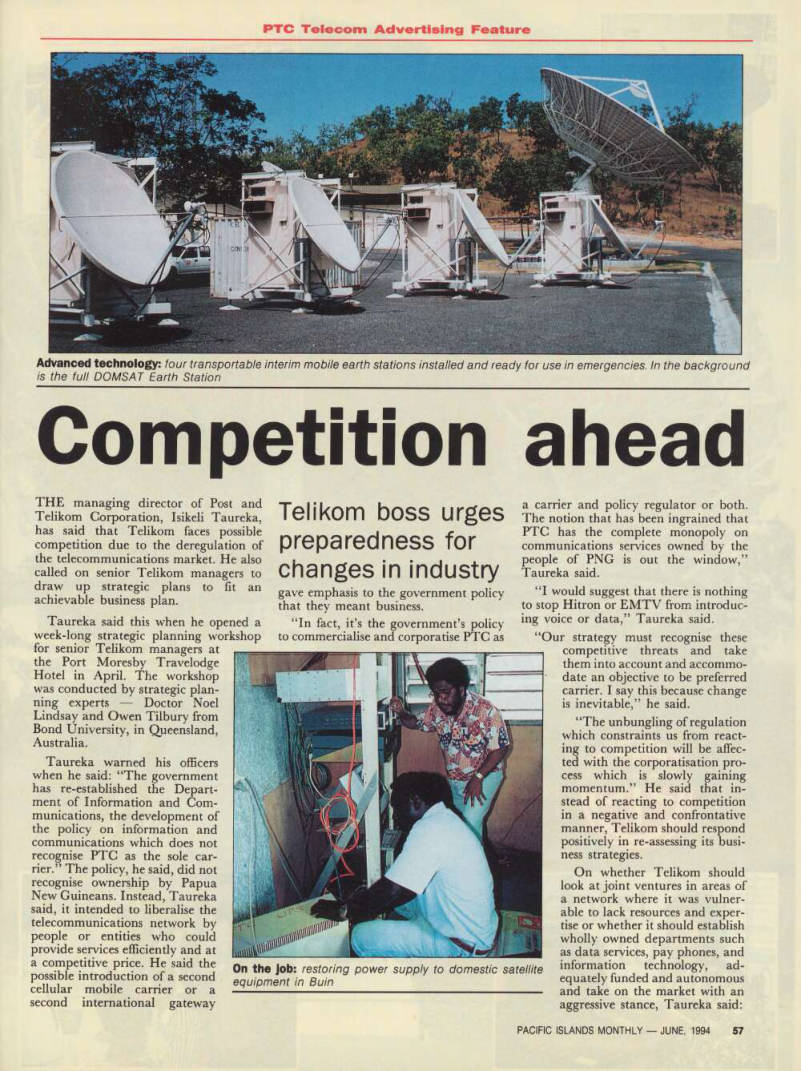
Advanced technology: four transportable interim mobile earth stations installed and ready for use in emergencies. In the background is the full DOMSAT Earth Station
On the Job: restoring power supply to domestic satellite equipment in Buin
“Frankly, as I see it, that in an
industry perspective and the community
requires access to freedom of information and communication.”
The managing director said the gov ernment or PTC could not deny the people this basic human right.
“In these circumstances, there might be partial dismantling of the network and the corporation may only hold a dominant position in the trunk routes and external plant because of the substantial up front investment on ongo ing maintenance of these networks and anything else would be up for grabs.”
Taureka told the senior Telikom managers that there was no room for complacency and internal conflict and
that they must plan strategies which
should be linked to an achievable business plan. □
Client service: two linesmen connect telephones for a customer
Equipment: antennas of HF radio on Tasman Island
Reliable service: an operator talks to a customer reporting a line fault