by telecom companies
The United Nations
Small islands cut off by telecom companies
UNITED Nations Development Pro gramme (UNDP) of ficials identified island governments and the telephone companies as a major obstacle to the devel opment of SIDS/ NET, a proposed small island elec tronic media net work. Gus Edgren, UNDP assistant ad ministrator, ex pressed pessimism
that governments and telecommunica tions companies were prepared to reduce the huge costs of overseas communica tions to make contact with the Internet possible.
Edgren told PIM that non governmental organisations and educa tional institutions who would most ben efit from such a network are a “weak constituency, and may not have enough political clout to get charges reduced”.
Ironically, delegates representing the same governments that have often col laborated with telecommunication com panies to give the latter an expensive monopoly, agreed to give UNDP the task of organising a feasibility study, in co ordination with the small island develop ing states and relevant sub-regional organizations, for SIDS/NET.
Edgren explained that the idea for SIDS/NET grew out of an existing UNDP project, the Sustainable Develop ment Network which connects some 20 national development networks. “There is such a lot of information that’s relevant to small islands, but you have to index the information relevant to SIDS, so that the volume is not overwhelming. Sec ondly it is facilitate communications, so the countries concerned can talk to each other. So they have to have computers and connections to Internet or other
networks. And thirdly, it is important that they should be able to communicate with each other directly.”
A prototype of SIDS/NET, funded by UNDP Barbados, was working on the conference site and uses UNDP’s own communications network to link with the Togethernet and Internet computer net works. It offered on-line data bases of conference documents and UN docu ments to delegates, NGO’s and journal ists at the conference, as well as providing E-mail services and on-line conferencing
facilities. Adam Rogers, co-ordinating
the project, pointed out that electronic conferencing was no substitute for face to
face meetings, but bringing people from
around the world was highly expensive.
After Barbados, delegates and other participants could continue building on the relationships they had established in a much cheaper way. UNDP consultant Peter Meincke, who briefed delegations about the proposal pointed out that E-mail is the cheapest form of communi cation, and so could provide a bridge to cross the increasing information gap between the rich and the poor countries.
But while cheaper, it is not free. On isolated islands it could cost anything from SIOO,OOO to 5500,000 to establish a satellite hub link and a dedicated circuit could range in cost from S2OO to 54500 per month. □
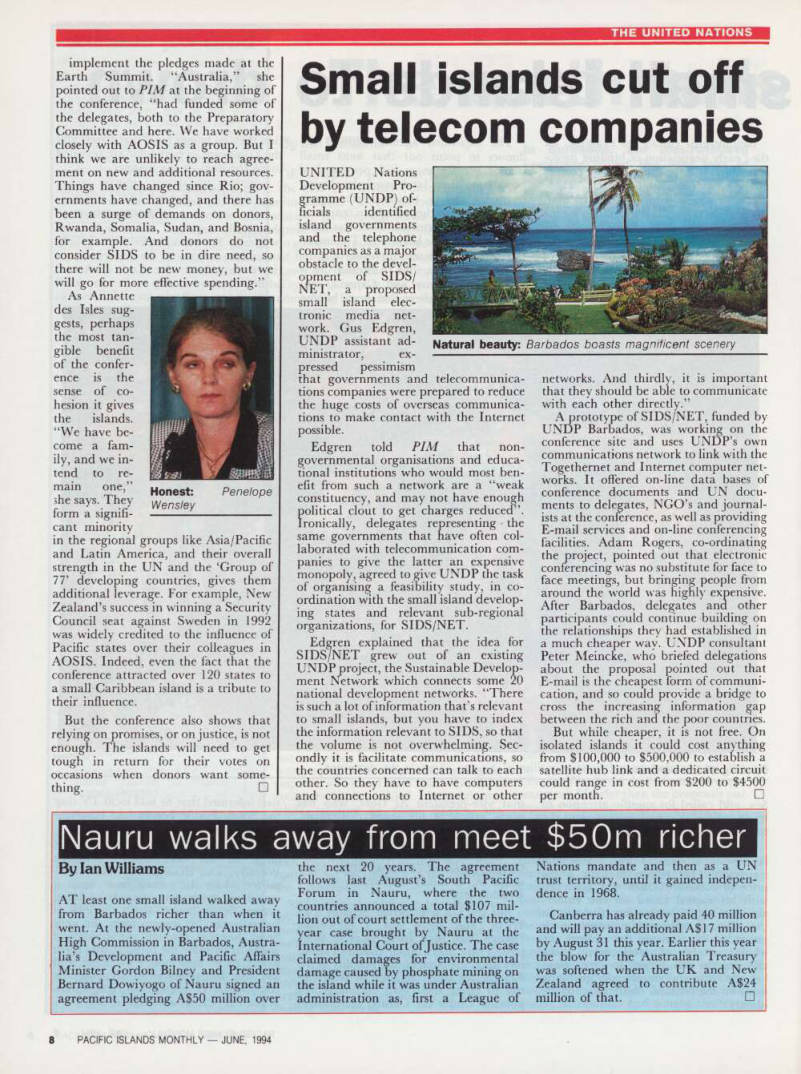
Natural beauty: Barbados boasts magnificent scenery