The north tells all islands to drown
pp. 6-8 · Read in the full issue
The United Nations
By lan Williams
DEPENDING on whom you spoke to, the first UN Global Conference on the Sustainable Development of Small Island Developing States was either a great success or a significant addition to global warming because of the column of hot air rising from Barbados’ brand new Sherbourne Conference Centre.
Trying to report the conference was something like watching the grass grow.
It is very important whether grass grows, or dies, but the description of the process is not too exciting.
In fact, the conference fell somewhere between the two stools. The donor countries did not honour their pledges at the Rio Conference to put new and additional resources towards the small island developing states. On the other
hand, they did not explicitly repudiate
them. It was pretty much as though they
had been handed an lOU that they had signed two years before, and instead of ripping it up, had re endorsed it but still not put any date or amount on the promise to pay.
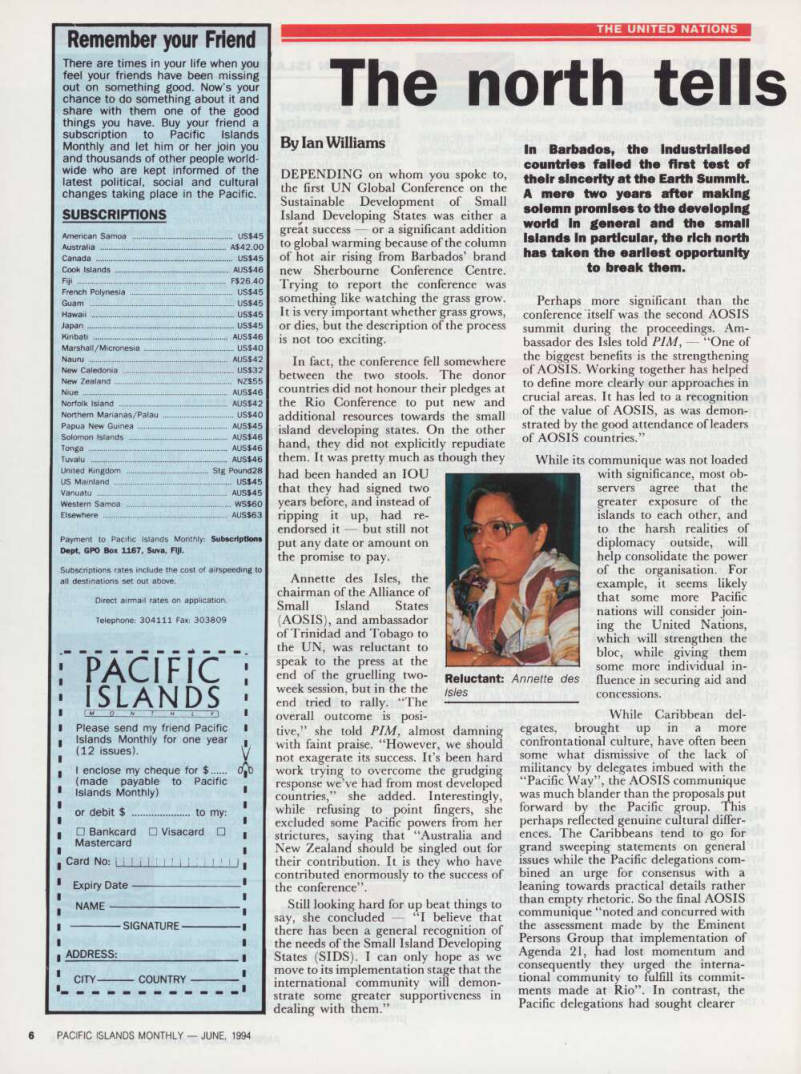
Annette des Isles, the chairman of the Alliance of Small Island States (AOSIS), and ambassador of Trinidad and Tobago to the UN, was reluctant to speak to the press at the end of the gruelling two week session, but in the the end tried to rally. “The overall outcome is posi
tive,” she told PIM, almost damning with faint praise. “However, we should not exagerate its success. It’s been hard work trying to overcome the grudging response we’ve had from most developed countries,” she added. Interestingly,
while refusing to point fingers, she
excluded some Pacific powers from her strictures, saying that “Australia and New Zealand should be singled out for their contribution. It is they who have contributed enormously to the success of the conference”.
Still looking hard for up beat things to say, she concluded “I believe that there has been a general recognition of the needs of the Small Island Developing States (SIDS). I can only hope as we move to its implementation stage that the international community will demon strate some greater supportiveness in dealing with them.”
In Barbados, the Industrialised countries failed the first test of their sincerity at the Earth Summit.
A mere two years after making solemn promises to the developing world In general and the small Islands In particular, the rich north has taken the earliest opportunity to break them.
Perhaps more significant than the conference itself was the second AOSIS summit during the proceedings. Am bassador des Isles told PIM, “One of the biggest benefits is the strengthening of AOSIS. Working together has helped to define more clearly our approaches in crucial areas. It has led to a recognition of the value of AOSIS, as was demon strated by the good attendance of leaders of AOSIS countries.”
While its communique was not loaded
with significance, most ob servers agree that the greater exposure of the islands to each other, and to the harsh realities of diplomacy outside, will help consolidate the power of the organisation. For example, it seems likely that some more Pacific nations will consider join ing the United Nations, which will strengthen the bloc, while giving them some more individual in fluence in securing aid and concessions.
While Caribbean del
egates, brought up in a more confrontational culture, have often been some what dismissive of the lack of militancy by delegates imbued with the “Pacific Way”, the AOSIS communique was much blander than the proposals put forward by the Pacific group. This perhaps reflected genuine cultural differ ences. The Caribbeans tend to go for grand sweeping statements on general issues while the Pacific delegations com bined an urge for consensus with a leaning towards practical details rather than empty rhetoric. So the final AOSIS communique “noted and concurred with the assessment made by the Eminent Persons Group that implementation of Agenda 21, had lost momentum and consequently they urged the interna tional community to fulfill its commit ments made at Rio”. In contrast, the Pacific delegations had sought clearer
Reluctant: Annette des Isles
commitment calling for example, for the “early negotiation of binding proto cols which will recognise the real costs of adverse environmental impacts. These protocols should address, in particular, the issues of targets and timetables for the reduction of carbon dioxide and the greenhouse gas emissions”. Equally, the Pacific called for the implementation of the Basel Convention which bans the transport of hazardous waste, welcomed the implementation of the Law of the
Sea, and called for specific attention to trade policies that took into account the special needs of SIDS.
All these specifics were vetoed in favour of a general and ineffectual statement. On? reason perhaps is the price of success. AOSIS was launched with an appeal based on the vulnerability of small islands to sea level rise. As the alliance gathered momentum, it expanded its horizons to address the whole complex of development issues affecting the islands, and to some extent lost the clear and emotionally grabbing focus on the physical obliteration of the islands.
The expanded agenda allowed the donors to point out that most small islands get far more aid per head of population than land-based developing countries, and so, to some extent, gave them the excuse they sought to renege on their Rio commitments. That was fairly apparent from the beginning. The indus trialised countries sent no heads of state, and only a few, like Australia, New Zealand, Germany and Canada, sent ministers. Organisers had been hoping
that vice-president A 1 Gore, who has made much of his green credentials, would come. He did not, perhaps for fear of being overshadowed and embarrassed theother star of the conference, Fidel Castro . P resldent of Cuba, whose party s “ e P* , ln '. 10 much excitement, on two * us m J ets * But the US sent former Senator Tim Wirth, and there vyas a noticeable change from such conferences in years past. Then, other donor countries could rely upon the often obtuse hostility of the Republican administration in Washington to cover their own curmudgeonly policies. Under the Clinton administra-
tion they no longer have that cover, and the Europeans in particular are revealed to be the dogs in the manger.
This is particularly perfidious in that many of the small islands are former colonies of France and Britain, who have shamefully neglected them since inde pendence. For example, Britain sent only an under secretary of the department ol the environment, the Earl ol Arran, while France merely sent its local ambassador to Barbados, who was so
well informed that he told local TV that the South Pacific Forum had represen tation from French territories.
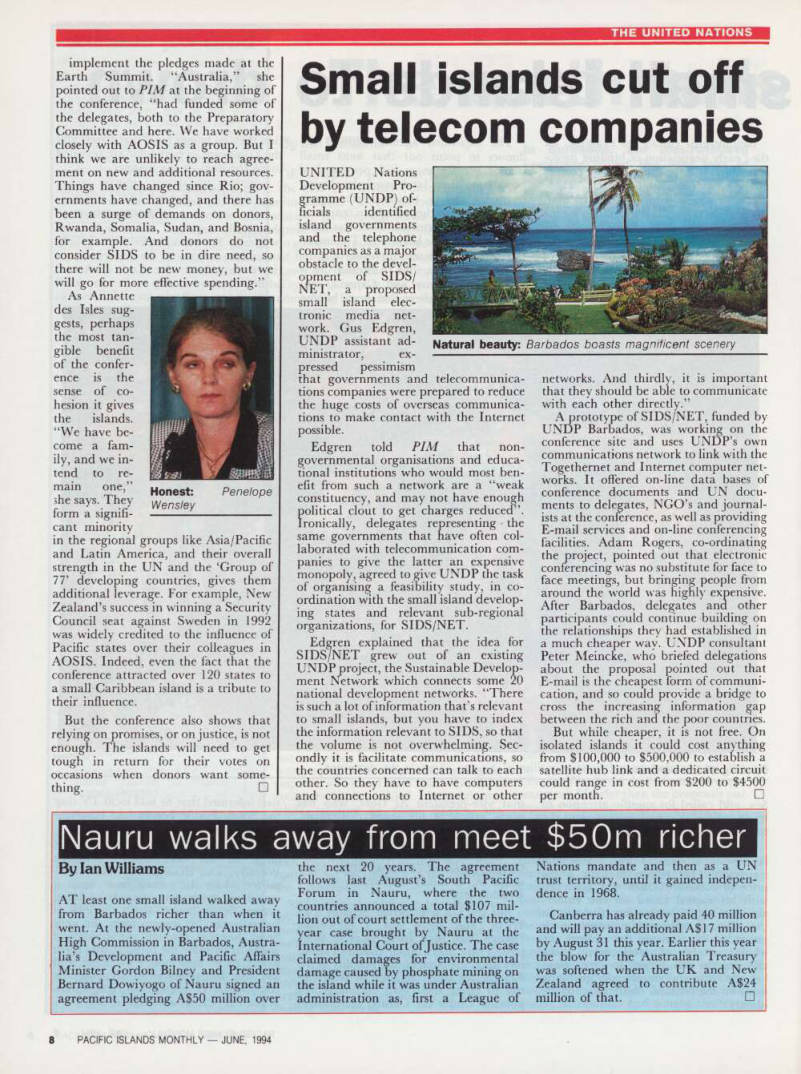
In contrast, Australia’s ambassador at large for the environment, Penelope Wensley, who chaired the Main Com mittee where the serious horse trading was done, made many friends by being pragmatically honest about the lack of commitment by donors from the very onset. She cut through the diplomatic waffle to reiterate the message that there would be no new money available, and she was instrumental in securing the compromise Programme of Action that, at least repeated, although it did not
lan Williams
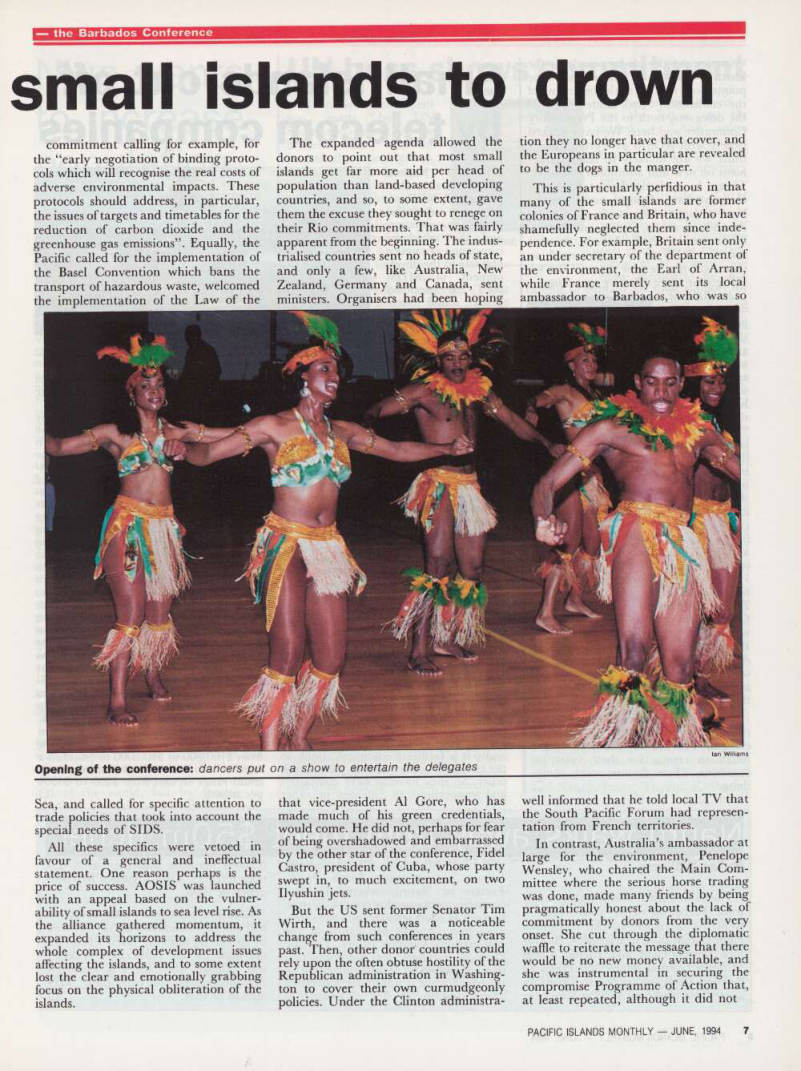
Opening of the conference: dancers put on a show to entertain the delegates
implement the pledges made at the Earth Summit. “Australia,” she pointed out to PIM at the beginning of the conference, “had funded some of the delegates, both to the Preparatory Committee and here. We have worked closely with AOSIS as a group. But I think we are unlikely to reach agree ment on new and additional resources.
Things have changed since Rio; gov ernments have changed, and there has been a surge of demands on donors, Rwanda, Somalia, Sudan, and Bosnia, for example. And donors do not consider SIDS to be in dire need, so there will not be new money, but we will go for more effective spending.”
As Annette des Isles sug
gests, perhaps
the most tan
gible benefit
of the confer ence is the sense of co hesion it gives the islands.
“We have be come a fam ily, and we in tend to re main one,” she says. They form a signifi
cant minority
in the regional groups like Asia/Pacific and Latin America, and their overall strength in the UN and the ‘Group of IT developing countries, gives them additional leverage. For example, New Zealand’s success in winning a Security Council seat against Sweden in 1992 was widely credited to the influence of Pacific states over their colleagues in AOSIS. Indeed, even the fact that the conference attracted over 120 states to a small Caribbean island is a tribute to their influence.
But the conference also shows that relying on promises, or on justice, is not enough. The islands will need to get tough in return for their votes on occasions when donors want some
thing. □
Honest: Penelope Wensley