Celebration of rain and royalty
pp. 54-55 · Read in the full issue
Yachting
By Sally Andrew
DAMN. We missed it. The rain had dampened our best intentions to arrive early and now trucks full of dancers rumbled down the road, heading away from Neiafu’s normally sleepy business district.
We kept heading toward town any way, carefully stepping over potholes filled with water, crossing from one side of the road to the other, trying to avoid the flip of the flop as our jandals sprayed mud up our backsides with each step.
Suddenly a brass marching band kicked in. We hadn’t missed it! In the next instant, hundreds of school kids paraded past. Sandals marching, skirts flapping, parents snapping photos and taking videos as red-skirted school girls waved red-cross-of-Tonga flags.
Fellowship had returned to Neiafu to take part in Regatta Week held annually in mid-June in Vava’u, Northern Tonga.
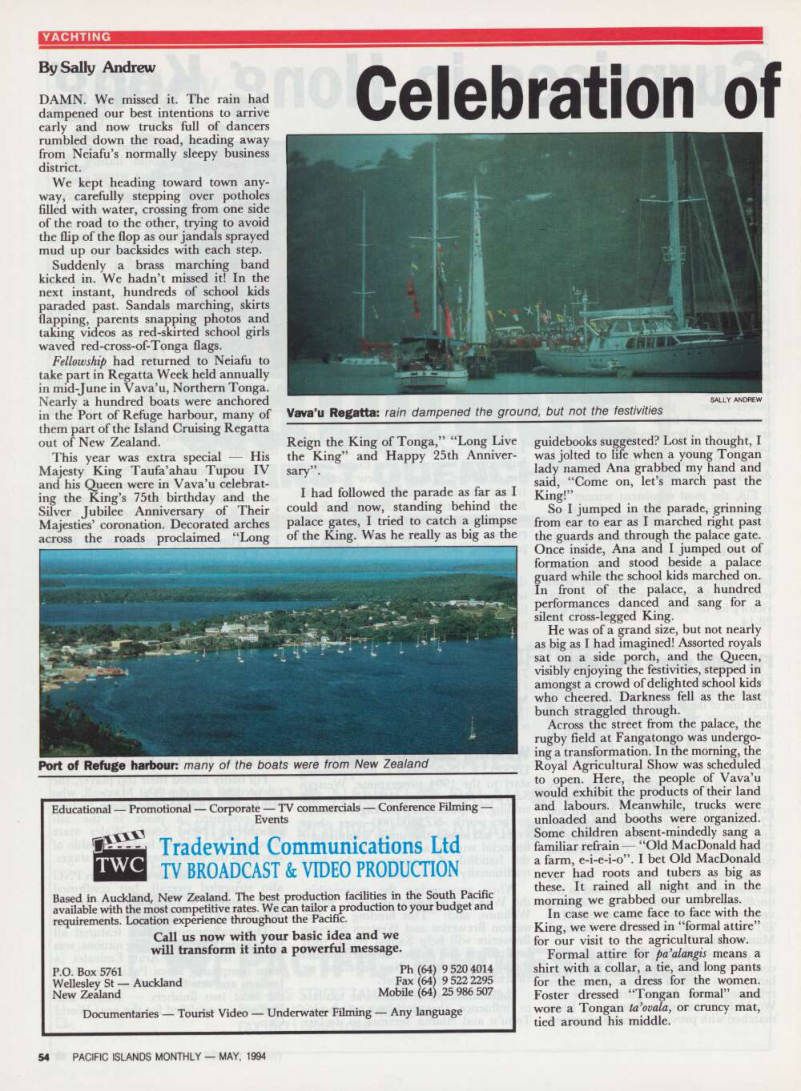
Nearly a hundred boats were anchored in the Port of Refuge harbour, many of them part of the Island Cruising Regatta out of New Zealand.
This year was extra special His Majesty King Taufa’ahau Tupou IV and his Queen were in Vava’u celebrat ing the King’s 75th birthday and the Silver Jubilee Anniversary of Their Majesties’ coronation. Decorated arches across the roads proclaimed “Long
Reign the King of Tonga,” “Long Live the King” and Happy 25th Anniversary”. T 1 had followed the parade as far as I could and now > standing behind the palace gates, I tried to catch a glimpse of the King. Was he really as big as the
guidebooks suggested? Lost in thought, I was jolted to life when a young Tongan lady named Ana grabbed my hand and said, “Come on, let’s march past the King!”
So I jumped in the parade, grinning from ear to ear as I marched right past the guards and through the palace gate.
Once inside, Ana and I jumped out of formation and stood beside a palace guard while the school kids marched on.
In front of the palace, a hundred performances danced and sang for a silent cross-legged King.
He was of a grand size, but not nearly as big as I had imagined! Assorted royals sat on a side porch, and the Queen, visibly enjoying the festivities, stepped in amongst a crowd of delighted school kids who cheered. Darkness fell as the last bunch straggled through.
Across the street from the palace, the rugby field at Fangatongo was undergo ing a transformation. In the morning, the Royal Agricultural Show was scheduled to open. Here, the people of Vava’u would exhibit the products of their land and labours. Meanwhile, trucks were unloaded and booths were organized.
Some children absent-mindedly sang a familiar refrain “Old MacDonald had a farm, e-i-e-i-o”. I bet Old MacDonald never had roots and tubers as big as these. It rained all night and in the morning we grabbed our umbrellas.
In case we came face to face with the King, we were dressed in “formal attire” for our visit to the agricultural show.
Formal attire for pa’alangis means a shirt with a collar, a tie, and long pants for the men, a dress for the women.
Foster dressed “Tongan formal” and wore a Tongan ta’ovala, or cruncy mat, tied around his middle.
Port of Refuge harbour: many of the boats were from New Zealand
Sally Andrew
Vava’u Regatta: rain dampened the ground, but not the festivities
Wet weather does not put a damper on Tonga’s Regatta Week festivities
With the help of Tupou (the dock attendant, not the King!) at the Paradise International Hotel, we wrapped the mat around Foster’s middle and tied the kafa to hold it all together.
Before we had walked very far, a taxi came along and the driver hollered, “jump in!” Off we went to Fangatongo, leaving a wake of flying mud puddles.
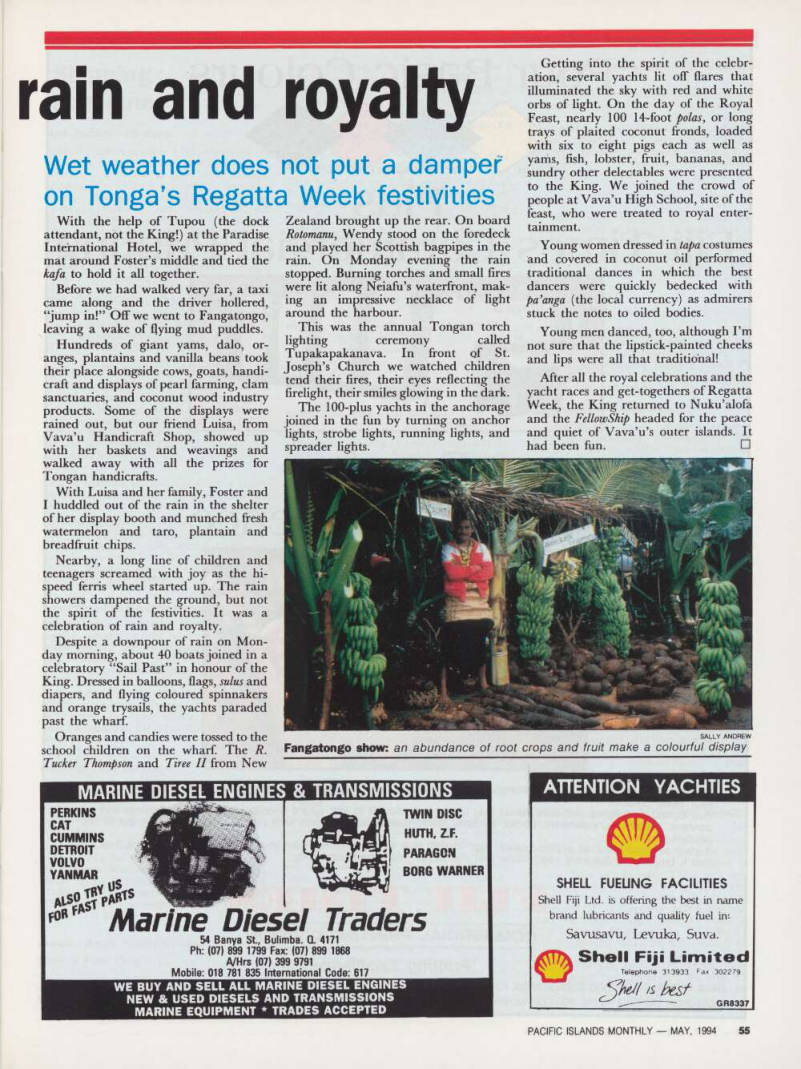
Hundreds of giant yams, dalo, or anges, plantains and vanilla beans took their place alongside cows, goats, handi craft and displays of pearl farming, clam sanctuaries, and coconut wood industry products. Some of the displays were rained out, but our friend Luisa, from Vava’u Handicraft Shop, showed up with her baskets and weavings and walked away with all the prizes for
Tongan handicrafts.
With Luisa and her family, Foster and I huddled out of the rain in the shelter of her display booth and munched fresh watermelon and taro, plantain and
breadfruit chips.
Nearby, a long line of children and teenagers screamed with joy as the hi speed ferris wheel started up. The rain showers dampened the ground, but not the spirit of the festivities. It was a celebration of rain and royalty.
Despite a downpour of rain on Mon day morning, about 40 boats joined in a celebratory “Sail Past” in honour of the King. Dressed in balloons, flags, stilus and
diapers, and flying coloured spinnakers
and orange trysails, the yachts paraded
past the wharf.
Oranges and candies were tossed to the school children on the wharf. The R.
Tucker Thompson and Tiree II from New
ry , , , , /"kuj Zealand brought up the rear. On board Rotomanu, Wendy stood on the foredeck and played her Scottish bagpipes in the rain. On Monday evening the rain stopped. Burning torches and small fires were lit along Neiafu’s waterfront, mak
ing an impressive necklace of light
around the harbour.
This was the annual Tongan torch lighting ceremony ca e Tupakapakanava. In front w Joseph s Church we watched children tend their fires ’ their e y es reflecting the firelight, their smiles glowing in the dark.
The 100-plus yachts m the anchorage
j° ined m the fun h Y turning on anchor h g hts > str obe lights, running lights, and
spreader lights.
Getting into the spirit of the celebr ation, several yachts lit off flares that illuminated the sky with red and white orbs of light. On the day of the Royal Feast, nearly 100 14-foot polas, or long trays of plaited coconut fronds, loaded with six to eight pigs each as well as yams, fish, lobster, fruit, bananas, and sundry other delectables were presented to the King. We joined the crowd of people at Vava’u High School, site of the feast, who were treated to royal enter tainment.
Young women dressed in tapa costumes and covered in coconut oil performed traditional dances in which the best dancers were quickly bedecked with pa’anga (the local currency) as admirers stuck the notes to oiled bodies.
Young men danced, too, although I’m not sure that the lipstick-painted cheeks and lips were all that traditional!
After all the royal celebrations and the
yacht races and get-togethers of Regatta
Week, the King returned to Nuku’alofa and the Fellowship headed for the peace and quiet of Vava’u’s outer islands. It had been fun. □
Sally Andrew
Fangatongo show: an abundance of root crops and fruit make a colourful display