Chuukese women fight against the odds
pp. 51-53 · Read in the full issue
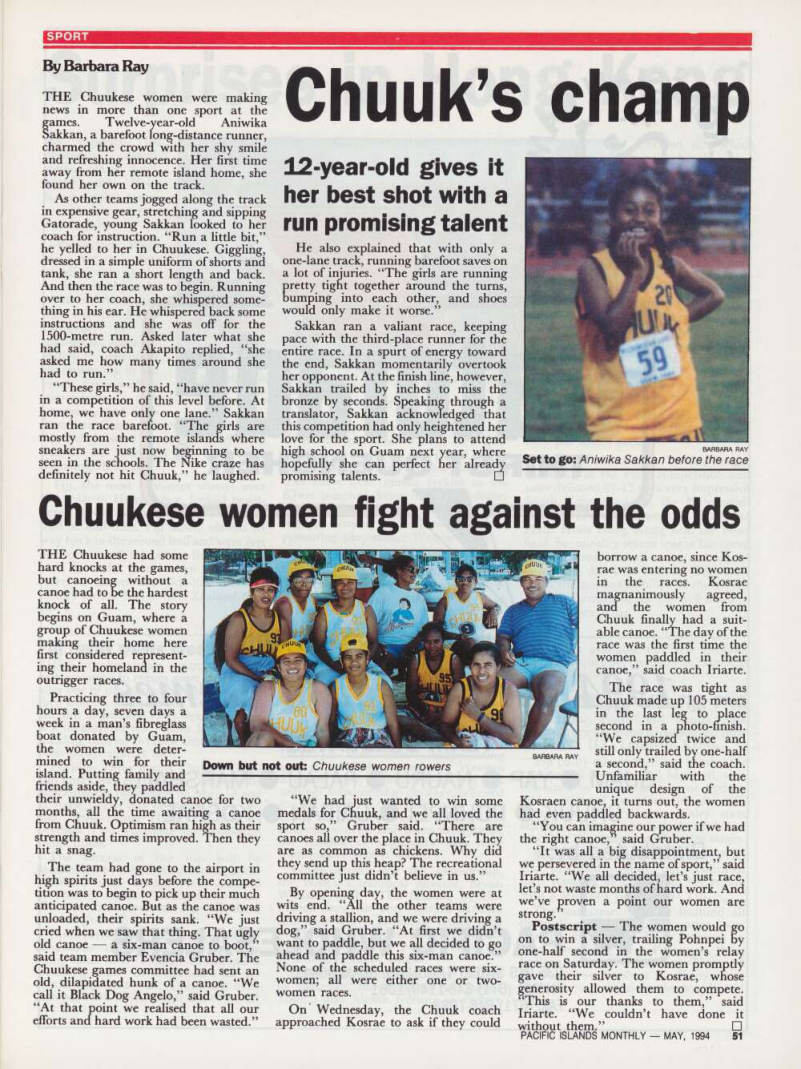
THE Chuukese had some hard knocks at the games, but canoeing without a canoe had to be the hardest knock of all. The story begins on Guam, where a group of Chuukese women making their home here first considered represent ing their homeland in the outrigger races.
Practicing three to four hours a day, seven days a week in a man’s fibreglass boat donated by Guam, the women were deter mined to win for their
island. Putting family and
friends aside, they paddled
their unwieldy, donated canoe for two months, all the time awaiting a canoe from Chuuk. Optimism ran high as their strength and times improved. Then they hit a snag.
The team had gone to the airport in high spirits just days before the compe tition was to begin to pick up their much anticipated canoe. But as the canoe was unloaded, their spirits sank. “We just cried when we saw that thing. That ugly old canoe a six-man canoe to boot,” said team member Evencia Gruber. The Chuukese games committee had sent an old, dilapidated hunk of a canoe. “We call it Black Dog Angelo,” said Gruber.
“At that point we realised that all our efforts and hard work had been wasted.”
“We had just wanted to win some medals for Chuuk, and we all loved the sport so,” Gruber said. “There are canoes all over the place in Chuuk. They are as common as chickens. Why did they send up this heap? The recreational committee just didn’t believe in us.”
By opening day, the women were at wits end. “All the other teams were driving a stallion, and we were driving a dog,” said Gruber. “At first we didn’t want to paddle, but we all decided to go ahead and paddle this six-man canoe.”
None of the scheduled races were six women; all were either one or two women races.
On Wednesday, the Chuuk coach approached Kosrae to ask if they could
borrow a canoe, since Kos rae was entering no women in the races. Kosrae
magnanimously agreed,
and the women from Chuuk finally had a suit able canoe. “The day of the race was the first time the women paddled in their canoe,” said coach Iriarte.
The race was tight as Chuuk made up 105 meters in the last leg to place second in a photo-finish.
“We capsized twice and still only trailed by one-half a second,” said the coach.
Unfamiliar with the unique design of the
Kosraen canoe, it turns out, the women had even paddled backwards.
“You can imagine our power if we had the right canoe, said Gruber.
“It was all a big disappointment, but we persevered in the name of sport,” said Iriarte. “We all decided, let’s just race, let’s not waste months of hard work. And we’ve proven a point our women are strong. ’
Postscript The women would go on to win a silver, trailing Pohnpei by one-half second in the women’s relay race on Saturday. The women promptly gave their silver to Kosrae, whose generosity allowed them to compete.
“This is our thanks to them,” said Iriarte. “We couldn’t have done it without them.” □
Pacific Islands Monthly May, 1994 51
Barbara Ray
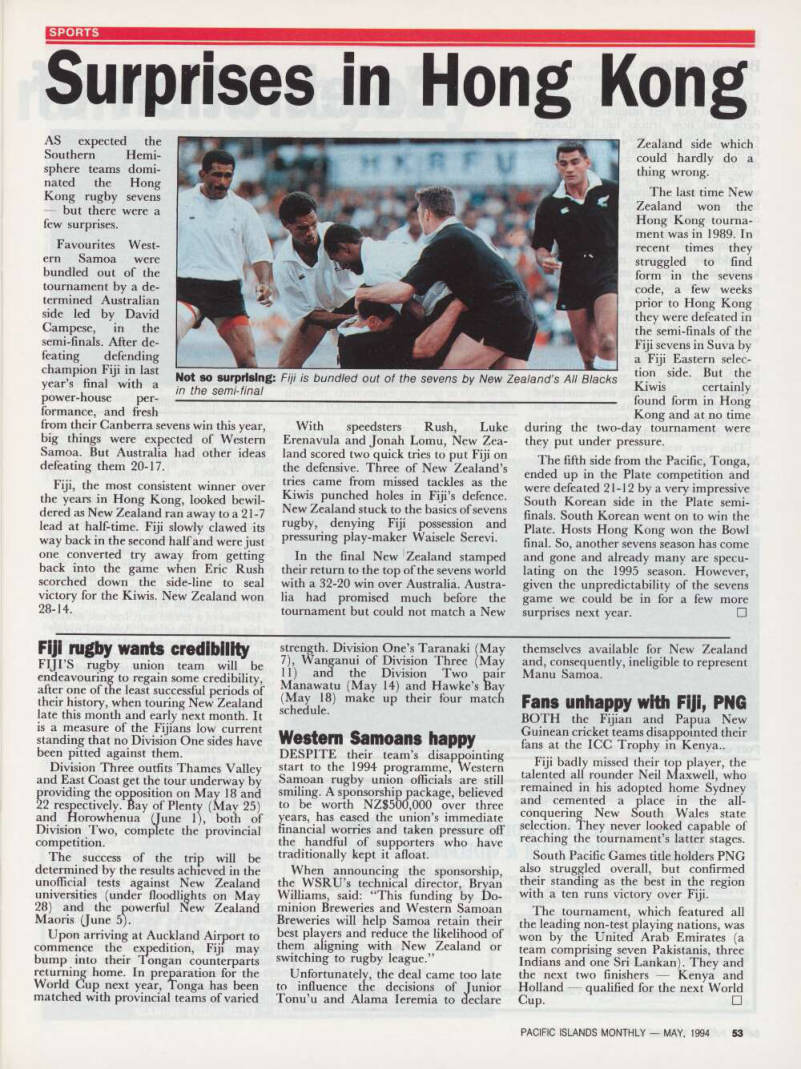
Down but not out: Chuukese women rowers
Fiji rugby wants credibility
Fiji’S rugby union team will be endeavouring to regain some credibility, after one of the least successful periods of their history, when touring New Zealand late this month and early next month. It is a measure of the Fijians low current standing that no Division One sides have been pitted against them.
Division Three outfits Thames Valley and East Coast get the tour underway by providing the opposition on May 18 and 22 respectively. Bay of Plenty (May 25) and Horowhenua (June 1), both of Division Two, complete the provincial competition.
The success of the trip will be determined by the results achieved in the unofficial tests against New Zealand universities (under floodlights on May 28) and the powerful New Zealand Maoris (June 5).
Upon arriving at Auckland Airport to
commence the expedition, Fiji may bump into their Tongan counterparts returning home. In preparation for the World Cup next year, Tonga has been matched with provincial teams of varied
strength. Division One’s Taranaki (May 7), Wanganui of Division Three (May 11) and the Division Two pair Manawatu (May 14) and Hawke’s Bay (May 18) make up their four matcn schedule.
Western Samoans happy
DESPITE their team’s disappointing start to the 1994 programme, Western Samoan rugby union officials are still smiling. A sponsorship package, believed to be worth NZ$5OO,OOO over three years, has eased the union’s immediate financial worries and taken pressure off the handful of supporters who have traditionally kept it afloat.
When announcing the sponsorship, the WSRU’s technical director, Bryan Williams, said: “This funding by Do minion Breweries and Western Samoan Breweries will help Samoa retain their best players and reduce the likelihood of them aligning with New Zealand or switching to rugby league.”
Unfortunately, the deal came too late to influence the decisions of Junior Tonu’u and Alama leremia to declare
themselves available for New Zealand and, consequently, ineligible to represent Manu Samoa.
Fans unhappy with Fiji, PNG
BOTH the Fijian and Papua New Guinean cricket teams disappointed their fans at the ICC Trophy in Kenya..
Fiji badly missed their top player, the talented all rounder Neil Maxwell, who remained in his adopted home Sydney and cemented a place in the all conquering New South Wales state selection. They never looked capable of reaching the tournament’s latter stages.
South Pacific Games title holders PNG also struggled overall, but confirmed their standing as the best in the region with a ten runs victory over Fiji.
The tournament, which featured all the leading non-test playing nations, was won by the United Arab Emirates (a team comprising seven Pakistanis, three Indians and one Sri Lankan). They and the next two finishers Kenya and Holland qualified for the next World
Cup. □