Industry grows
pp. 39-41 · Read in the full issue
Nz Buildpacific >94
STAN GREGEC is New Zealand’s trade commissioner based in Suva. From Suva he also covers the Samoas, the Cook Islands, Tonga, Kiribati, Tuvalu and Nauru markets which collectively take around 54 per cent of New Zealand’s total exports to the South Pacific region. Here he gives his views on building and construction opportunities for New Zealand in the region.
What is the current outlook for building and construction activity in the South Pacific?
Overall there is a good level of current
activity throughout the region in my
view steady rather than spectacular growth, with a continuous ebb and flow effect, so that there is always something happening somewhere but not necess arily everywhere at once. In my neck of the woods the buoyant markets at the moment are Fiji, American Samoa and Tonga, the first two in particular show ing a good stream of civil construction works as w'ell as new building projects.
These are not huge-scale developments by international standards but they do represent sizeable opportunities in South Pacific terms. Elsewhere, my perception is that New Caledonia and Papua New Guinea will always be significant centres of construction activity, and I am aware of other pockets of activity in Vanuatu, Western Samoa, the Cooks and the Marshall Islands.
You say that Fiji is currently a buoyant market. What is the basis of this assessment?
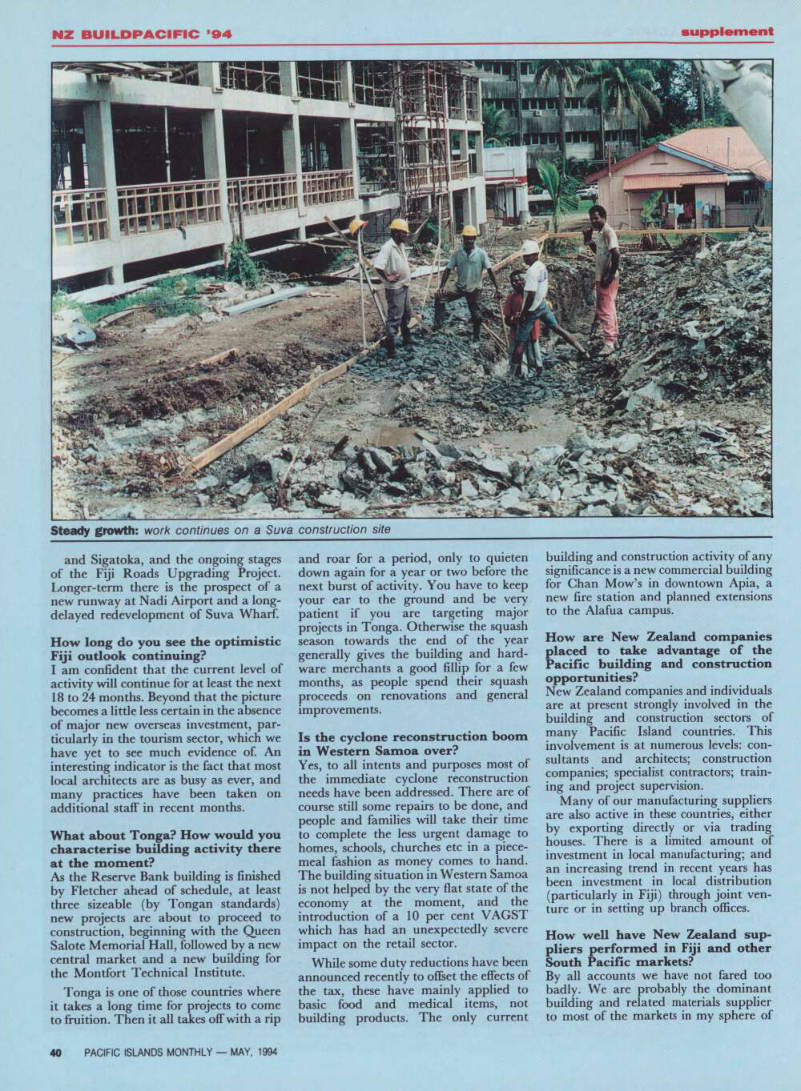
I think it's no secret that Fiji is in the middle of something of a building recovery. It might be an exaggeration to call it a boom of any kind. Most of this is catch-up from the period after the coup when construction work died off com pletely for a few years. You have only got to drive around the centre of Suva and the area between Nadi and the interna tional airport to observe the large number of new commercial and indus trial developments which have sprung up in the last two years.
There has also been a healthy ex plosion of residential building in and around Suva and Nadi again, to some
degree fuelled by the Housing Author
ity’s land development and low-cost housing programmes but also at the higher-priced levels as housing invest ment has become profitable again. In
Suva there are around half a dozen large buildings either going up or about to proceed, with a host of smaller commer cial two to three-storey buildings in the
pipeline.
And of course the Grand Pacific Hotel is sitting in splendid anticipation of a major overhaul. The civil construction outlook is dominated by plans to build new permanent bridges at Ba
Stan Gregec: optimistic
and Sigatoka, and the ongoing stages of the Fiji Roads Upgrading Project.
Longer-term there is the prospect of a new runway at Nadi Airport and a longdelayed redevelopment of Suva Wharf.
How long do you see the optimistic Fiji outlook continuing?
I am confident that the current level of activity will continue for at least the next 18 to 24 months. Beyond that the picture becomes a little less certain in the absence c ■ ■ of maior new overseas investment, particularly in the tourism sector, which we have yet to see much evidence of. An interesting indicator is the fact that most local architects are as busy as ever, and many practices have been taken on additional staff in recent months.
What about Tonga? How would you characterise budding activity there at the moment?
As the Reserve Bank building is finished by Fletcher ahead of schedule, at least three sizeable (by Tongan standards) new projects are about to proceed to construction, beginning with the Queen Salote Memorial Hall, followed by a new central market and a new building for the Montfort Technical Institute.
Tonga is one of those countries where it takes a long time for projects to come to fruition. Then it all takes off with a rip
and roar for a period, only to quieten down again for a year or two before the next burst of activity. You have to keep your ear to the ground and be very patient if you are targeting major projects in Tonga. Otherwise the squash season towards the end of the year generally gives the building and hardware merchants a good fillip for a few months, as people spend their squash proceeds on renovations and general
improvements.
Is the cyclone reconstruction boom in Western Samoa over?
Yes, to all intents and purposes most of the immediate cyclone reconstruction needs have been addressed. There are of course still some repairs to be done, and people and families will take their time to complete the less urgent damage to homes schools, churches etc in a piecemeal fashion as money comes to hand.
The buildmg situation m Western Samoa is not helped by the very flat state of the economy at the moment, and the introduction of a 11) per cent VAOM which has had an unexpectedly severe impact on the retail sector.
While some duty reductions have been announced recently to offset the effects of the tax, these have mainly applied to basic food and medical items, not building products. The only current
building and construction activity of any significance is a new commercial building for Chan Mow’s in downtown Apia, a new fire station and planned extensions to the Alafua campus.
How are New Zealand companies placed to take advantage of the Pacific buildmg and construction opportunities.
New Zealand companies and individuals a .' P"*'"* scrongly involved m the buildinsr and construction sectors of -r T , j a • ynany aci ic san coun nes. is involvement is at numerous levels, con- J"“!J ist contractors; train r’T • • § P J P f .’ M^ n Y of our manu acturmg supp iers are also actlve * n th f, se countries either u “ P °There isT hmited Tmount'o® ; in )oca manufacturing; and ; nrrpa<! i n{ y trPn d in recent vears has
invest^ent in local attribution
, particularly in Fiji) through joint ven or in setting up branch offices, Hqw weU have New Zealand sup pliers performed in Fiji and other South Pacific markets?
By all accounts we have not fared too badly. We are probably the dominant building and related materials supplier to most of the markets in my sphere of
Steady growth: work continues on a Suva construction site
coverage, including Fiji. In Fiji our export sales of these products have shown steady growth in recent years to reach an estimated NZ$5O million in 1993. That represents a little over a quarter of our total merchandise exports to Fiji, and probably amounts to about a 25 per cent share of Fiji’s total import market for these products. In addition there is the sizeable contribution made by our con sultants and contractors, particularly with companies like Fletcher Construc tion and McConnell Dowell.
Are there signs that this growth is starting to plateau?
Yes, I think that is a fair question. While our sales have been increasing there are indications that we have probably reached a plateau in terms of market share, and we will have to lift our game plan if we are to aspire to win new business particularly against newer and more aggressive competition from South East Asia, and from our tra ditional main competitor Australia.
How will New Zealand achieve this?
One of the main ways is by adopting a much stronger marketing approach. This means our companies maximising the advantages New Zealand has in this part of the world. It also means a recognition that the South Pacific is becoming an increasingly sophisticated and competi tive marketplace, and consequently less
forgiving of sloppy or second-rate service.
How Will Nz Buildpacific ’94
help to boost the efforts of NZ building and construction com fanies in the South Pacific? ssentially by reinforcing New Zealand’s strong capability in the building sector; and by positioning us as the primary and preferred supplier of materials and ser vices to the region.
The trade show will not only be a chance to get a strong message across about New Zealand’s reliability and commitment to the South Pacific region, but will obviously give individual partici fiants an opportunity to show off their atest products and to obtain direct feedback from their customers and cli ents. This is the first dedicated building and construction trade show to be held in Fiji since before the coup, which should say a lot about the confidence New Zealand has in the opportunities of the region, and our ability to contribute.
Who is the trade show aimed at?
We are deliberately keeping a trade focus only. This will not be an event for the general public. Anybody with a profes sional or business involvement m the building industry is welcome to attend.
We have also invited key contacts and buyers from neighbouring Pacific Island countries to attend, so that the event will have a maximum regional perspective. □