Black pearl industry
p. 35 · Read in the full issue
Cook islanders set to cash in on the goods
CASHING in on civilisation’s centuries-old love affair with pearls, Cook Islands is seeking markets for an
exotic, and expensive, variety.
Prices for cultured black pearls, unique to Cook Islands and French Polynesia, boomed until 1991 but then plunged by half as recession struck their main market, Japan. Now, despite growing-pains, the fledgling industry is ready to expand again.
Although called black, the pearls in fact have a green, purple, golden or copper hue. Prize specimens are sought for their special sheen and natural glow, and a single strand can retail for up to U 5525,000.
“The perfect ones are so rare you can virtually ask what you want,” said Trevon Bergman, who owns a pearl shop in the capital of the Cook Islands, Rarotonga. The industry has been a boon for the remote nation and with a population of 19,000. It now brings in about USSS6 million (A 58.57 million) per year.
Pearl farming in the Cooks began in 1986 when a Tahitian, Yves Tchen Pan, brought in the necessary technology and started up in Manahiki in the north of the island group. Others followed suit with state assistance, and the govern ment is now looking for new sites.
Temu Okotai, chief executive of the prime minister’s office, said there were plans to establish a new pearl farming centre in Penrhyn Island, which has a massive 280 sq-km lagoon. A US-funded laboratory has been set up there.
The government is also investigating possibilities on Suwarrow, Pukapuka and Palmerston atolls, all with tiny popu lations.
“Having an industry get off the ground based on natural resources gives us the confidence to extend it to other islands,” Okotai said in an interview.
“We suspect from preliminary work that Suwarrow will produce some fantas tic, unique pearls,” he said.
Black pearl oysters will only grow in equatorial latitudes and only certain types of lagoons are suitable. The pearl forms in the black-lipped oyster (pincdata margaritifera). A technician implants a nucleus and stimulus of live tissue from a sacrificial oyster into another specimen, which is then tied to an underwater platform until harvesting three years later.
Japan’s secretive pearl industry pro duces artificial black pearls, but the natural ones fetch the best prices. That has meant good business for retailers like Bergman, who cater to a growing tourist market. In far-flung Manihiki, five hours’ flight time from Rarotonga and too isolated to benefit from the tourism boom, pearl farming has reversed a steady population decline since the 19605. About 500 people live there now.
But conditions are tough on the atoll, which consists of 40 isles encircling a 4km-wide, totally enclosed lagoon. Fa cilities are spartan and the work hard, with farmers spending most of the day in the salty water in temperatures of 30 degrees Celsius and high humidity.
“It’s a sad situation at the moment for a lot of farmers,” said Peter William, whose family owns one of the half dozen large and profitable farms growing over 50,000 oysters.
“There were people in 1990 who believed they would be millionaires but didn’t envisage what hard work it was and the three years of sacrifice you need
before the money comes in.”
Many small farmers have been given loans equivalent to A$ 14,280 loans by the government via the Asian Develop ment Bank but have uneconomic units
with production, quality and marketing
problems. Problems often revolve around the technician, a job so skilled that he commands a fee of up to 30 per cent of returns.
Most are Japanese but seven locals have acquired the skills with varying results. William said his Japanese tech nician has an 85 per cent success rate in implanting the nucleus, taken from Mississipi oysters. But some only achieve 15 per cent. Marketing is a major problem. Unlike Tahiti, which has regular auctions, auctions in the Cooks have not taken off.
Instead, farmers must go to Japan where half a dozen powerful pearl buyers often act in concert to force prices down.
To overcome the problem, William has set up a marketing company, which will buy the pearls from small farmers so he can sell marketable parcels of 10,000 or more. He said it has been a long and steep learning curve for all involved in the industry, but he remains optimistic.
“The quality has been improving every year. The size of the Cooks pearls is not as great as those from Tahiti, but the colouring and lustre makes them the most sought-after,” he said. Reuter □
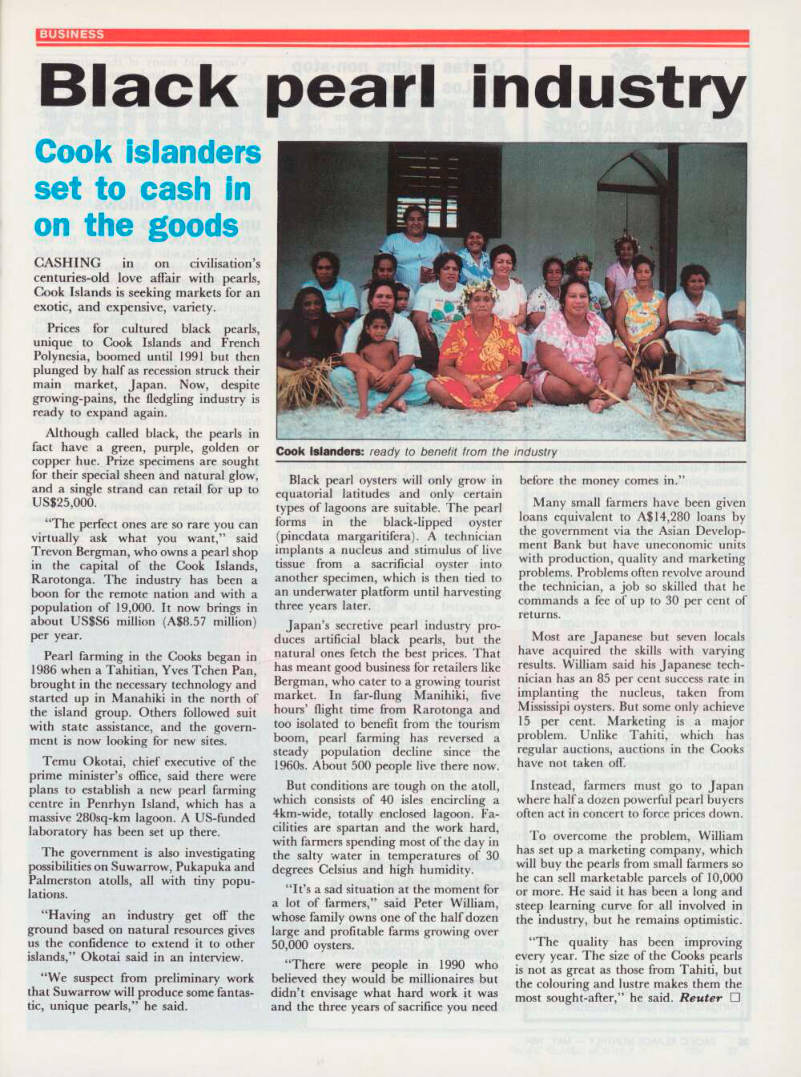
Cook Islanders: ready to benefit from the industry