Serving the disabled
pp. 20-21 · Read in the full issue
Issue
By Bill Winkley
SERVICES for disabled persons in the developing nations of the Pacific have sprung up over the past 20 years or so.
Many programmes have been estab lished and grown up without a real plan or sense of direction, often under the guidance of an expatriate who has recognised the need and designed a Erogramme based on a model from his or er home country, usually a developed nation.
Training for the staff of these pro grammes has usually been based on Western culture; often these trainees are frustrated and lost when their expec tations do not mesh with the reality of providing services in a developing na tion. Many upfront problems have been built into these programmes, problems that agencies and their staff are often left to fend with long after the expatriates and their money have left.
Probably the greatest challenge to “post-expat” agency staff is the challenge of keeping the programme alive long enough to identify workable solutions.
Sustainability seems to overlay every thing as a blanket challenge for agencies, their boards and staff. In fact several programmes in the Pacific region are in danger of folding at this very moment.
Probably the first consideration for those persons left behind to sort out these agencies has to be money, since money tends to be the bottom line on most programmes and their sustainability.
In too many instances, the funding basis for service programmes is built and dependent upon the contacts and fundraising capabilities of the expatriate who has founded the agency. As might be expected (but somehow never is), when that expat leaves, the knowledge for fundraising and the contacts from which to do it also leave. Those nationals left behind are then challenged to develop the fundraising skills and ferret out the possible funders to keep the programme alive, obviously an enormous challenge.
This dilemma is often compounded with the reality that the programmes are not appropriate and far too costly ever to be sustainable from the available re sources of the country. In essence the nations are left behind with an imposs ible task; unfortunately, but as might be expected, there are programmes m the region today that have been suspended because of a lack of funds. The toll of these situations is heavy for disabled persons and for the staff of these agencies.
Unfortunately services for disabled clients are interrupted and the progress they have made in their rehabilitation programmes is lost. Additionally, before new funding can be securea, much money has been lost, money that was spent in the training of these laid-off {irofessionals who have understandably bund other employment.
One might think that the solution to these problems is money, and plenty of
it. My experience has been that money, in large amounts, can be the source of problems rather than the solution. Large amounts of money tend to attract persons whose commitment is more to the money than the disabled persons it is intended to serve. So many times in the Pacific I have seem board members abusing their positions by dipping into the resources of the agency, either through outright theft or, more often, through use of agency facilities or equipment for personal needs. Less offensive, but nonetheless deceptive and certainly unacceptable, is the practice of board members selling gooas or services to the agency, some times at prices higher than what is available on the open market. I have seen several managers or chief executive officers of agencies who have been fired or asked to resign because of their abuse of the funds, facilities or equipment belonging to an agency.
In essence, money can be a twofold evil for agncies serving disabled persons: it can create expensive and inappropriate programmes and it can attract the wrong types of persons into leadership positions for the agencies. My experience has been that money can create more problems than it solves for programmes that have received large amounts from outside donors. It can be a two-edged sword, with both the lack of money or a surplus
of it being equally problematic.
There seems to be little commitment in most agencies in the Pacific to empower disabled persons to share in the power
and decision-making processes that affect their lives. Denying disabled persons positions on boards of directors and key
managerial and professional positions
makes as much sense as denying women a role in organisations designed to serve women. My experience has been that far too many agency boards and leadership staff have a paternalistic approach to serving disabled persons and will really resist attempts to involve disabled per sons in anything but token roles in the agencies of service. Of the many service programmes with which I have been associated, only two, the Vanuatu So ciety for Disabled Persons and the Fiji Ministry of Education, have actually hired disabled persons in responsible professional roles. And I can name at least 21 programmes that have not, several of which have overtly resisted attempts by disabled persons to gain employment within them.
In more than one instance I have seen boards elect one disabled person on the board, often a carefully selected person who has no real knowledge or skill in serving on a board. By so doing, the board “dressed the window” and at the same time has guaranteed no real participation and therefore influence from the community of disabled persons, the very persons for whom the agency has been established.
In training programmes I often have challenged workers in the field of serving disabled persons to evaluate their own motivations and their own attitudes toward persons with disabilities.
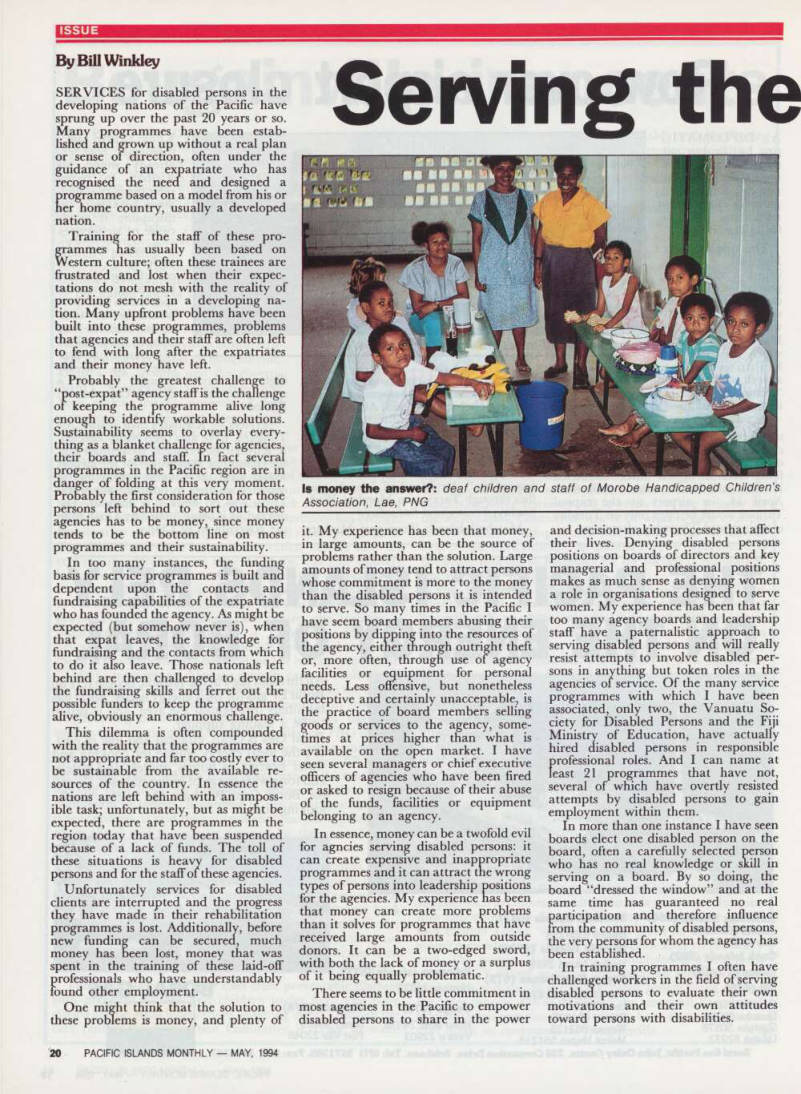
Is money the answer?: deaf children and staff of Morobe Handicapped Children’s Association, Lae, PNG
Too often I have met “professionals” whose commitment is really to the job, their personal salary, and the perks and public profile that might go with the job, rather than the empowerment of dis abled persons to take charge of their lives and the programmes that serve them. I know one director of a Pacific island programme who purposefully hires
marginally capable staff, mainly out of
fear that her hiring a really capable persons could jeopardise her own pos ition.
Often agencies have miniscule caseloads of disabled persons, serving as few as 10 or 12 clients at any given time.
And often those cli ents tend to be the same persons year after year. Estimates of disabled persons in most countries are in the neighbourhood of five per cent to 15 per cent of the total population. A city of 50,000 could have 2500 to 7500 dis abled persons, yet one is likely to find no more than a few hundred persons re ceiving services from all of the local agencies. What hap pens for the other thousands of per sons? Nothing! A
cynic might conclude that disabled Cersons are used to create jobs for able odied persons, rather than the other way around.
Which leads to another interesting point: very little if any job development and placement in mainstream employ ment are done by most of the agencies purporting to “rehabilitate” disabled persons. I have run job placement training programmes and know from firsthand experience that jobs can be found for disabled persons in any country, no matter how difficult and competitive the job market might be. It has been my experience that the lack of commitment from agencies and their boards to placing disabled persons in remunerative employment has kept those I have trained from ever plying their new skills. Probably an agency not willing to hire disabled persons onto its own staff would not make a good advocate for placing disabled persons into main stream employment. Sheltered work shops have developed in two countries of the region, a model for employing disabled persons being discontinued in
most countries of the world. In such a facility, disabled persons are “sheltered” in factories (some would call them “sweat factories”) where they usually are paid sub-standard wages in an artificial en vironment, and without steady work. I know of one programme that actually told its job developer or placement specialist to quit placing the clients in mainstream employment. Rather, these disabled persons were “needed” to justify and keep the sheltered workshop open. I say, if these facilities are meant to serve clients rather than the clients to serve the facility, close down and place these human beings in the real world!
With some impressive exceptions, my
experience has been that one of the greatest deterents to full emancipation of disabled persons in the developing na tions of the Pacific has been the lack of leadership among disabled persons them selves. Often I have seen young disabled persons with the right philosophy and determination begin a movement to ensure the rights of disabled persons.
Often and usually with the funding from outside agencies, these persons unfortu nately learn that the positions they hold and their disabilities can be tickets to other parts of the world, opportunities for studies overseas and for attending the interminable calendar of meetings, con ferences and workshops of various organ isations of and for disabled persons. Soon the flash life of overseas travel blinds these “leaders” to the real needs of disabled persons. Especially ignored or overlooked are sub-populations of dis abled persons, such as the impoverished, women, and especially rural-based dis abled persons. Often an elite corps of urban, disabled persons becomes the voice for all disabled persons in a country. And unfortunately these per
sons, who are well positioned to do some really substantial work on behalf of disabled persons in their countries, often lose the opportunity.
To this point, this discourse has been quite negative, for which I offer no apology. I remember a training pro gramme I took several years ago that promoted the belief that negative criti cism comes from those who love you, those who really care and want to see you improve. I like to consider myself in the category of persons who are familiar with the situation in the developing nations of the region and who really care to see services and the quality of life for disabled persons substantially improved.
To point out shortcomings and problems is but half the mission I have set for these writings. There are affordable and ef ficient solutions to each. The real challenge is the commitment of service providers and leaders among the dis abled persons themselves, as well as the majority population, to meaningful
change. Suggestions
for these individuals are as follows: I. Sustainability has to be paramount in the minds of all persons establishing and funding pro grammes of service for disabled persons.
The challenge is to ask constantly whether these pro grammes would sur vive, were the ex
patriate support
and/or the external funds to be termin ated tomorrow.
Money must be seen as a possible source of problems rather than
a solution to meeting the needs of disabled persons. The best programmes I have seen are those that were conceived and planned by nationals, often disabled themselves, programmes that were im plemented with local funds that can be depended upon over the years. 2. Non-disabled persons have to be willing to move over and encourage disabled persons to take up leadership roles, roles that carry real power, in the running of agencies providing services and/or advocating on behalf of disabled persons. Nobody understands disability and the needs of disabled persons better than disabled persons themselves, as well as the parents of disabled infants and children. 3. Greater emphasis must be placed on serving rural, disabled persons, find ing them and developing appropriate and effective service models. 4. Disabled persons in leadership roles must keep their focus on the disabled persons in their countries, not on the overseas opportunities for training and attending conferences, meetings and workshops. □
Bill Winkley
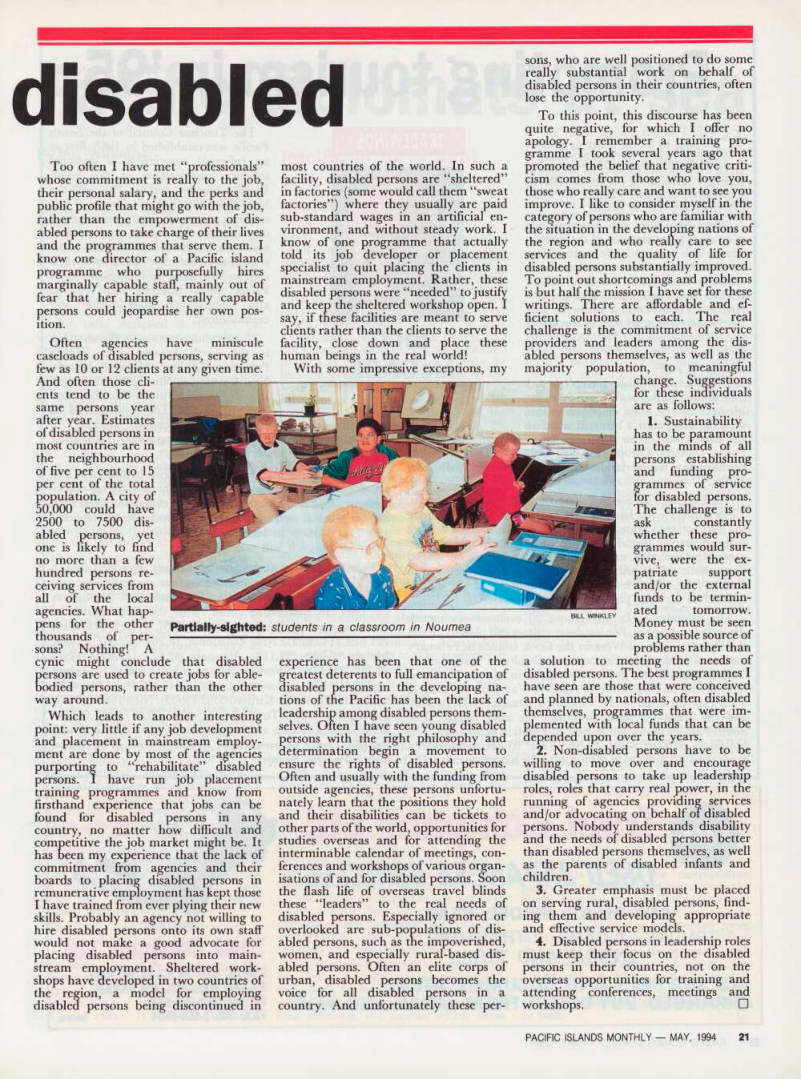
Partially-sighted: students in a classroom in Noumea