Kava concern hits Fiji
p. 17 · Read in the full issue
Culture
By Stuart Parker THE narcotic drink kava has long been central to life in the South Pacific, but not all islanders are happy about the widespread use of the regional “grog”.
A growing number of influential Fijians believe excessive use of the intoxicant is posing a threat to families, village life and to Fiji’s economic health.
Many church leaders, politicians, health workers and government officials in Fiji
are becoming increasingly concerned
about the heavy consumption of kava, which once was restricted to men of senior social rank.
Excessive drinking is being linked to
health and nu tritional problems, a drop in production of food crops and pres sures on family life.
“It’s one of the biggest downfalls of Fiji today,” said Savenaca Kamika mica, administrative officer with the Min
istry of Fijian Affairs,
which is charged with safeguarding the interests of Fiji’s indigenous popu lation.
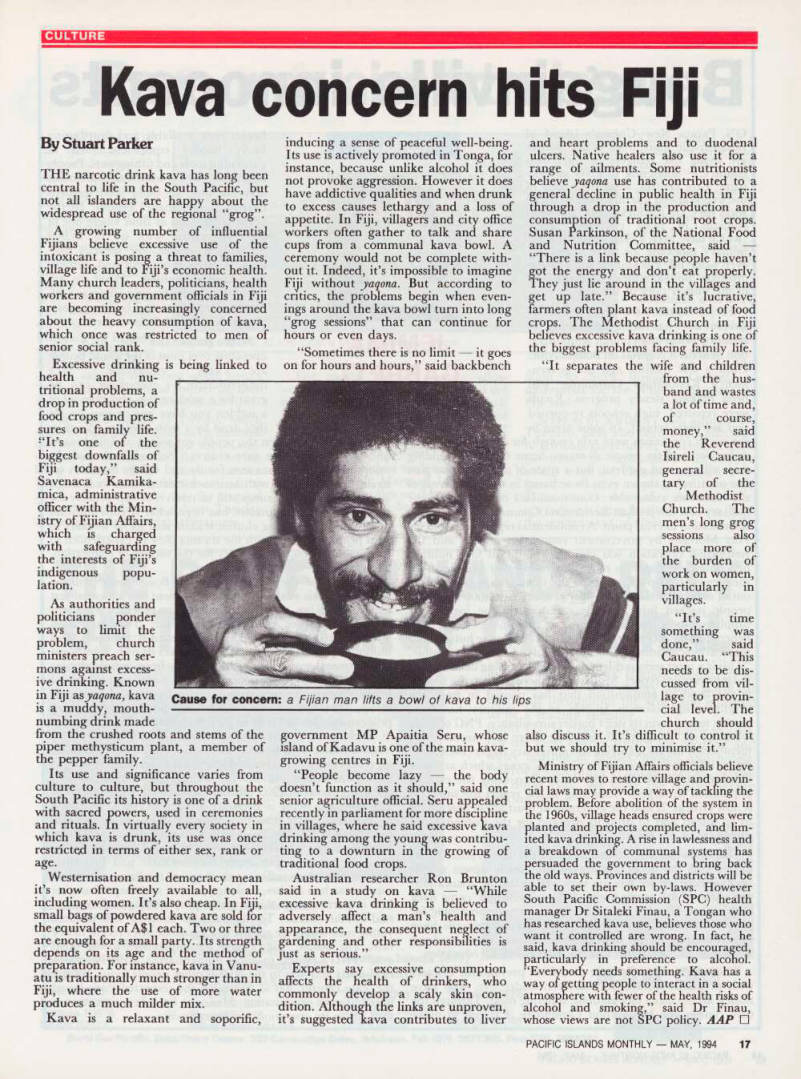
As authorities and politicians ponder ways to limit the problem, church ministers preach ser mons against excess ive drinking. Known in Fiji as yaqona, kava is a muddy, mouth numbing drink made
from the crushed roots and stems of the piper methysticum plant, a member of the pepper family.
Its use and significance varies from culture to culture, but throughout the South Pacific its history is one of a drink with sacred powers, used in ceremonies and rituals. In virtually every society in which kava is drunk, its use was once restricted in terms of either sex, rank or age.
Westernisation and democracy mean it’s now often freely available to all, including women. It’s also cheap. In Fiji, small bags of powdered kava are sold for the equivalent of Asl each. Two or three are enough for a small party. Its strength depends on its age and the method of preparation. For instance, kava in Vanu atu is traditionally much stronger than in Fiji, where the use of more water produces a much milder mix.
Kava is a relaxant and soporific,
inducing a sense of peaceful well-being.
Its use is actively promoted in Tonga, for instance, because unlike alcohol it does not provoke aggression. However it does have addictive qualities and when drunk to excess causes lethargy and a loss of appetite. In Fiji, villagers and city office workers often gather to talk and share cups from a communal kava bowl. A ceremony would not be complete with out it. Indeed, it’s impossible to imagine Fiji without yaqona. But according to critics, the problems begin when even ings around the kava bowl turn into long “grog sessions” that can continue for hours or even days.
“Sometimes there is no limit it goes on for hours and hours,” said backbench
government MP Apaitia Seru, whose island of Kadavu is one of the main kava growing centres in Fiji.
“People become lazy the body doesn’t function as it should,” said one senior agriculture official. Seru appealed recently in parliament for more discipline in villages, where he said excessive kava drinking among the young was contribu ting to a downturn in the growing of traditional food crops.
Australian researcher Ron Brunton said in a study on kava “While excessive kava drinking is believed to adversely affect a man’s health and appearance, the consequent neglect of gardening and other responsibilities is just as serious.”
Experts say excessive consumption affects the health of drinkers, who commonly develop a scaly skin con dition. Although the links are unproven, it’s suggested Kava contributes to liver
and heart problems and to duodenal ulcers. Native healers also use it for a range of ailments. Some nutritionists believe yaqom use has contributed to a general decline in public health in Fiji through a drop in the production and consumption of traditional root crops.
Susan Parkinson, of the National Food and Nutrition Committee, said “There is a link because people haven’t got the energy and don’t eat properly.
They just lie around in the villages and get up late.” Because it’s lucrative, farmers often plant kava instead of food crops. The Methodist Church in Fiji believes excessive kava drinking is one of the biggest problems facing family life.
“It separates the wife and children
from the hus band and wastes a lot of time and, of course, money,” said the Reverend Isireli Caucau, general secre tary of the Methodist Church. The men’s long grog sessions also place more of the burden of work on women, particularly in villages.
“It’s time something was done,” said Caucau. “This needs to be dis cussed from vil lage to provin cial level. The church should
also discuss it. It’s difficult to control it but we should try to minimise it.”
Ministry of Fijian Affairs officials believe recent moves to restore village and provin cial laws may provide a way of tackling the problem. Before abolition of the system in the 19605, village heads ensured crops were planted and projects completed, and lim ited kava drinking. A rise in lawlessness and a breakdown of communal systems has persuaded the government to bring back the old ways. Provinces and districts will be able to set their own by-laws. However South Pacific Commission (SPC) health manager Dr Sitaleki Finau, a Tongan who has researched kava use, believes those who want it controlled are wrong. In fact, he said, kava drinking should be encouraged, particularly in preference to alcohol.
“Everybody needs something. Kava has a way of getting people to interact in a social atmosphere with fewer of the health risks of alcohol and smoking,” said Dr Finau, whose views are not SPC policy. AAP □
Cause for concern: a Fijian man lifts a bowl of kava to his lips