or sweatshop?
pp. 13-14 · Read in the full issue
Women
PAFCO: showcase or sweatshop?
By’ Atu Emberson-Bain
IF you’re feeling that advancing age is taking its toll on your senses and I don’t mean your mental condition a walk down the production line at Fiji’s premier tax-free tuna fish plant in Levuka (known as PAFCO) might be just the tonic. Certainly, the experience reactivated all my senses and the mem ory remains sharply evocative. The mountain range that rises majestically over the single street town that once was the country’s capital has a haunting beauty. What goes on behind the scenes at the government-owned cannery is equally haunting, though in rather different ways.
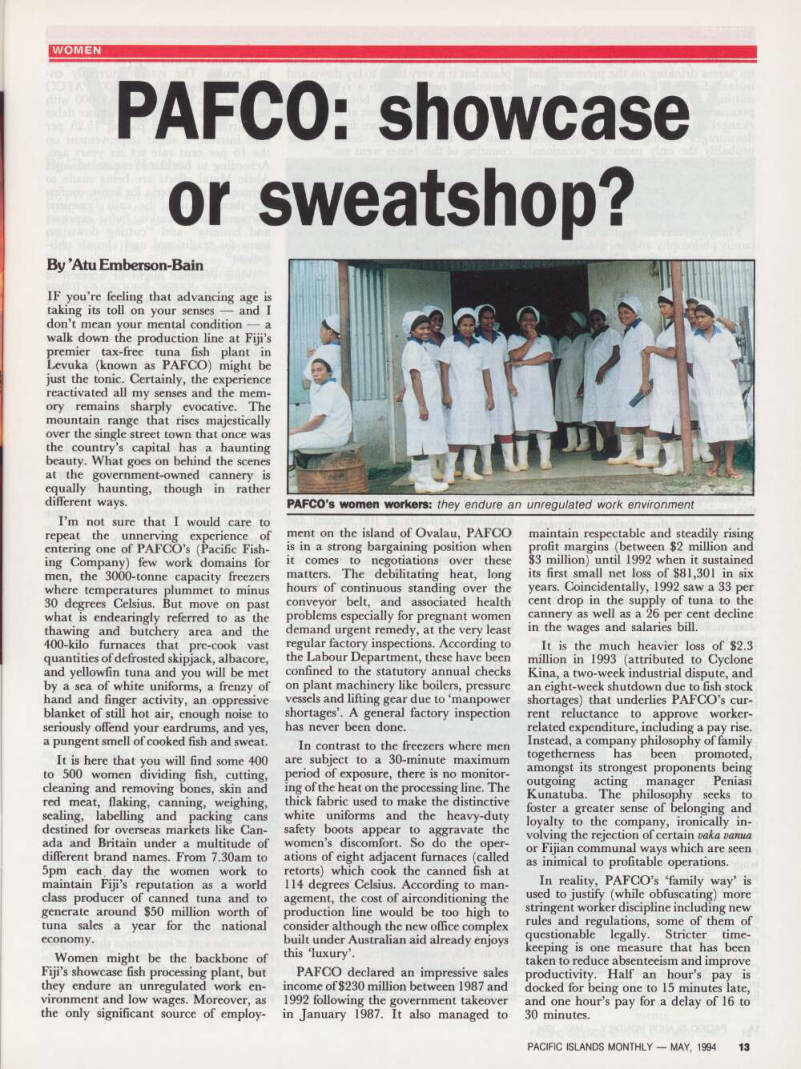
I’m not sure that I would care to repeat the unnerving experience of entering one of PAFCO’s (Pacific Fish ing Company) few work domains for men, the 3000-tonne capacity freezers where temperatures plummet to minus 30 degrees Celsius. But move on past what is endearingly referred to as the thawing and butchery area and the 400-kilo furnaces that pre-cook vast quantities of defrosted skipjack, albacore, and yellowfin tuna and you will be met by a sea of white uniforms, a frenzy of hand and finger activity, an oppressive blanket of still hot air, enough noise to seriously offend your eardrums, and yes, a pungent smell of cooked fish and sweat.
It is here that you will find some 400 to 500 women dividing fish, cutting, cleaning and removing bones, skin and red meat, flaking, canning, weighing, sealing, labelling and packing cans destined for overseas markets like Can ada and Britain under a multitude of different brand names. From 7.30 am to spm each day the women work to maintain Fiji’s reputation as a world class producer of canned tuna and to generate around $5O million worth of tuna sales a year for the national economy.
Women might be the backbone of
Fiji’s showcase fish processing plant, but
they endure an unregulated work en vironment and low wages. Moreover, as the only significant source of employ-
ment on the island of Ovalau, PAFCO is in a strong bargaining position when it comes to negotiations over these matters. The debilitating heat, long hours of continuous standing over the conveyor belt, and associated health problems especially for pregnant women demand urgent remedy, at the very least regular factory inspections. According to the Labour Department, these have been confined to the statutory annual checks on plant machinery like boilers, pressure vessels and lifting gear due to ‘manpower
shortages’. A general factory inspection
has never been done.
In contrast to the freezers where men are subject to a 30-minute maximum period of exposure, there is no monitor ing of the heat on the processing line. The thick fabric used to make the distinctive white uniforms and the heavy-duty safety boots appear to aggravate the women’s discomfort. So do the oper
ations of eight adjacent furnaces (called
retorts) which cook the canned fish at 114 degrees Celsius. According to man agement, the cost of airconditioning the production line would be too high to consider although the new office complex built under Australian aid already enjoys this ‘luxury’.
PAFCO declared an impressive sales income of $230 million between 1987 and 1992 following the government takeover in January 1987. It also managed to
maintain respectable and steadily rising profit margins (between $2 million and S 3 million) until 1992 when it sustained its first small net loss of 581,301 in six years. Coincidentally, 1992 saw a 33 per cent drop in the supply of tuna to the cannery as well as a 26 per cent decline in the wages and salaries bill.
It is the much heavier loss of 52.3 million in 1993 (attributed to Cyclone Kina, a two-week industrial dispute, and an eight-week shutdown due to fish stock shortages) that underlies PAFCO’s cur rent reluctance to approve worker related expenditure, including a pay rise.
Instead, a company philosophy of family togetherness has been promoted, amongst its strongest proponents being outgoing acting manager Peniasi Kunatuba. The philosophy seeks to foster a greater sense of belonging and loyalty to the company, ironically in volving the rejection of certain vaka vanua or Fijian communal ways which are seen as inimical to profitable operations.
In reality, PAFCO’s ‘family way’ is used to justify (while obfuscating) more
stringent worker discipline including new
rules and regulations, some of them of questionable legally. Stricter time keeping is one measure that has been taken to reduce absenteeism and improve productivity. Half an hour’s pay is docked for being one to 15 minutes late, and one hour’s pay for a delay of 16 to 30 minutes.
PAFCO’s women workers: they endure an unregulated work environment
Regular prayer meetings, prohibitions on yaqona drinking on the premises, and instant dismissal for anyone found com mitting adultery (off as well as on premises) are administered with similar evangelical zeal. The unwritten rule that discourages talking on the line offers probably the only room for occasional disobedience when the watchful eyes of supervisors are averted. As for the ban on adultery, it is not difficult to enforce according to a smiling Kunatuba “Levuka is a small town!”
Many workers are cynical of PAFCO’s family philosophy and are quick to point out its contradictions. As one working mother of four put it: “the Acting Manager told us that they are concerned mostly with our family welfare. But if they are concerned with our family welfare they should look into our needs, that are concerning our wages, the condition of the work and our working place. How could they say that they are for our family welfare?”
Another view expressed by a male freezer worker is equally blunt. “Now the boss, they don’t bother to come down and sit with us and have one bowl of grog. If you drink, you are chased out from the company, you go home. Now we just like the cat and the rat they stay on that side, we stay on this side”.
The majority of PAFCO’s women earn the minimum rate of $1.65 an hour, 12 cents less than their male counterparts.
According to the submission of the National Union of Factory and Com mercial Workers Union during arbi tration last year, this is as much as $1.17 short of the base rate paid by the tobacco
processing Central Manufacturing Com
pany which is also a large employer of women. PAFCO’s rate is better than that paid to women cannery workers at Voko Ltd, a private sector joint (Korean-Fiji) venture based in Suva. However, its wage movements during the past few years have been noticeably sluggish with the last increase being in 1990 under the seven per cent government wage guide line. Over the same (1990 to 1993) period, inflation rose by between 17 per cent and 18 per cent.
Unlike the former Japanese manage ment which is remembered with nostal gia by many PAFCO old hands for the regular pay increases, the bosses’ visits to the production line, and the sharp knives (for cleaning the fish!), the current local regime offers no productivity bonuses or wage adjustments after long periods of service. Celebratory parties thrown after a big job was done are also now a thing of the past. “Today management don’t give that kind of entertainment, they entertain themselves, they go out to resorts and entertain themselves.”
In the view of Australian Deputy General Manager (Finance and Admin istration) Paul Kirby, merit increases are fine in principle but problematic in
practice. “We would love to have that in place but it is very hard to lay down and control, to organise such a system. We tried to implement a bonus on the number of fish cleaned but at the end of the day, there were more fish counted than the fish processed. Some double counting of fish bones went on.”
PAFCO’s wage system takes on a special significance when one considers that the work performed by women requires skill, precision and efficiency (all qualities readily acknowledged by man agement to explain its preference for hiring them). PAFCO’s promotional brochure indeed describes the contri bution of “hundreds of skilled women [who] methodically divide the fish, remove skin and bones, and clean and prepare the meat for canning.” Com pany employment data also reveals that about 45 per cent of women employees have a minimum seven years experience with 20 per cent between 16 and 23 years of experience.
Moreover, although total numbers on the payroll can swell to as many as 1000 with the bulk of the extras being temporary shift workers, there is a ceiling of just 300 women workers (six lines of 50 working back to back) in the pre-canning cleaning area. The crude implication of this is that any increases in the daily tonnage of fish put through the cannery (averaging 50 to 75 tonnes with a maximum capacity of 100 tonnes) are handled by the same number of women although the hours worked may extend with overtime until Bpm. Some quick calculations based on company figures are revealing. Even if the lower throughput of 50 tonnes is taken, each woman would clean some 3731 b of fish per day or 471 b an hour. Paid a daily rate of $13.94, this means that she earns less than four cents per pound of fish.
An equally disturbing feature of the low wage system is the gulf between gross earnings and pay in the hand. Pay slips show weekly earnings of nearly $7O for a 42 and a half hour week with net pay for the lucky ones hovering close to $4O after deductions for tax, Provident Fund, insurance and the credit union are made.
But actual disposable income is even less than this because just about all women workers have been forced to take out hefty bank loans to supplement their wages. The loans have proved a ‘curse in disguise’, demanding weekly repayments of between $2O and $3O, levies that amount to between one-third and one half of gross earnings. Deducted at source, they effectively mean that cash for food, children, transport and other basic needs in a town where the cost of many things is significantly higher than Suva, habitually dwindles to as little as $lO to $l5, sometimes less.
The availability of unsecured personal loans to PAFCO workers is a service that has been offered since 1988 by Westpac
which until recently enjoyed a monopoly in Levuka. The system currently en snares between 400 and 500 PAFCO employees in debts of up to $3OOO with some women running two or more debts concurrently and all paying 15.25 per cent interest, a slight improvement on the 16 per cent rate set six years ago.
According to Levuka Westpac manager Abele Matai efforts are being made to tighten up the criteria for loans, confin ing them to what he calls “essential purposes like education, living expenses and housing” and “cutting down on loans for traditional and church obli gations”.
While Westpac might be accused of overlending, the fact of the matter is that its credit facilities have shielded workers and their families from destitution. As the bank moves to reduce the loans, and ultimately to phase out the system altogether, times will certainly become tougher for workers although the debt noose may loosen in the long run. The only reprieve would seem to be an improvement in wages. But this seems unlikely. According to PAFCO’s sub mission to last year’s arbitration, “the decline in the employees’ standard of living is not at all related to their pay. It is fact related to their neglect of tra ditional chores (like cassava and dalo planting) and being too dependent on their pay packets even for primary items like bele, rourou etc”.
Kunatuba is optimistic about the future prospects for PAFCO because of “changing attitudes within the work force, a better fish supply, and new market opportunities”. But he argues that the company’s financial position remains precarious in the wake of heavy losses last year. Yet it is difficult to be sure exactly how profitable or unprofitable company operations are. Despite the howling publicity of last year’s industrial dispute (which resulted in criminal charges against 12 union members, five of them women, for involvement in an allegedly illegal strike), PAFCO remains an enigma to the general public.
The company might be a fully locally owned enterprise with public funds sustaining the 98 per cent government equity but it is nevertheless allowed to play its cards extremely close to its chest.
There are no annual reports of oper ations available to the taxpaying public.
Nor is data on costs and profitability easily accessible. If you are lucky enough to get security clearance for a tour of the production plant you will find that even photographs of women on the pro duction line are out because “they might give the wrong impression. We can’t tell for sure the sort of impression that people may get out of here”. Under the circumstances, it is difficult to walk away from the factory with the ‘right’ im pression, whatever that may be. □