PNG media freedom comes under threat
pp. 8-9 · Read in the full issue
Papua New Guinea
EARLY last month Papua New Guinea faced threats to two key principles of its constitution unity and media freedom.
In the face of a likely abolition by parliament of the expansive and expens ive provincial government, premiers of the five island provinces got together to discuss their governments’ future with secession being a possibility. Like Bou gainville, which is one of the five island provinces, the others had already openly threatened secession if the national government did not back down on its moves for which legislation had already been drafted. In Rabaul, the Islands Regional Secretariat had drawn up a draft plan of action for the new Feder ated Melanesian Republic to comprise the provinces of Manus, New Ireland, and East and West New Britain, with an option for Bougainville to join if it wanted to.
The premiers are opposed to any change of the decentralisation process, at least for them, because they believe the system had worked for them in so far as achieving development aspiration was concerned. The national government’s main reason for proposing the change was that provincial governments (there are 19 of them) had been a failure, and were a complete waste of public money, absorbing a third of the annual budget but showing little for their existence for the past 18 years. Many provinces had been suspended for mismanagement and misuse of public monies and several leaders jailed as a result. Said Islands Premiers’ Conference chairman Bernard Voage on West New Britain: “To abolish the provincial government system is similar to breaking the power-sharing arrangements that had been established between the national government and the people of this country.
“The Islands people therefore see the proposed Bill to abolish provincial gov ernments and replace them with provin cial authorities with limited legislative powers as a breach of the power-sharing contract.
“I call on the government to be more cautious and sensitive when dealing with issues that can make or break our great country, PNG.”
Whether the Islands premiers were serious about secession and had the support of their population or not, or were merely using the threat to hold onto ?ower is an issue that remains to be seen, he national government’s reaction to this was to consider laying charges of sedition against those leaders concerned, and in a surprise move banned the state funded but independent National Broad casting Commission from reporting any discussions out of the premiers’ confer-
ence. The Broadcasting Act, while call ing for the NBC to provide “balanced,
objective and impartial broadcasting
services”, also authorises the minister to prohibit the commission from broadcast ing matters specified by him or request the commission to refrain from broad casting certain matters.
In his order to the NBC, Communica tions and Information Minister Martin Thompson said: “Let me remind the commission that whilst it is our duty to
provide a balanced, objective and impar
tial broadcasting service, it is paramount that such services should reflect our drive for national unity and that we should take extreme care in broadcasting ma terial that could inflame racial or
sectional feeling.”
NBC chairman Sir Alkan Tololo said it was it was an order they had to comply with. The whole media fraternity, the parliamentary opposition and the prem iers concerned went to town the next day
denouncing the ban. The biggest daily,
the Post-Courier , dedicated its first three news pages, and the main features page to stories on the ban. Thompson ex plained that next day that his actions were intended to “protect” NBC journal ists. He said in the case of the Islands premiers, there was a “fine line” separat ing politics and criminals acts, and these leaders were treading closer to that fine line. Thompson said if the police were to move in and arrest any of the leaders, it was his “duty to protect my journalists”.
He admitted that the ban conflicted with the Journalists Code of Ethics. In its criticism, the opposition said the ban was a government move to “muzzle” the media. Leader Chris Haiveta said the ban was “childish, unconstitutional and unprecedented”. “We cannot kill se cession by banning any discussion on it,” he said.
Haiveta said it was silly of the government to all of a sudden resort to censorship when it came to secession
when right throughout the Bougainville
crisis another secessionist issue all media had covered it extensively.
“If Mr Thomson is concerned about the secessionist overtones of the Kimbe
meeting, what does he imagine Bougain
ville is all about?” Haiveta asked.
There was a certain amount of irony in Thompson’s order on the NBC. It was a complete about-turn to his National Policy on Information and Communica
tion, a 79-page document presented by
him and adopted by parliament only 37 days earlier on March 1. The policy, which covers all aspects of communica tions, is also graced with continuous proclamation of the rights of the people to information and the freedom of the media. In fact, the very second sentence of the preamble states clearly: “The people of Papua New Guinea past, present and to come acknowledge that communication in all its modes and forms is a basic right through which men, women and children share life, experi ence, ideas, values, hopes, and aspir ations to build community.
“We acknowledge that communica tion is a right equal with all others. It includes the right to inform and to be informed, the right to freedom of ex pression, the right to freedom of infor mation and assembly, and the right to communication opportunities. It is sub ject only to the rights of others under the National Constitution.”
On access to information, the policy states that all media providers, whether public or private, must base their policies and strategies on a commitment to provide increased levels of access to information and communication services to the entire population.
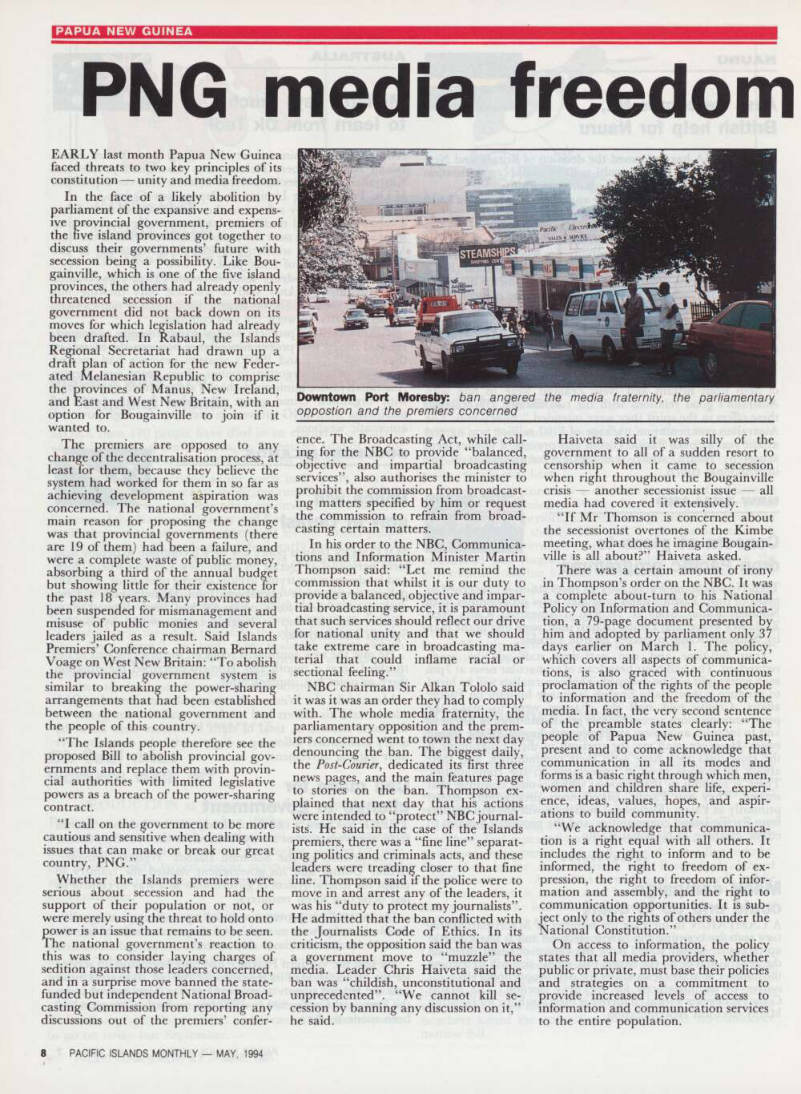
Downtown Port Moresby: ban angered the media fraternity, the parliamentary oppostion and the premiers concerned
On information content, it says: “The {lower of the media to influence is based argely on its contents. Because of this, priority must be given to encouraging Papua New Guinea cultures, Christian values and promoting national aspir ations and development objectives.” On the print media: “Finally, the print media policy will focus on issues related to freedom of the press and the role of print media in society. Freedom of the Eress is a prerogative of the people. It elongs to them. It has to be guarded as an inalienable right of people in a free society. Its existence must be defended against the self-interest and assault from any individual or group, public or
private.”
On objectives for the print media, the
policy states: “...emphasising positive
news coverage; promoting honest, com plete, and balanced reporting; reporting on provincial and national cultural events, issues and traditions; discourag ing content hostile to PNG interests; and discouraging the publication of conflict ing statements and reports.”
For the radio and television broadcast ing, the policy has the following to say: “The expansion of the broadcast media will facilitate the flow of information as affordable rates to enable news and information to be available to all men, women, and children. This will support government initiatives to educate, inform and mobilise, and entertain the people.”
On programme content it says: “It shall be the policy of the government to promote comprehensive, fair, responsible
and meaningful broadcasting content.”
And on the strategy through which this can be achieved it says: “...promot ing content friendly to PNG traditional
culture, Christian values and national
aspirations, and emphasising positive
news and information.” It further em
phasises the following strategy: “...pro
moting broadcasting services that pro vide fair, accurate, and balanced cover age of issues and events.”
On the Press Code of Ethics: “Journal ists must remain alert at all times to bring the public issues to the public knowledge.
They are responsible to discuss, question,
and challenge statements and actions of the government and public or public institutions without fear or favour. In a free society, journalists have the right to voice controversial opinions, and the privilege to agree with the majority.
“They must be vigilant against exploi
tation of the press by an individual or group for selfish purposes. Journalists should not take sides on an issue where there is a dispute. They should use balance, that is present at all sides of an argument fairly. ’
The policy also has a clause on sedition which says: “Sedition is words or action designed to cause people to act unconsti
tutionally.
“Today, laws on sedition often have more to do with promoting racial and social harmony than with protecting the state. Sedition is often defined as the intention to promote feelings of ill-will or hatred between different races, classes or religious groups within the country. The law usually recognises that it is all right to question decisions by the head of state, government or parliament as long as this is done in good faith with a view to correcting errors or defects.
“Political comment, even in strong terms, is acceptable, as long as it is not done with the intention of attempting to
overthrow the government or legal system by unlawful means.”
It has the following to say about the code of ethics for radio broadcasting in PNG: “A communications policy aims to defend and uphold freedom of the media.
The radio industry should grow as a free medium following the rights provided by the PNG constitution. The extent of this freedom is underscored by the laws which prohibit censorship of broadcast material.” On controversial public issues, the policy says: “Radio facilitates the participation of a wide variety of people, becoming a forum to discuss current affairs, including controversial public issues.
“Aware of this role, radio should be responsible with views on public issues and give fair representation to all parties rgarding such issues. Programmes deal ing with public issues must be presented with manifest aimed to facilitate public participation on issues that affect them.
But such programmes should not give an impression that they are designed for mere controversial or programme pur
poses.”
Owing to the above and Thompson’s action, one is left wonder if the policy is genuine. One politician who was quite critical of the policy during debate on it was Wewak MP Bernard Narokobi who described it as a policy on “misinfor mation and non-communications”.
And he concluded: “I am going to burn this report because it does not have any substance. In my dialect we have an expression which says, ‘Do not blow the lime and blind someone.’ This report fits the expression. It has simply been written by fools.” □