Fabulous Funafuti
p. 63 · Read in the full issue
Yachting
By Sally Andrew
AN atoll landfall the palm trees make a fuzzy edge on the horizon before rising into view as we sail up the western edge of the reef looking for the entrance into the lagoon. Foster climbs up into the rigging to get a better perspective, and there it is the pass snows dark blue.
Conditions are ideal for sighting the dangerous coral heads that rise from 20 fathoms. We make our way in, carefully, and zig-zag seven miles across the lagoon to the anchorage in front of the new Vaiaku Langi Hotel. We have arrived at the heart of Tuvalu and its capital Funafuti.
Funafuti is a typical atoll a large lagoon encircled by tiny, flat coral islets centered within the deep blue of tropical sea and sky. One of the smallest independent nations in the world, Tu valu’s suitable pseudonym “Tiny Island Nation” is proudly silk screened on local T-shirts. Funafuti itself, the seat of the national government, is 2.8 sq km in size and home to nearly half of Tuvalu’s population of 8000.
Our first night in Tuvalu introduced us to modern traditions. It was Island Twist Night at the hotel and “Funafuti Island Power” (the local dance band) blasted across the lagoon. Guitars, syn thesisers and a Jammed dance floor happily celebrated the weekend.
Tuvaluans love music and dancing.
Friday and Saturday’s Island Twists (at the hotel and at the Matagi Cali Bar) attract big turnouts. During the week the sound of music emanates from Funafuti’s many community halls or maneapas. We were invited to a fundraiser at the Talimalie Maneape where, in lieu of walls, huge colorful sheets had been strung around the perimeter. At 8.30, a solitary dancer, skin glistening with coconut oil, started the performance.
Throughout the evening, women under went constant costume changes as they performed short skits and danced to recorded music cassettes. In one slapstick
routine, a woman’s “pants” kept falling
down as she and her friends imitated a rock and roll band. Then a young Tuvaluan woman did an impression of Gilbertese dancing a playful and not
quite-complementary routine that had everyone in stitches.
Planes touch down at Funafuti’s international airport five times a week. A siren heralds each arrival and clears the runway of cars, dogs and pedestrians.
Very few foreigners come as tourists, perhaps because the Tuvalu route is one of the most expensive per mile in the South Pacific. Radio Funafuti announces the arrival of outsiders as well as the off island travel of government workers, students on aid-subsidised study courses and remittance workers. Clandestine arrivals and departures are difficult.
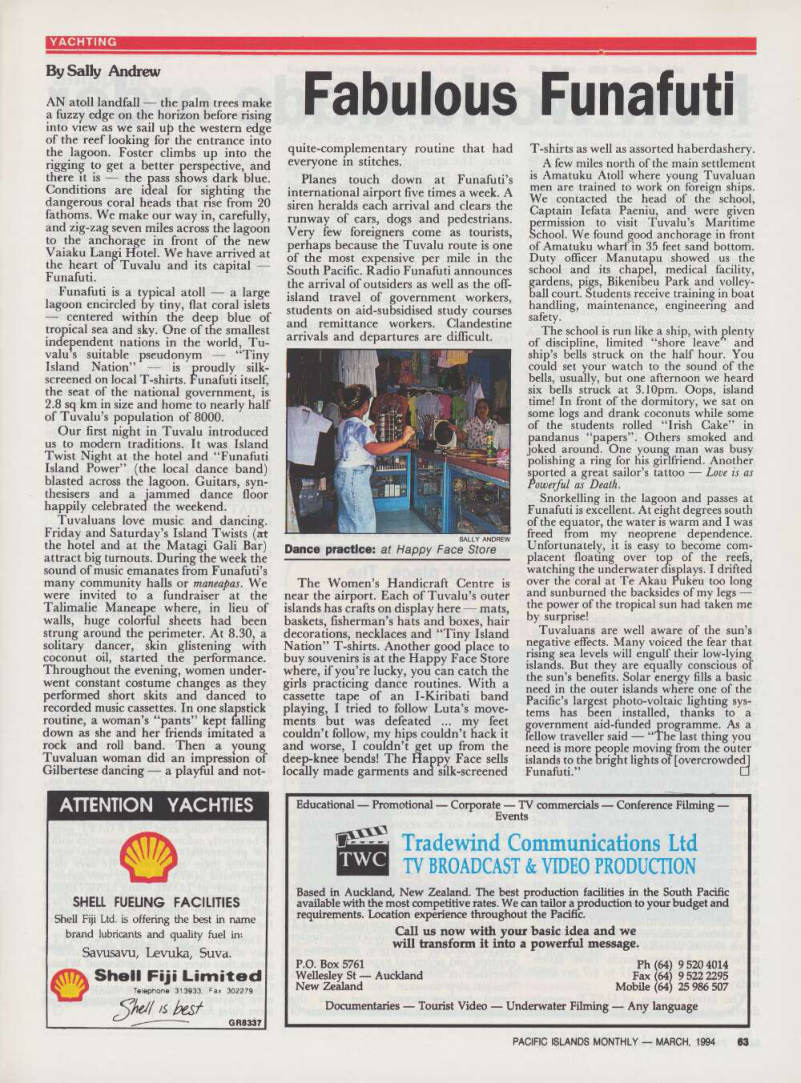
The Women’s Handicraft Centre is near the airport. Each of Tuvalu’s outer islands has crafts on display here mats, baskets, fisherman’s hats and boxes, hair decorations, necklaces and “Tiny Island Nation” T-shirts. Another good place to buy souvenirs is at the Happy Face Store where, if you’re lucky, you can catch the girls practicing dance routines. With a cassette tape of an I-Kiribati band playing, I tried to follow Luta’s move ments but was defeated ... my feet couldn’t follow, my hips couldn’t hack it and worse, I couldn’t get up from the deep-knee bends! The Happy Face sells locally made garments and silk-screened
T-shirts as well as assorted haberdashery.
A few miles north of the main settlement is Amatuku Atoll where young Tuvaluan men are trained to work on foreign ships.
We contacted the head of the school, Captain lefata Paeniu, and were given Permission to visit Tuvalu’s Maritime chool. We found good anchorage in front of Amatuku wharf in 35 feet sand bottom.
Duty officer Manutapu showed us the school and its chapel, medical facility, gardens, pigs, Bikembeu Park and volley ball court. Students receive training in boat
handling, maintenance, engineering and
safety.
The school is run like a ship, with plenty of discipline, limited “shore leave” and ship’s bells struck on the half hour. You could set your watch to the sound of the bells, usually, but one afternoon we heard six bells struck at 3.10 pm. Oops, island time! In front of the dormitory, we sat on some logs and drank coconuts while some of the students rolled “Irish Cake” in pandanus “papers”. Others smoked and joked around. One young man was busy polishing a ring for his girlfriend. Another sported a great sailor’s tattoo Love is as Powerful as Death.
Snorkelling in the lagoon and passes at Funafuti is excellent. At eight degrees south of the equator, the water is warm and I was freed from my neoprene dependence.
Unfortunately, it is easy to become com placent floating over top of the reefs, watching the underwater displays. I drifted over the coral at Te Akau Pukeu too long and sunburned the backsides of my legs the power of the tropical sun had taken me
by surprise!
Tuvaluans are well aware of the sun’s negative effects. Many voiced the fear that rising sea levels will engulf their low-lying islands. But they are equally conscious of the sun’s benefits. Solar energy fills a basic need in the outer islands where one of the Pacific’s largest photo-voltaic lighting sys tems has been installed, thanks to a government aid-funded programme. As a fellow traveller said “The last thing you need is more people moving from the outer islands to the bright lights of [overcrowded] Funafuti.” □
Sally Andrew
Dance practice: at Happy Face Store