Super sevens
p. 61 · Read in the full issue
Sport
Rivalries aside, the
tournament’s essential
role in developing island
rugby has become clear
in only its second year
NEW Zealand rugby sevens captain Eric Rush called it the toughest rugby sevens tournament in the world. Few of the teams that participated in last month’s Air Pacific Fiji International Sevens would disagree. There is only one Fijian team to contend with at the bigger and more famous Hong Kong Sevens. At Suva’s National Stadium on March 11-12, there were three Fijian sides blocking all entries to the final.
As at the inaugural event last year, this year’s final was again an all-Fijian affair.
Rush won the Player of the Tournament award but New Zealand, like the 12 other overseas teams, fell by the wayside.
At best, the Kiwis and the Tongans featured in the semis but fell victim to Fiji’s mastery in rugby sevens here, while the Australian development side had to be content being plate winners. Rivalries aside, the tournament’s essential role in
uplifting rugby in the islands has become clear in only its second year.
Teams like the Solomons, Vanuatu, Cook Islands and New Caledonia stand almost no chance of getting invitations to Hong Kong or qualifying for the World Sevens. Neither could these countries have afforded costly trips to play else where.
The Fiji sevens is right next door, affordable and offers a chance to play against both the world’s best teams and against teams of equal strength. The tournament has become truly an international event with Uru guay, Sri Lanka, Japan and Malayasia sending in full na tional teams.
These sides may have been massacred by southern hemi sphere teams but the main reason for their Fiji trip - for the moment at least - is educational, anyway. Sri Lanka won the bowl competition 21-14 over Uruguay in one of the most entertaining games of the tournament.
Enroute the final, Sri Lanka overcame a huge weight disad vantage to thrash newcomer, New Caledonia 42-5.
The Fiji Rugby Football Union (FRFU) is aiming for a bigger tournament next year and will impress upon participants to send full strength teams. It’s well
recognised that
Fiji has contrib uted immensly to the sevens code and in return the FRFU is asking for more support for its own tourna ment.
To weaker rugby nations, the
Fiji Sevens is being
marketed as a chance to learn the game in the code’s
adopted home.
For the more es tablished
countries, playing
and winning in the
Fiji rugby sevens
jungle should be seen as a chal
lenge. New Zealand sent a development team last year but came with the national team this time.
The All Blacks have apparantly recog nised there is no better way to build up for the Hong Kong Sevens than mixing it with a few Fiji teams two weeks before the event. Australia and defending Hong Kong Sevens champions Western Samoa haven’t been sending their best teams while World Sevens champion, England, is yet to be represented.
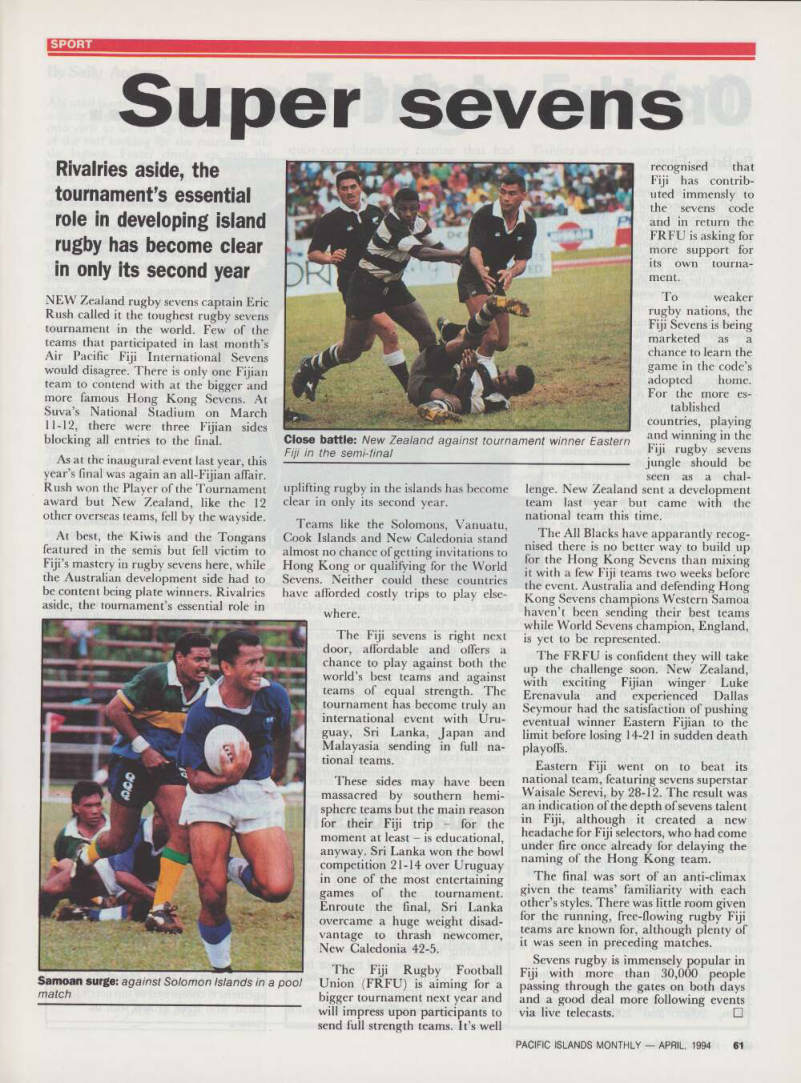
The FRFU is confident they will take up the challenge soon. New Zealand, with exciting Fijian winger Luke Erenavula and experienced Dallas Seymour had the satisfaction of pushing eventual winner Eastern Fijian to the limit before losing 14-21 in sudden death playoffs.
Eastern Fiji went on to beat its national team, featuring sevens superstar Waisale Serevi, by 28-12. The result was an indication of the depth of sevens talent in Fiji, although it created a new headache for Fiji selectors, who had come under fire once already for delaying the naming of the Hong Kong team.
The final was sort of an anti-climax given the teams’ familiarity with each other’s styles. There was little room given for the running, free-flowing rugby Fiji teams are known for, although plenty of it was seen in preceding matches.
Sevens rugby is immensely popular in
Fiji with more than 30,000 people passing through the gates on both days and a good deal more following events via live telecasts. □
Samoan surge: against Solomon Islands in a pool match
Close battle: New Zealand against tournament winner Eastern Fiji in the semi-final