Targeting growth
p. 51 · Read in the full issue
and development
THE success of Western Samoa’s growth and development depends in a very part on two institutions The Central Bank of Samoa and the Development Bank of Western Samoa.
One of the main areas the Central Bank is concentrating on is foreign investment. They are responsible for making conditions attractive to potential
foreign investors.
In recent times the Japanese firm Yazaki has taken advantage of Western Samoa’s investment potential, and has set up in a big way. Because of Samoa’s
cheap labour, what Yazaki has basically done is set up a department of Yazaki Australia making automotive parts.
The firm employs close to 2000 locals.
A significant proportion considering the estimated labour force is 88,000, with only about a half this number actually employed.
Incentives offered by the Central Bank include some exemption from duty, tax free holidays and other special exemp tions. The inflation rate is good and firms are allowed to repatriate funds. All this adds up to very favourable investment opportunities. As Jeremy Forster, the general advisor to the Central Bank of
Samoa, says, he is “amazed there are not more foreign investors coming in to take advantage of the opportunities”. Al though Forster says Yazaki plan some expansion because of the favourable conditions.
The Central Bank’s Deputy Governor, Ray Ah Liki, says he has no doubts Yazaki’s success in the country will attract more investors and he is confident off more coming in.
Apart from the attractive incentives and cheap labour force, Western Samoa’s other assets include a stable
government, good infra structure and good shaping and air links.
Ah Liki says they are look ing at potential investors from Australia, New Zealand and Asia especi ally Hong
Kong, Singa
pore and In donesia.
As far as lo cal investment
and develop
ment is con cerned, this is
basically
looked after by
the Develop
ment Bank of Western
Samoa. The bank helps the finance institutions with credit, advisory service and technical assistance as well as the private sector.
The private sector development is in such areas as tourism, agriculture, transport
and industry.
The assistance includes things like advice and funding to develop certain crops, training for small business and setting up women’s projects such as handicraft making and selling. The help also includes a weekly business advice column in the paper.
As the bank’s General Manager, Falefa Lima, points out, the bank provides a large contribution to the
economy and to job creation. It is t
major financer of primary industry ai
tourist project in the country. At prcsc its total loans portfolio is WS$42 millio The country is still trying to get bac on its feet following to devastatii cyclones in 1991 and more recently a ta
blight, which has basically wipcd-out 01
of the major foreign exchange earner
Lima said the 1992 financial year was di Hi cult one for the bank because of tl devastation caused by Cyclone Val o many of the projects financed by tl bank. He said this left many clien finding it difficult trying to service the loans. However, Lima said he w; satisfied with the bank’s performance.
Lima says they are trying to cncourag a more diversified production of crop This includes reviving banana expor and redeveloping the cocoa crop. But h says agricultural development needs t looked at very closely.
In the bank’s 1992 annual report Lim
highlights the continuing high losses from
agricultural loans. “From the bank’s owi experience it is quite clear that ccrtaii types of farming activities which now provide the basic source of income for th rural community are not commercially viable. The bank considers it a priority therefore that a study be undertaken a
national level, perhaps by the Depart
ment of Agriculture, the Bank and the Planning Office, to determine alternative farming approaches that will make i possible for farmers to earn higher incomes.”
Over the last 10 years Lima says he has seen a lot of encouraging changes such as the improvement of infrastructure, in
dudeing roads, electricity supply, tele
phone services and transports, and the availability of services and skills. He says this is important as the country trys to attract foreign investors. He said there has bee a sharp shift in the type ol
industry from primary agriculture to
“produced goods”. These include coco nut cream and fruit juice, and there is also talk of developing a fish cannery.
Lima said no doubt tourism and tourism-related markets will play a very important part in the economy in the next 10 years, as the number of tourist are predicted to double by the year 2001.
Already hotel occupancy rates are very high and there is an urgent need to increase the number of beds and related tourist facilities.
The future for Western Samoa looks bright, and it is reassuring to know the country is in the capable hands of the Central Bank of Samoa and the Devel opment bank of Western Samoa. □
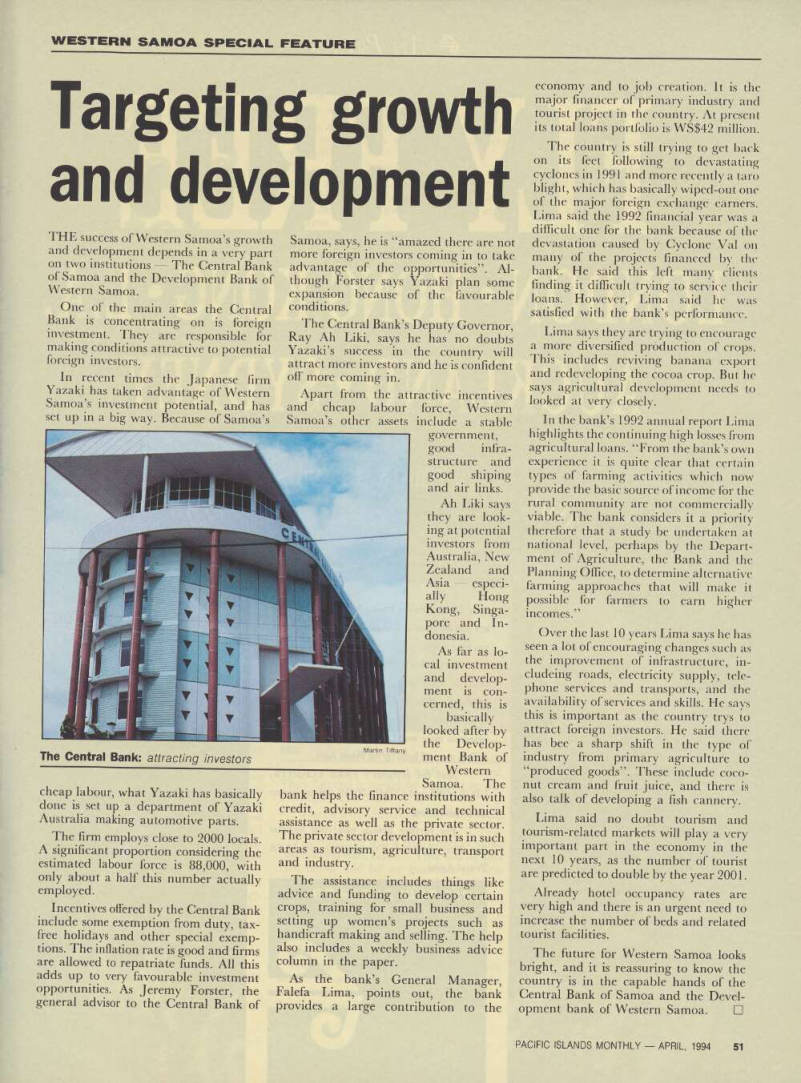
The Central Bank: attracting investors
Martin Tiffany