Tourism...on the move
p. 47 · Read in the full issue
A FAFF on Apia’s Beach Road houses the headquarters of what will no doubt be one of Western Samoa’s major growth industries. In the fale, opposite the Catholic Church at Mulivai, is the Western Samoa Visitors Bureau.
Tourism is already an import foreign exchange earner for the economy. How ever, compared with regional neighbours like Fiji, Western Samoa can be devel oped a lot further.
“Our tourism industry is smaller compared to some other Pacific countries, we have had our teething problems, but we are learning to address our problems,” says Mataia Vensel Margraff, the general manager of
Wsvb.
Margraff lead a determined team, who with help from the Tourism Council of the South Pacific, are tackling these problems. The problems they have to address range from getting the major roads tar-sealed to make places of interest more accessible to more specific ones such as putting changing facilities and toilets at beaches.
As Margraff explains they are not only responsible for attracting tourists to the country but, to some degree, for the country itself. They look after beautifi cation of the towns and country-side and hold a beautification contest annually.
They have also recently begun looking after tourism investment. They act as the intermediary between potential investors and land owners, to ensure transactions are made easier and correctly.
This go-between role is very important because if a potential investor has difficulties trying to set-up, there is no shortage other Pacific countries ready to welcome the investor with open arms.
Tourist arrivals to Western Samoa are not increasing dramatically, but they are increasing. In 1990 arrivals totalled 48,853, however two devastating cyc lones in February and December 1991 took its toll with numbers dropping to 34,953. In 1992 the total climbed to 37,507 with the 1993 figures looking set to top this for the first half of 1993 the country played host 18,652 visitors, with the end of the year usually the busiest period. American Samoa is by far the main source market, followed by New Zealand, Australia and the USA respect ively, The United Kingdom and Europe are also very important markets.
Margraff realises they can’t just sit back and hope visitor numbers will grow, they have to look at the overall situation and decide what best way to approach
the future, To do this The Western Samoa Tourism Development Plan 1992-2001 j^ as been prepared by the Tourism Gouncil ol the South Pacific under the Euro P ean Community financed Pacific Re g lonal Tourism Development Pro gramme at the request of the Western Samoan Government.
A passage from the executive summary of this Plan perhaps sums-up the tourism situation in the country. It states “The tourism development strategy will ensure that tourism in W. Samoa will be
environmentally responsible and
culturally sensitive; follow a policy of “ low volume high yield” traffic, and
attract discerning and environmentally
and culturally aware visitors, who will
use generally high quality small and
medium sized facilities. The proposed development strategy does not envisage , Samoa becoming a mass tourist destinatloI h nor does it entail large scale resorts and other lar § e tounst facillties -”
The Plan targets a growth rate of 9.8 per cent for the period 1992-2001, with visitor arrivals increasing from 41,000 in 1992 to 101,000 in 2001. According to the document, the bulk of the projected visitor traffic increase will come from holiday travel (16 per cent average
annual growth rate), while the largely
non-discretionary travel markets of busi ness travellers and visitors to friends and relatives will grow at a much slower pace along a linear trend, American Samoa and New Zealand account for almost half the visitor traffic
although these markets are mainly ethnic-oriented. Substantial increases in visitor traffic are expected to be gener ated by other markets such as Australia, North America, Europe and Japan.
As for accommodation requirements, the Plan envisages 614 hotel rooms by 1996 and 1120 rooms by 2001. This means the construction of 690 new rooms
over the 10-year period, plus upgrading
to minimum international standard 100 of the existing sub-standard rooms.
As far as marketing goes, the proposed marketing strategy entail seeking out higher spending leisure tourists in Aus tralia, New Zealand, North America and Japan. This will include the WSVB establishing direct representation in Aus tralia and New Zealand and be rep resented through the TCSP in the long haul markets.
Although the implementation of this
10-year tourism development plan will
mean an estimated investment of WS$l3B million, the returns should be
worth it. First, foreign exchange earnings
measured in constant 1991 prices are projected to increase from WS$4l mil lion in 1992 to WS$l7 million in 2001.
Even with a relatively high import
leakage ratio, tourism’s net foreign
exchange earnings will make a significant
contribution to the country’s balance of payments.
Secondly, direct and indirect local income generated as a result of the projected increase in tourist expenditure over the Plan period will grow consider ably. Thus, it is estimated that tourism will contribute WS$54 million to GDP in the year 2001. Thirdly, Government revenue from tourism is estimated to increase to W 5523.5 million by 2001.
Finally, the number of direct and indirect full-time equivalent jobs result
ing from the projected tourist expendi
ture will increase to 4,700 in the year 2001.
What the Plan has basically done is give the country a blue print for future tourism success. Although the plan itself states that Western Samoa is not likely to become a mass tourist destination, tourist numbers are expected to double by 2001.
Going hand in hand with this is increased
earning and more jobs.
For more information on Western Samoan tourism contact Western Samoa Visitors Bureau, PO Box 2272, Apia, Western Samoa. Ph (685) 26557; Fax (685) 20886 □
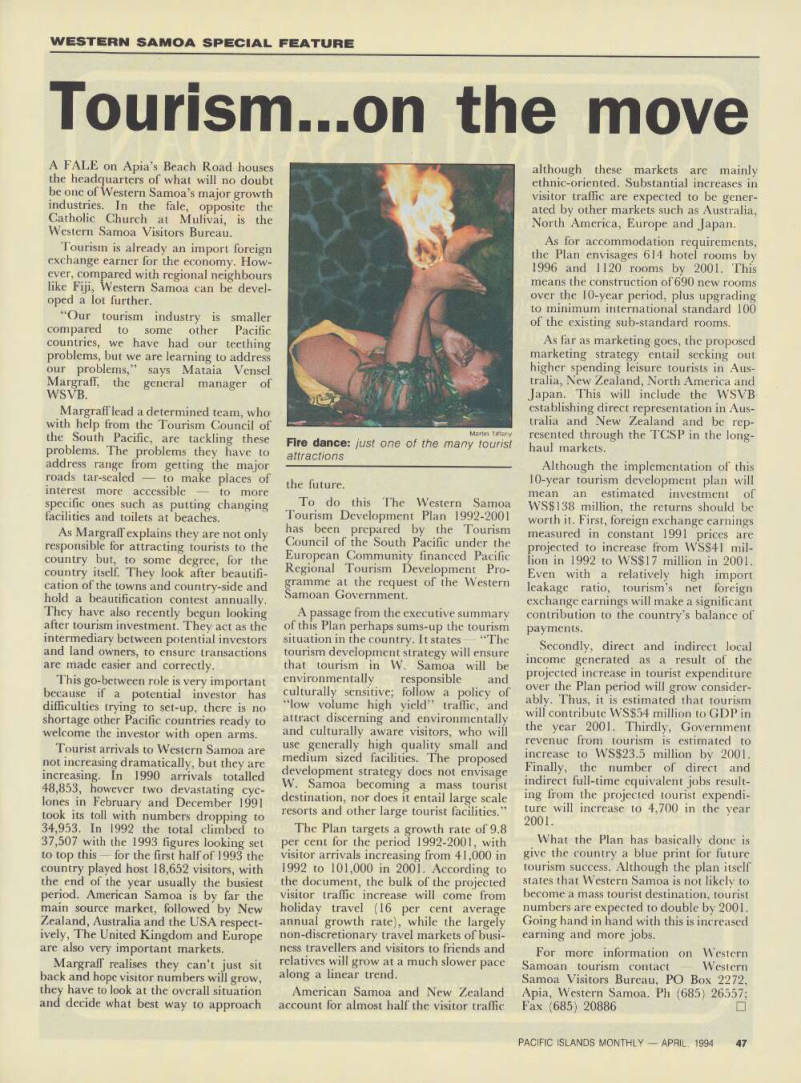
Martin Tiffany Fire dance: just one of the many tourist attractions