Investment guide
p. 41 · Read in the full issue
Western Samoa Special Feature
IF YOU have visited Western Samoa recently, chances are you will have come across an information package titled “A Guide to Investment”. It is one of the latest tools the government is employing to boost the economy by vigorously promoting the investment potential in Western Samoa.
According to Prime Minister Tofilau Eti Alesana the publication “heralds the significant changes government has made to the Investment Incentives
Legislation, providing for significantly
improved benefits to investors in Western Samoa”. “Western Samoa has a lot to offer potential investors and would merit your serious consideration. For example, politically we are very stable and we also have good infrastructure, telecommuni cation systems as well as a strong and educated labour pool,” Alesana adds.
One of the most apparent advantages in investing in Western Samoa is the stable government, but there are many other pluses such as the preferential access the country enjoys. It has prefer ential access to Australia and New Zealand under SPARTECA, to Europe under the LOME Convention and to the USA under the GSP scheme. Then there is the progressive land laws which allows the long term leasing of lands for agricultural and industrial use.
Loans are available through the De velopmert Bank of Western Samoa, the National Provident Fund and the two commercal banks. There is also freedom for reparation of both capital and profits.
Manuhcturing and tourism top the Governrrent’s priority list as far as
development and investment are concerned.
To assist ;nd en courage their development the Government
provides infra
structure md at tractive incen tive packiges to both loed and foreign inves tors.
New enter prises whch in tend to export at least 95 per cent of their mnual productioi, en joy the folowing
incentives • A tax holiday up to 10 years • A subsequent tax rate of 25 per cent on assessable income. • A holiday on tax on dividends op up to 10 years (up to the limit of funds
invested).
• Complete relief from all custom and excise duties on both imports and exports.
A pool of educated labour is available, with most able to communicate in English. It is a government policy to utilise local labour whenever possible but skilled expatriate labour may be used where locals are not available. The total estimated labour force in Western Samoa was 88,000 in 1989.
As far as essential facilities are con
cerned, electricity (240 volt) is accessible
to all areas within declared boundaries of towns and a large portion of the rural area, and piped water is easily obtain able. There are 2050 km of sealed roads.
The new extended Apia port provide a wide-range of services which include,
pilotage, deep berths, general and cargo
handling, freezer and cooler for loose
cargo warehousing, weighbridge (up to
16T), stevedoring, cargo and container storage and fumigation. Other facilities in the port include a coconut oil pipeline
and a submerged pipeline for petroleum
products.
Apia is currently connected by air to and from Hawaii, Auckland, Sydney, Brisbane, Nadi, Noumea, Tonga, Rarotonga and American Samoa. West ern Samoa’s International Airport lo cated 32 km from Apia is able to accommodate Boeing 747 aircraft.
Finance in Western Samoa is looked after by the Central Bank of Western Samoa, the Development Bank of West ern Samoa and two commercial banks.
Foreign exchange transaction come un der the control of the Central Bank which directs the current policy on matters related to the stability and supply of money within the country and international transactions, including overseas transfer of funds and funding of imports. The Development Bank pro vides the majority of medium and long term loans to industry and agriculture.
The two commercial banks provide a full range of banking and services to business and the public. These are the Bank of Western Samoa, a joint venture between the Australia and New Zealand Banking Group Ltd (ANZ) and the government, and the Pacific Commercial Bank, a joint venture between the Bank of Hawaii and the Westpac Banking
Corporation.
The National Provident Fund, the Public Trust, the Western Samoa Life Assurance Corporation, National Pacific Insurance and the Accident Compen sation Board also provide term loans.
As far as places to develop in Western Samoa there is no scarcity of land for Industrial and Commercial purposes.
Land holdings in Western Samoa basi cally fall into three categories custom ary land, freehold land and public land.
Customary land is not for sale but can be leased out to locals as well as foreigners. This is usually the option taken by foreign investors, particularly in the tourism industry. Freehold land has mostly been taken up for residential
purposes lo cated around the Apia urban area .
A 100 acre industrial es tate has been
developed five
kms from Apia at Vaitele. The site is well sup
plied with
water and elec
tricity. Long
term leases are
generally
available at at tractive rentals. □
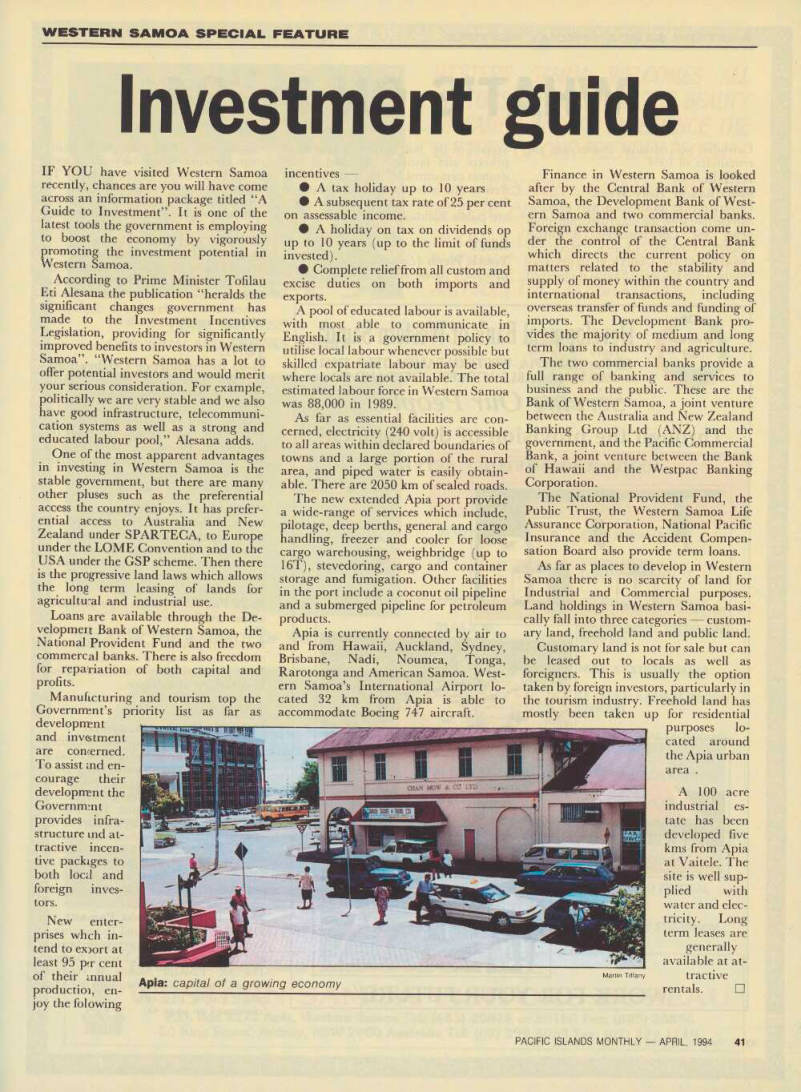
Apia: capital of a growing economy
Marlin Tiffany