Burning Bunge
pp. 60-61 · Read in the full issue
By Atama Raganivatu
FRANK BUNCE has his Niuean mother to thank for his elev ation, in just two short years, from an apparently just above average New Zealand provin cial player in the twilight of his career to one of the most respected and feared performers on the international rugby scene. The turning point came in 1990 when he, then aged 29, learnt that Western Samoan Rugby Union officials were in New Zealand to recruit well performed players with Samoan ancestry for their country’s historic World Cup
campaign the following year.
Bunce tentatively approached the of ficials and enquired if he qualified for consideration through his Niuean back ground. The reply was positive; after all Niue and Samoa have many finks cultural, geographical and political and, moreover, the former had no World Cup team of its own. Ironically, a later scrutiny of the Bunce family tree revealed that he had a Samoan maternal grand mother and was a distant cousin of Manu Samoa’s coach, Peter Schuster!
Bunce admits he had some trepidation about becoming involved with the West ern Samoan team. “I hadn’t had much to do with them and, at the time, many players were coming out of the wood work and claiming Samoan blood from about a million years ago. However, I knew most of the guys in the squad from New Zealand domestic rugby, had no concerns about the validity of my own heritage claims and was familiar with the rugby set up in Samoa having played sevens football there many times. I was accepted into the fold without any
problems.”
And so, Bunce was smoothly drafted for the Manu Samoa squad that toured New Zealand early in 1991 and played a major role in their epic adventure at the World Cup in Britain later that year.
He played in all four games and scored the try, against Argentina, which secured them a quarter final berth. While wearing the now famous blue jersey, Bunce proved himself as an exceptional exponent of the centre’s art. His ferocious tackling; deceptive pace; ruthless deter mination; fearlessness; capacity to create
and exploit openings; quicksilver
running and uncanny knack for being in the right place at the right time marked him as one of the tournament’s outstand
ing talents.
With Niuean and Samoan heritage, Frank Bunce the former Mam Samoa player prepares to don the silver fern for the 1995
Rugby World Cup.
While Bunce served Western Samoa with great distinction, Western Samoa served to completely resurrect Bunce’s career. Prior to his involvement with them, he had been known merely as a
reliable, but hardly distinguished, player
who had failed to fulfil his potential. 1986 saw him make his debut for the provin cial selection of home town Auckland, but five seasons were to pass before Bunce was presented with the blazer which commemorates 14 appearances. Auck land plays about 20 games each year.
Even though only playing sporadically
for the star-studded Auckland side, which could almost always boast of an international in every position during this period, Bunce was twice called upon for higher duties. He represented the North Island in its then annual fixture with the South Island in 1986 and featured in an All Blacks trial game two years later. In the former he was injured and, by his own admission, had “a shocker” in the latter. That appeared to destroy any chance he ever had of winning a New Zealand cap.
Like virtually every New Zealand born male, Bunce, one of a family of eight, had dreamed of playing for the All Blacks since the time he first handled a rugby ball. He joined the unfashionable Manukau club when seven years old and served them for 22 years; 13 as a loose forward before being converted to the centre position where his talents began to flourish. Educated at Mangere College, he was never chosen for its First XV.
It was the quest to gain a place in the Western Samoan World Cup team which made the loyal Bunce reluctance leave Manukau and Auckland. Informed by WSRU officials that he would have to become regularly involved in inter provincial fare if to be considered for a place in the party leaving for Britain, Bunce transferred to the Helensville club in the neighbouring North Harbour union. With Harbour, an excellent 1991 domestic season was enjoyed and a ticket
for the World Cup secured.
Despite his heroics with Manu Samoa, Bunce still harboured no thoughts of becoming an All Blacks when returning to Auckland after the World Cup and, indeed, it appeared for a time that his next career move would be a switch to
rugby league. Prominent Sydney club
Canterbury - Bankstown offered him a contract and, upon this becoming public, All Blacks selector Peter Thornburn rang Bunce to inform him that he was being considered for a place in the side to meet The World XV in the New Zealand Rugby Union’s Centenary Series sched uled for early 1992.
Bunce rejected Canterbury
Bankstown’s approach and duly lined up for his native country in all three games of the Centenary Series. He has subsequently become a cornerstone of the most consistent side in international rugby over the past two years. This consistency has made the All Blacks favourites for the 1995 World Cup.
Although now very much committed to the Kiwi’s cause, he reserves a special affection for Manu Samoa and acknowl edges their crucial role as a springboard to his current status.
“Of course my time with them was very important and enjoyable,” he reflects. “There is not nearly as much pressure playing for Manu Samoa as
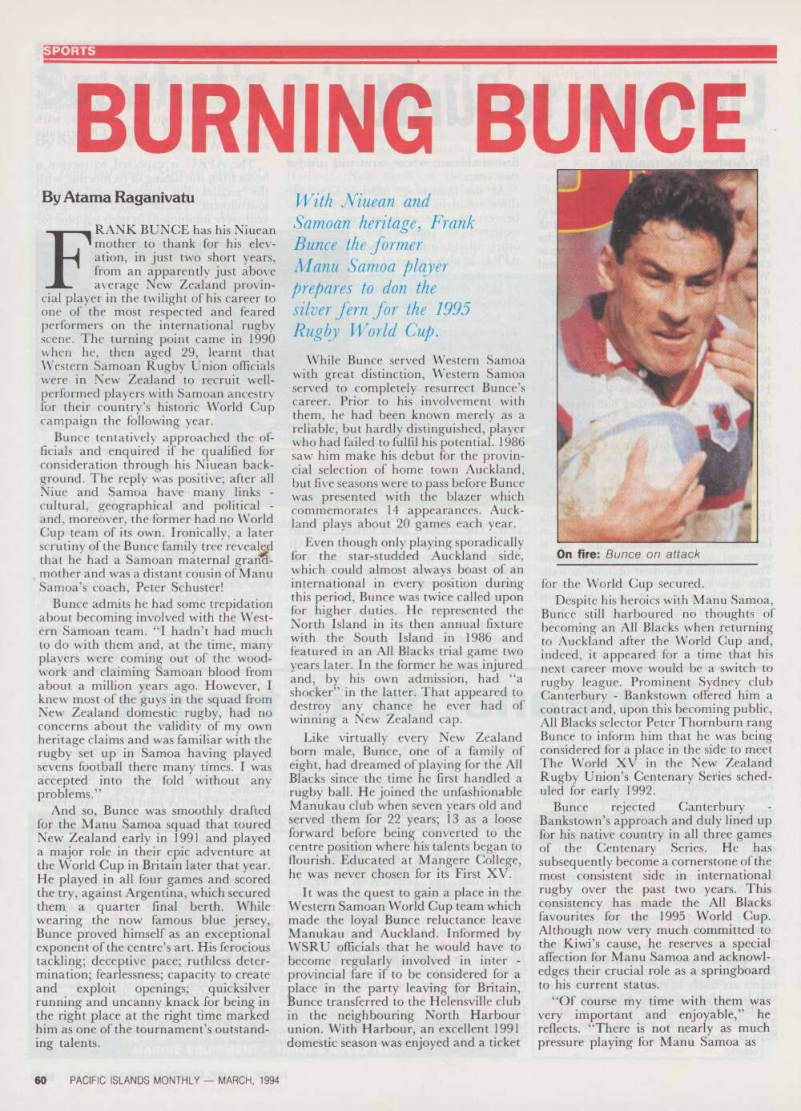
On fire: Bunce on attack
playing for the All Blacks. Playing for Samoa was a bit of a flag-waving exercise and wins were bonuses, but all New Zealanders expect the All Blacks to win every game. Even so, I was so nervous before the opening World Cup match against Wales that I forgot to tie up my boots and it was only when I was on the field that I noticed my laces were loose!
I certainly hope they go on to do well.”
Bunce’s sights are now firmly set upon the next World Cup. “The World Cup is very, very important. After winning the World Cup, you can still play badly for the next four years and call yourself World Champions until another team takes the Cup from you. My aim is to play on until the World Cup and then assess the situation.”
Even though he turned 33 on Febru ary 4, such is Bunce’s determination and fitness that only a major mishap seems
capable of preventing him from being
one of the tournament’s most influential
figures. □