So, what’s a ‘junk rig’
p. 58 · Read in the full issue
Yachting
By Sally Andrew
IN June last year, Michael and Judy Churchouse left Auckland, New Zea land, aboard Shantung a 31-foot Lidgard design with a Chinese junk rig. Her hull is built of three-skin kauri, a native New Zealand hardwood prime boat-building
material.
Shantung is equipped for an extended voyage north through the Solomons, Micronesia, and eventually to Japan and Alaska.
Michael and Judy have made several special modifi cations for short-handed long distance cruising. For example, self-steering is handled by a trim-tab ar rangement attached to both a windvane and a low powered Navico tillerpilot 5000. It has worked great even under extreme con ditions. A radar display unit can be slid. In this way, the display can - be seen by helmsperson in the cockpit.
Michael and Judy enjoyed
their first year of the Pacific Island cruising. After clearing in at Port Vila this season, Shantung sailed to Tanna, one of Vanuatu’s most visited outer islands and perhaps its most magical. Tanna’s Yasur Volcano smokes and bubble, hisses and rumbles, belches and spits. Tanna has a number of natural and cultural wonders fantastic beaches, blowholes,
hot springs, dugongs, frequent festivals
with dancing, pig-killings and feasting,
kastom villages and curious John Frum cargo cult. Yachties generally anchor near the volcano at Port Resolution, home of the Tanna Yacht Club, and receive a bigfela welkam.
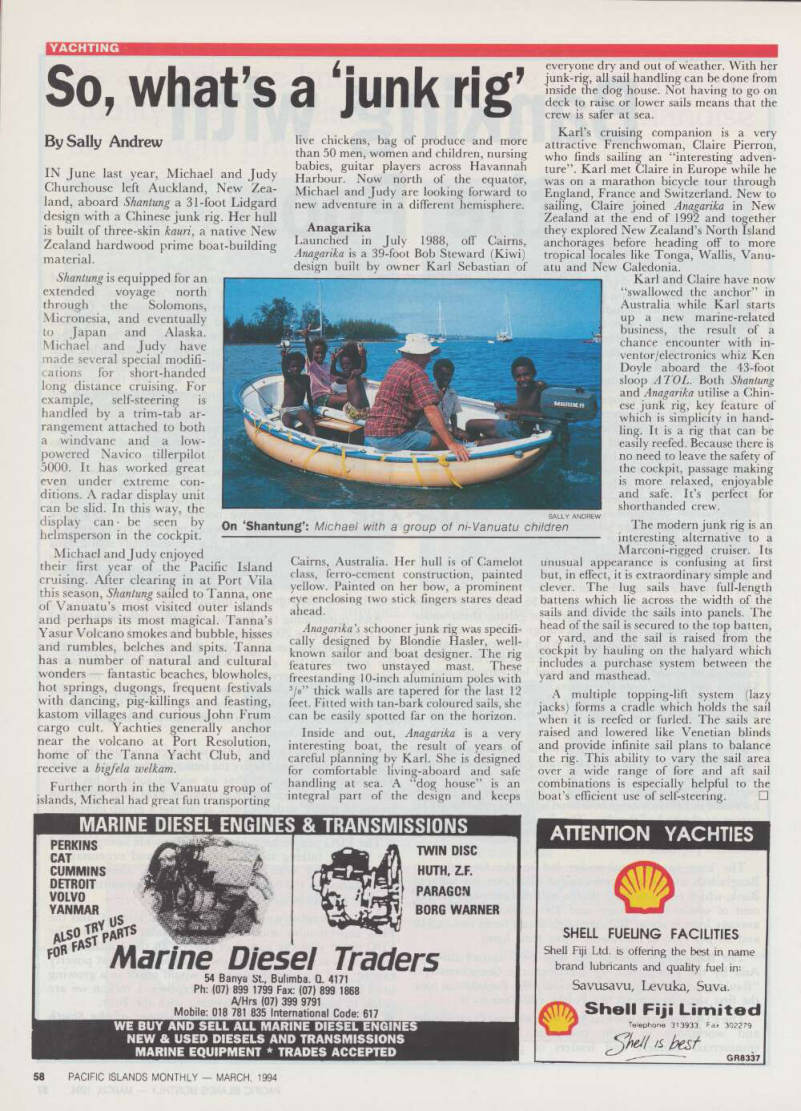
Further north in the Vanuatu group of islands, Micheal had great fun transporting
live chickens, bag of produce and more than 50 men, women and children, nursing babies, guitar players across Havannah Harbour. Now north of the equator, Michael and Judy are looking forward to new adventure in a different hemisphere.
Anagarika
Launched in July 1988, off Cairns, Anagarika is a 39-foot Bob Steward (Kiwi) design built by owner Karl Sebastian of
Cairns, Australia. Her hull is of Camelot class, ferro-cement construction, painted yellow. Painted on her bow, a prominent eye enclosing two stick fingers stares dead ahead.
Anaganka’s schooner junk rig was specifi
cally designed by Blondie Hasler, well known sailor and boat designer. The rig features two unstayed mast. These freestanding 10-inch aluminium poles with 3 1 s” thick walls are tapered for the last 12 feet. Fitted with tan-bark coloured sails, she can be easily spotted far on the horizon.
Inside and out, Anagarika is a very interesting boat, the result of years of careful planning by Karl. She is designed for comfortable living-aboard and safe handling at sea. A “dog house” is an integral part of the design and keeps
everyone dry and out of weather. With her junk-rig, all sail handling can be done from inside the dog house. Not having to go on deck to raise or lower sails means that the crew is safer at sea.
Karl’s cruising companion is a very attractive Frenchwoman, Claire Pierron, who finds sailing an “interesting adven ture”. Karl met Claire in Europe while he was on a marathon bicycle tour through England, France and Switzerland. New to
sailing, Claire joined Anagarika in New
Zealand at the end of 1992 and together they explored New Zealand’s North Island anchorages before heading off to more tropical locales like Tonga, Wallis, Vanu atu and New Caledonia.
Karl and Claire have now “swallowed the anchor” in Australia while Karl starts up a new marine-related business, the result of a chance encounter with in ventor/electronics whiz Ken Doyle aboard the 43-foot sloop ATOL. Both Shantung and Anagarika utilise a Chin
ese junk rig, key feature of
which is simplicity in hand ling. It is a rig that can be easily reefed. Because there is no need to leave the safety of the cockpit, passage making is more relaxed, enjoyable and safe. It’s perfect for shorthanded crew.
The modern junk rig is an interesting alternative to a Marconi-rigged cruiser. Its
unusual appearance is confusing at first but, in effect, it is extraordinary simple and clever. The lug sails have full-length battens which lie across the width of the sails and divide the sails into panels. The head of the sail is secured to the top batten, or yard, and the sail is raised from the cockpit by hauling on the halyard which includes a purchase system between the yard and masthead.
A multiple topping-lift system (lazy
jacks) forms a cradle which holds the sail when it is reefed or furled. The sails are raised and lowered like Venetian blinds and provide infinite sail plans to balance the rig. This ability to vary the sail area over a wide range of fore and aft sail combinations is especially helpful to the boat’s efficient use of self-steering. □
Sally Andrew
On ‘Shantung’: Michael with a group of ni-Vanuatu children