Copra:
pp. 51-55 · Read in the full issue
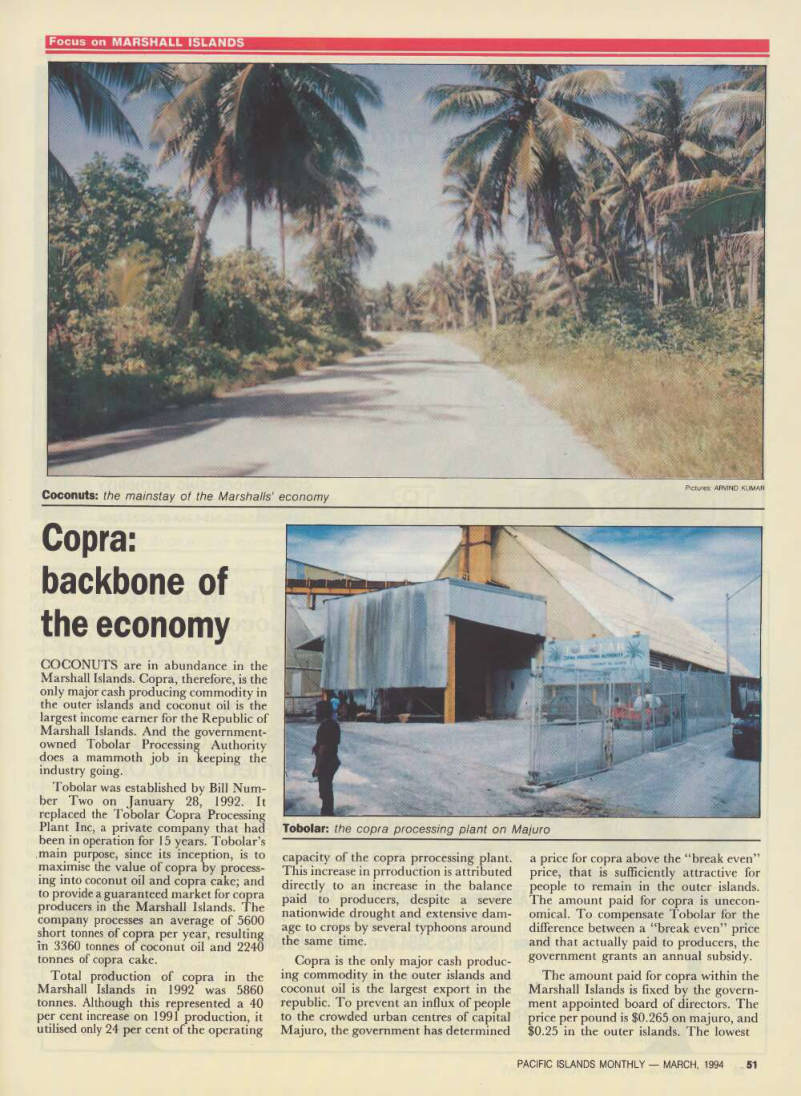

backbone of the economy
COCONUTS are in abundance in the Marshall Islands. Copra, therefore, is the only major cash producing commodity in the outer islands and coconut oil is the largest income earner for the Republic of Marshall Islands. And the government owned Tobolar Processing Authority does a mammoth job in keeping the
industry going.
Tobolar was established by Bill Num ber Two on January 28, 1992. It replaced the Tobolar Copra Processing Plant Inc, a private company that had been in operation for 15 years. Tobolar’s main purpose, since its inception, is to maximise the value of copra by process ing into coconut oil and copra cake; and to provide a guaranteed market for copra producers in the Marshall Islands. The company processes an average of 5600 short tonnes of copra per year, resulting in 3360 tonnes of coconut oil and 2240 tonnes of copra cake.
Total production of copra in the Marshall Islands in 1992 was 5860 tonnes. Although this represented a 40 per cent increase on 1991 production, it utilised only 24 per cent of the operating
capacity of the copra processing plant.
This increase in production is attributed directly to an increase in the balance P a id to producers, despite a severe •, r , >., r . • , nat ‘° nwlde drou g ht a " d extensive damage to cro P s several W 1100 " 8 a r°und ,he same tlmc ' Copra is the only major cash produci n g commodity in the outer islands and coconut oil is the largest export in the republic. To prevent an influx of people to the crowded urban centres of capital Majuro, the government has determined
a price for copra above the “break even” price, that is sufficiently attractive for people to remain in the outer islands.
The amount paid for copra is unecon -i-r . 4* , , c > omical. To compensate Tobolar for the difference between a “break even” price and that actual| y P Md to producers, the government grants an annual subsidy.
The amount paid for copra within the Marshall Islands is fixed by the govern ment appointed board of directors. The price per pound is 50.265 on majuro, and 50.25 in the outer islands. The lowest
Tobolar: the copra processing plant on Majuro
price paid to the outer islands is to offset the cost of freight. The world market price for copra is $0,125 per pound. For the year ended September 1992, two types of subsidy were paid by the Marshalls government. The first was an annual subsidy of US$BOO,OOO. The second was a special subsidy of US$3 million, granted in January 1992 to allow a significantly higher amount to pro ducers to stimulate and increase copra production in urban areas (price in creased from to 25£ per pound).
This reflects the government’s policy of encouraging people to move back to rural areas; thus reducing the strain on the infrastructure in the main population centres of Majuro and Ebeye and demand for imports. During its regular session in September 1992, the govern ment appropriated U 55756,000 for the basic subsidy. Of the 24 inhabited atolls and islands, 20 locations produced copra in 1991. Of the 23 producing communi ties, Tobolar received 80 per cent of its copra from only 10 locations.
Tobolar completed construction of a small batch soap factory in late 1991.
After initial trials and testing, this plant became fully operational in August 1992.
The plant produces body bar and pure soap based laundary powder for the domestic market. The soap produced is made from pure coconut oil, and as such it is 100 per cent environment friendly
and fully biodegradable. As the soap is made from pure coconut oil it is very gentle on the body; it does not strip the body of its natural oils and rejuvenates dry, damaged skin.
For fiscal year 1992 Tobolar had a net
earnings amountingto approximately
U 55682,184, decreasing the company’s deficit balance to U 55221,310. Line of credit at year end was US$BOO,OOO,
slightly higher than the previous year’s year-end balance of U 55785,940. The annual interest payment on the current line of credit came to U 5539,510 for 1992 (U 55142,513 for 1991).
Tobolar estimates that the total Marshall Islands copra production for 1993 will come to around 7000 short tonnes, provided there is no drop in the price paid for copra. The Marshall Islands is seeking assistance to fund a
Pictures: ARVIND KUMAR
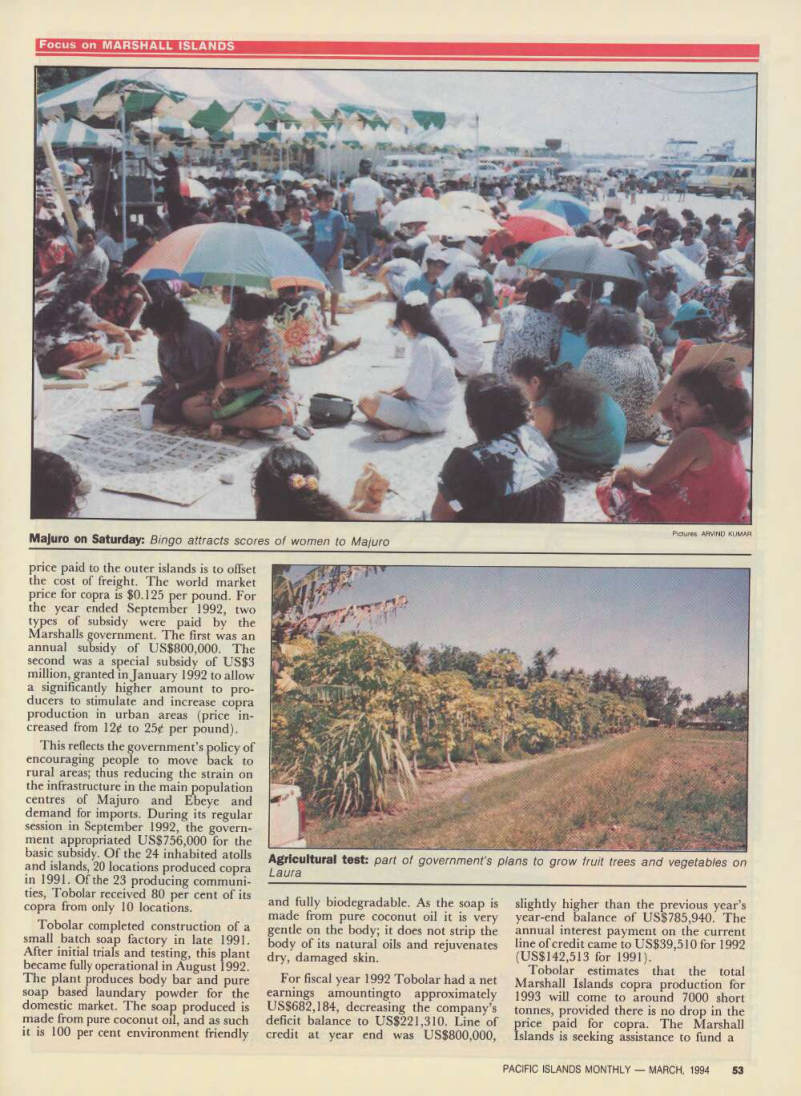
Majuro on Saturday: Bingo attracts scores of women to Majuro
Agricultural test: part of government’s plans to grow fruit trees and vegetables on Laura
massive rehabilitation of the republic’s copra industry. Equipment assistance (such as a landing craft, bulldozers,
chipping machinery, and other heavy
machinery) is needed to clear old, senile trees, plant new coconut trees and clear uncontrolled undergrowth.
Rehabilitation of plantations is not only required to improve copra pro duction but is essential to allow inter cropping of food crops to decrease reliance on imported foods. Assistance is also required to improve harvesting and drying techniques to make the pro duction of copra easier and more efficient. Coconut oil sales make up over 90 per cent of the revenue from process ing of copra in the Marshalls.
Coconut oil prices in early 1992 were at 33 j per pound but current price is per pound, representing a drop of over 42 per cent. The Marshalls produces and exports less than 0.002 per cent of the world’s demand for coconut oil; therefore Tqbolar is subjected to market fluctu ations with limited market for its crude oil. To insulate the copra industry from world market fluctuations alternative uses and markets for oil and other products must be found, says a report on Tobolar.
The Tobolar pilot soap plant in operation was designed to target this need to find value added alternative uses for the oil. The existing pilot plant is designed to service the local market, with target production of 200 tonnes of soap
annually but utilises only about six per cent of annual oil production. Based on the performance of the existing plant, a feasibility study has been conducted into installing a soap plant that would utilise all of the oil produced, producing a product for the export market.
The study shows that such a plant would be feasible; being self supporting and providing sufficient income to guarantee a stable price to copra producers without the need for government subsidies. The next
stage of the study will be to conduct market research in the United States and japan being principal markets so far identified, for which financial assistance will be required.
The results of this research will deter mine whether to proceed and at what level of activity. In addition to soap, other oil based products are being researched in an attempt to find other markets for oil
{moduced, together with other products
fom the coconut tree (ie. canned coconut milk), often described as “The Tree of Life”. □
Pictures: ARVIND KUMAR Eastern Gateway Hotel: one of the biggest hotels on Majuro expected to be completed by August next year
Poultry: another project by the government