Marshalls magic
pp. 43-45 · Read in the full issue

Focus On Marshall Islands
LIFE in the Marshall Islands has its own pace one that harmonises, rather than conflicts, with nature.
And it is this harmony that makes Marshalls such a spe cial place to visit. Sandy beaches ringed with coconut
laden palm trees, crystal
clear lagoons teeming with
tropical fish, giant turtles,
colourful coral, warm,
friendly people eager to
share with you the rewards of an uncomplicated, tra ditional island lifestyle ...
This can be the experience awaiting you at one of the outer atolls in the Marshalls.
Coupled with a visit to Majuro, the westernised capital, your vacation is the republic is sure to be an unforgetful one. The Mar shalls is eager to show off its two greatest natural re sources miles and miles of
turquoise-hued lagoons and
all that goes with them, and people who are some of the
friendliest, most hospitable
people you’ll encounter in
your travels around the world.
Its lagoons are the Mar shalls’ most prized pos
sessions. Whether on Majuro or on the outer atolls, the lagoons and the ocean offer snorkeling, scuba diving, gamefishing and sailing. But whatever your choice, the opportunities are limitless. ome countries encourage their citizens to be friendly to tourists. But the Marshallese are sincerely warm, friendly an giving.
Majuro has several modern hotels and
reasonably-price accommodation wityh
appeals to the average tourist who does not want to spend a fortune. Latest model rental cars and taxis are also available. In fact, one of the first things a visitor to Majuro notes is the number of modem vehicles in a place of its size.
Majuro also boasts the longest paved
road in Micronesia — stretching 30 miles from Rita, a bustling residential area at one end, to Laura, the rural/agricultural end of the island with wide, white, sandy beaches. Laura is ideal for picnics, swimming and snorkeling. Rita and Laura named by US servicemen urmg Wor d War 11.
The history of Marshall Islands actu-
ally begins millions of years ago when
powerful volcanoes pushed upward from
the ocean floor, creating volcanic islands high above sea level. Over the course of thousands of years, these islands slowly sank back into the sea. But by the, living coral had begun growing around the islands, creating colourful coral reefs,
protected azure lagoons and, ultimately,
low, hat islands made out of broken coral that form the “string of pearls” appear ance of the atolls.
The Marshall Islands were first be ii ev ed to have been settled somet^L 0 B .C when determined Voyagers journeyed into Micronesia in sturdy canoes. In the 16th Century Spanish navigators were the first in a long series Q f visits by foreigners. Later, Russian navigators visited the islands extensivelv It w S as the 18th Century when John Marshall, a British naval explorer, “rediscovered” and named the islands.
Marshall had just taken British prisoners to Australia and was on his way to China to trade goods wheen he came upon Mili Atoll.
In the late 1800 s, European traders became involved in the Marshalls, set ting up shop on Jaluit Atoll. In 1885, Germany annexed the islands, establishinh a protectorate relationship.
German influence continued until the e nd of World War 1 when, under a League of Nations mandate, the Japan, ese administered the islands, again from T a J u i t Atoll During World War 11, both Japanese and American forces used the islands strategically. By the end of WWII, island
administration had again changed
hands, with the US taking over. Ameri can efforts were concentrated on Majuro and Kwajalein islands. The US con tinued to administrate for four decades under the United Nations Trusteeship Agreement. Independence for the Mar shalls arrived in two steps a sovereign government was established May 1, 1979, and in 1986, the Compact of Free Association took effect, giving indepen dent nation status to the Republic of Marshall Islands along with a close
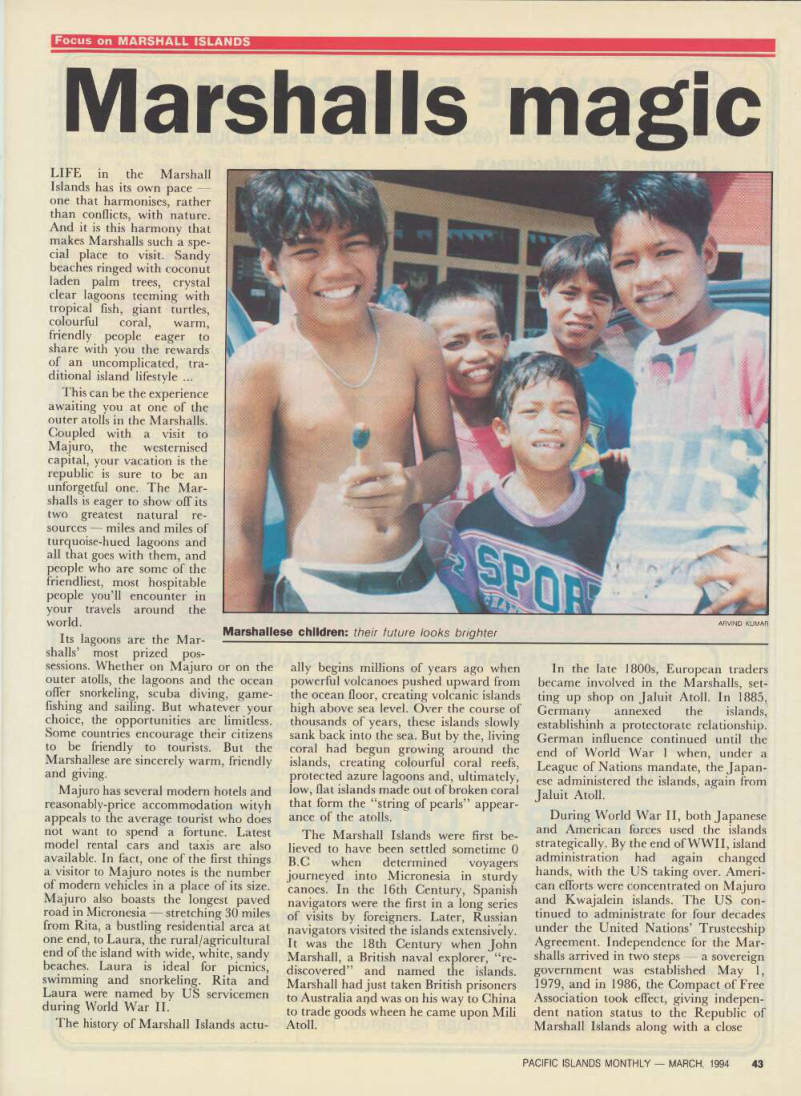
Arvind Kumar
Marshallese children: their future looks brighter
continuing relationship with the US.
Today, the Marshall Islands has a
unique peacetime significance due to
both its strategic location and the US missile testing base on Kwajalein Atoll.
The country also bears painful memories of mankind’s propensity to war. Nuclear testing carried out on Bikini and Enewetak Atolls unwittingly harmed both people and islands. It is a lesson in history that must not be forgotten.
The people of the Republic of Marshall Islands today are proud be be a stable, self governing democracy that is moving into a bright future with economic potential.
The Marshall Islands consists of two parallel chains of atolls, roughly 800 miles long from north to south. The eastern chain is called Ratak, meaning sunrise, and the western one is Ralik, or sunset.
Kwajalein Atoll - Largest atoll in the world, it is home to the US missile testing base. Missiles are launched into the Kwajalein lagoon from the US West Coast and tracked by military engineers on Kwajalein Island. Two islands away is Ebeye, home to the Marshallese employed at the base.
Bikini Atoll Site of atomic and hydrogen test bombings in the late 1940 s and 19505. Bikinians still hope to resettle their atoll with US assistance. Bikini lagoon has many American and Japanese target ships still intact. □