The South Pacific Alliance for Family Health or SPAFH is a Regional non-
pp. 31-33 · Read in the full issue
Govemment, non Profit organization whose primary objective is the promotion of Family Planning and Population activities in its member countries namely the Cook Islands, Fiji, Kiribati, Papua New Guinea, Solomon Islands, Vanuatu, Tonga, Tuvalu, Niue and Western Samoa.
These Island Nations are scattered over the vast Pacific Ocean with different ethnicity, tradition and cultures. Each nation falls into one of the three ethnic groups Melanesian, Polynesian and Micronesian. The absolute size of their populations are not large by world standards ranging from less than 3,000 in Niue to almost 3.8 million in Papua New Guinea. But because of the relatively high fertility, rapid population growth is one of the major factors hindering the development or these countries from a socio-economic point of view.
In 1985 there were a few population programmes in the South Pacific region. Although the U.N.F.P.A was providing funding to the Governments of the Island nations, much of this funding was returned unspent.
A review sponsored by U.S.A.I.D revealed that fertility was high and the continued population growth was seriously threatening the nations. It also revealed the need for developing Indigenous capacity in Family Planning rather than relying on long term continuing inputs from expatriates.
The concept of developing an Indigenous Regional Family Planning institution was formulated by U.S.A.I.D and was supported by donors such as U.N.F.P.A. and W.H.0., as well as by the Governments of the region.
SPAFH was incorporated in Tonga in 1986 with a Formal Charter and By-Laws. It became operational in 1987.
Its Board of Directors consists of Senior Health Officials from its ten member countries.
SPAFH’s mission statement is “COMMUNITY HEALTH AND WELL BEING IS OUR NUMBER ONE
Concern”
Since its inception, our organization has been funded by the United States Agency for International Development (U.S.A.I.D) which has provided us with varying amounts of funding the principal one being an amount of US$l.9 million for phase one which ran from September 1 1990 to September 31 1993, and Phase II (U 551,214 million) from 1 October 1993 1 October 1995.
However, the organization was given a big boost to its activities with the approval of Project EXCEL (Expanding Country Efforts at All Levels) in 1992 which provided a sum of U 553,285 million for five years from July 1 1992.
This was to promote Social Marketing of Contraceptives and Improve family planning service provision in the countries of Fiji, The Solomon Islands, Tonga and Vanuatu. Of the US $3,285 million, the Australian International Development Assistance Bureau (A.1.D.A.8.) is to provide U 552,613 million while U.S.A.I.D. is to provide US $0,672 million through two American organization; S.E.A.T.S. (Service Expansion and Technical Support), and SOMARC (Social Marketing for Change II).
Other organization which have assisted in the past are: The Overseas Development Administration of the U.K., The U.N.F.P.A. The Republic of China and The Papua New Guinea Government.
SPAFH is recognised by both the International organizations in the region as well as Member countries and it has been acknowledged by the major donors as a channel of funds to provide service in family planning to the countries concerned. Our organization enjoys a good working relationship with Government and Non-Government organizations in the Countries.
SPAFH has demonstrated its potential to help meet the critical family planning challenges in the region. Its major strengths are an increasingly active and committed Board comprising ranking officials of the member countries, installation of viable management and operation systems, growing recognition as a major player in the family planning field, an impressive amount of programming given the emphasis of Phase one on institutional development, the ability to respond rapidly to regional needs, adherence to its implementation objective as expressed by the Benchmarks and its significant contributions to family planning expertise in the region.
Significant not only because of its joint sponsorship by A.1.D.A.8. and U.S.A.I.D and to the tune of U 553,235 million over five years, but also it is the beginning of activities which will help further strengthen and compliment the efforts of others in expanding family planning in the region.
The Secretariat
The Secretariat is headed by the Secretary General. Others are divided as technical and support staff. The Secretariat is responsible for the implementation of the organizations programmes and activities. As of December 1992, SPAFH’s manpower consisted; Secretary General, five Senior Project Officers (SPO’s), one Accountant, one Accounts Clerk, one Administrative Officer, one Secretary, one Steno/Typist and one Driver.
Recently under Project EXCEL, an Australian Resident Advisor for the organization was appointed with funding from AIDAB. The organizations functions are also assisted through the services of part time consultants, for example in computing and accountancy.
The Regional Office of the Secretariat is located in Nuku’alofa in the Kingdom of Tonga. The technical staff are recruited from the region while the general support staff are recruited locally. Because SPAFH is relatively a small and a young organization, and the fact that its mandate is fairly specific at this stage, the total of staff is quite small.
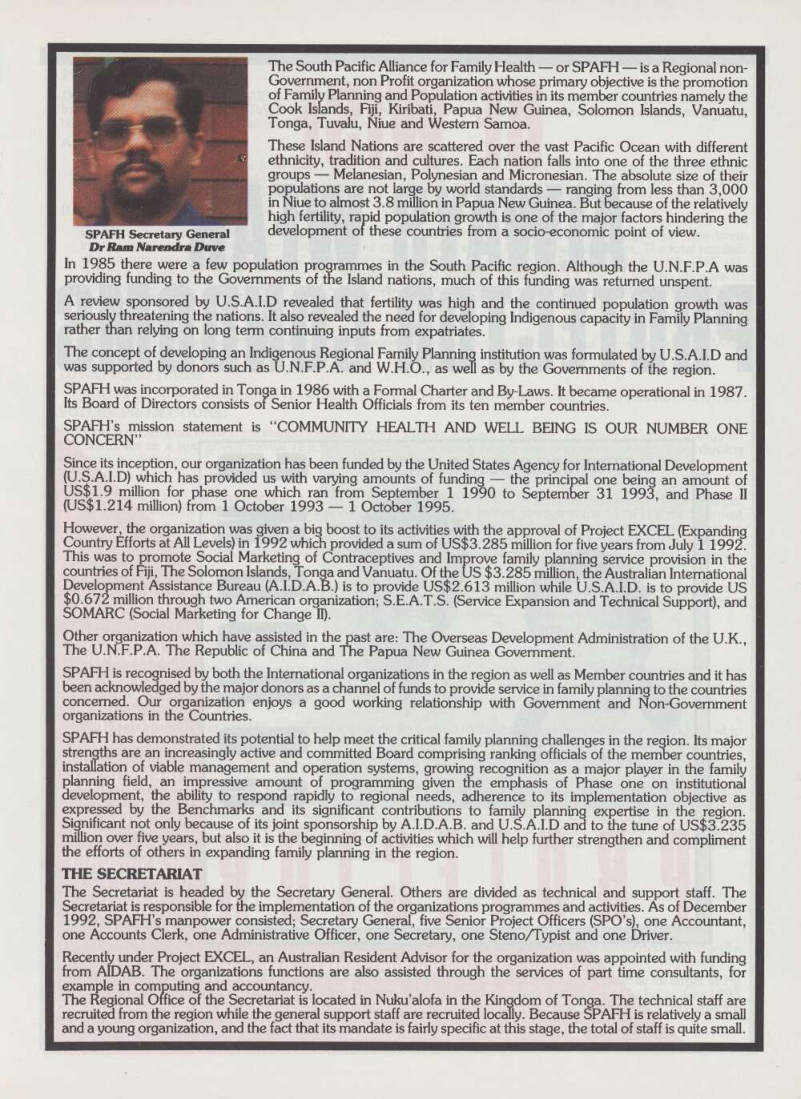
SPAFH Secretary General Dr Ram Narendra Duve
Project Activities:
During the first phase of the USAID Cooperative Agreement, the focus in the organization has primarily been one of Institution building. In addition, SPAFH over the years, has been involved in the implementation of both in country and regional activities. These activities are summarized below: A. National Population Policies With SPAFH’s assistance, the following countries have now adopted official population policies; Solomon Islands (1.9.88) and Papua New Guinea (1991). Vanuatu and Western Samoa are currently formulating their policies. In Kiribati activities of a National Population Policy Committee is being reactivated through SPAFH’s assistance.
B. Family Planning Service Delivery Contraceptive Supply Management and lEC Activities. A number of in country and regional projects have been implemented in the area of service delivery and the contraceptive supply management activities. The total number of in country grants made so far is 32 and distributed as follows: Cook Islands (2), Fiji (4), Kiribati (2), PNG (4), Solomon Islands (6), Tonga (3), Tuvalu (1), Vanuatu (5), and Western Samoa (4). Of the 32 grants, 26 were to Governments and 6 to Non Government Organizations. The distribution of grants by activities were: Traininq/ Workshops (63.1%) lEC (15.12%), Population Policy (20.12%) KAP Survey (1.7%).
C. Regional Activities A total of 14 regional activities, mainly regional workshops have been either conducted or supported by SPAFH during the period 1988 92 giving an average of 2.4 per year.
D. Non USAID Projects Non USAID Projects implemented came from UNFPA, ODA (UK), AIDAB (Aust) and the Norman Kirk Fund (NZ).
Future Projections:
With the achievements in the organization to-date, SPAFH’s future appears promising. However to further strengthen its capabilities as a non governmental regional organization in family health and population sector, the following strategies are listed:— A. 1993: 1993 was the last year of phase one (1/9/90 31/9/93) of the USAID Co-operative Agreement Project. As per per Agreement, the main emphasis should continue to be one of further strengthening SPAFH’s management capabilities as a regional Institution. 1993 has also seen this primary focus shifting more towards greater efforts in the implementation of more family planning activities in the member countries. Project implementation, subject to availability of funding, will continue to be the main emphasis of the second phase of the USAID Cooperative Agreement Project.
The approval of Project EXCEL (1992 1997) by AIDAB and USAID, will not only provide more funds and resources to SPAFH, but will also provide the necessary impetus in the further development of project strategies outlined in the joint agreement with this two important funding bodies.
B. 1994 and Beyond 1. Phase II of USAID Cooperative Agreement Project would become operational.
Project EXCEL activities will become the major focus of activities of the organization. Most of the regional training activities planned under the USAID Cooperative Agreement Phase 1 will be completed by 1993, hence there would be greater emphasis on in country projects in family planning service delivery, contraceptive social marketinq and lEC activities between 1994 1997. a 3. It is also essential that SPAFH continues to build on its present footing and continues to strengthen relationship with other international and regional organizations and donors. This is necessary in that it would not only become more effective in delivering the goods it is mandated to deliver, but it will enjoy the international and regional recognition it duly deserves. 4. There were mixed responses to the formation of SPAFH. Some saw it as a competitor while others welcomed it on the grounds that it would lead to the building up of indigenous capabilities in population and family planning sectors in the South Pacific region. However, with the adoption of an open-policy attitude and its willingness and interest to welcome close collaboration with other regional and international agencies in the disciplines of family health and population issues, SPAFH is presently recognised as an important regional organization in population and family planning activities in the South Pacific.
Collaboration The organisation collaborates with other regional/intemational organizations in the promotion of family planning/ population activities in the South Pacific. These agencies include: UNFPA, SPC and IPPF.
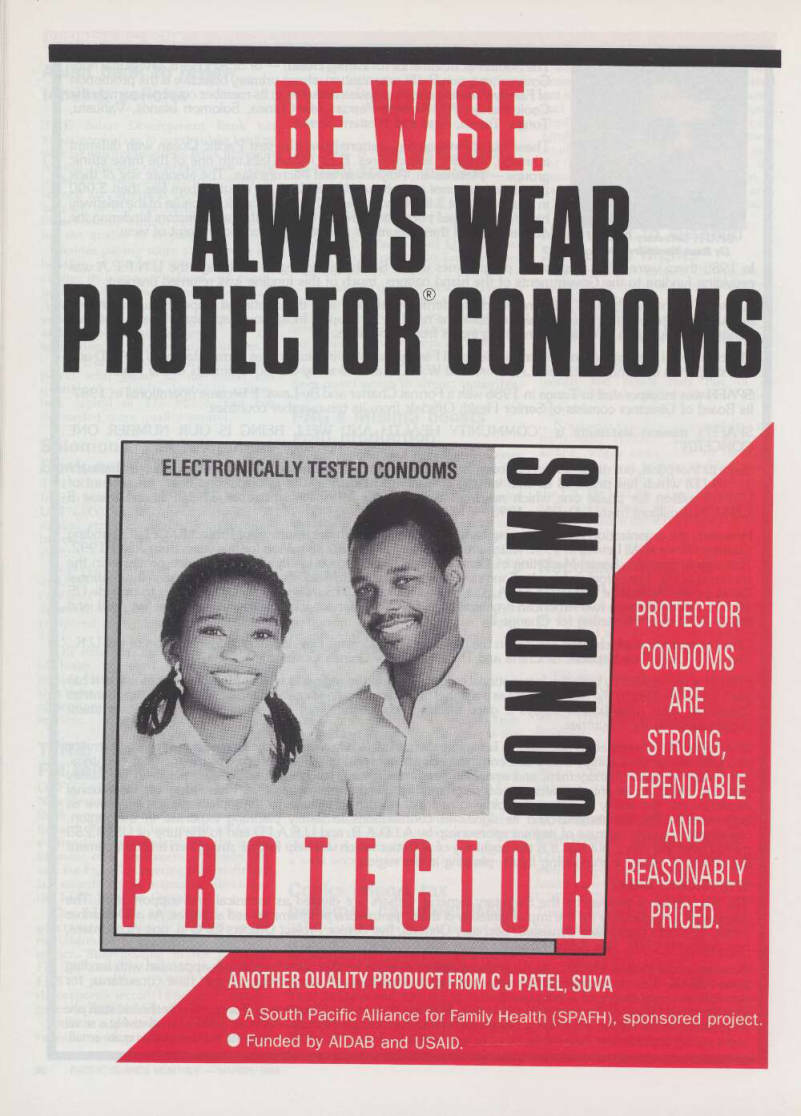
Social Marketing of Contraceptive One of the major components of Project EXCEL is the Social Marketing of contraceptive programme designed to make Condom and pills more readily available, accessible and affordable in Fiji, Tonga, Vanuatu and Solomon Islands.
The target for sale of PROTECTOR condoms in the first year is 525,000 in the four countries while its target in Fiji is 367,000/year which is about 30,625 condoms/months. The Protector condom was launched in Fiji in July 1993 and so far the sales have averaged about 34,000/month (above target), and very encouraging. Protector condoms are expected to be launched in SI, Vanuatu and Tonga early in 1994.