Stormy seas
p. 22 · Read in the full issue
New Caledonia
Stormy seas for new ferry
FOR many years, the choice offered to New Caledonians and tourists to travel from Noumea to The Loyalty Islands (Lifou, Mare and Ouvea) was very simple they could take a plane, or boat. Flying was fast, but expensive, and getting a ticket was difficult during peak periods. Sailing (on old coasters) was cheaper, but very long and uncom fortable. The same choice applied to the transportation of goods.
The launching, on January 6, 1994 of the ferry President-Teiwene was therefore seen by many Loyalty Islanders as a turning point in their daily life. It’s also a major investment made by the pro independence Loyalty Islands Province, through its Societe de Development des lies Loyaute (SODIL), and the Societe Maritime des lies Loyaute (SMIL), in charge of the management of the ship, to make its population less isolated and to encourage tourism.
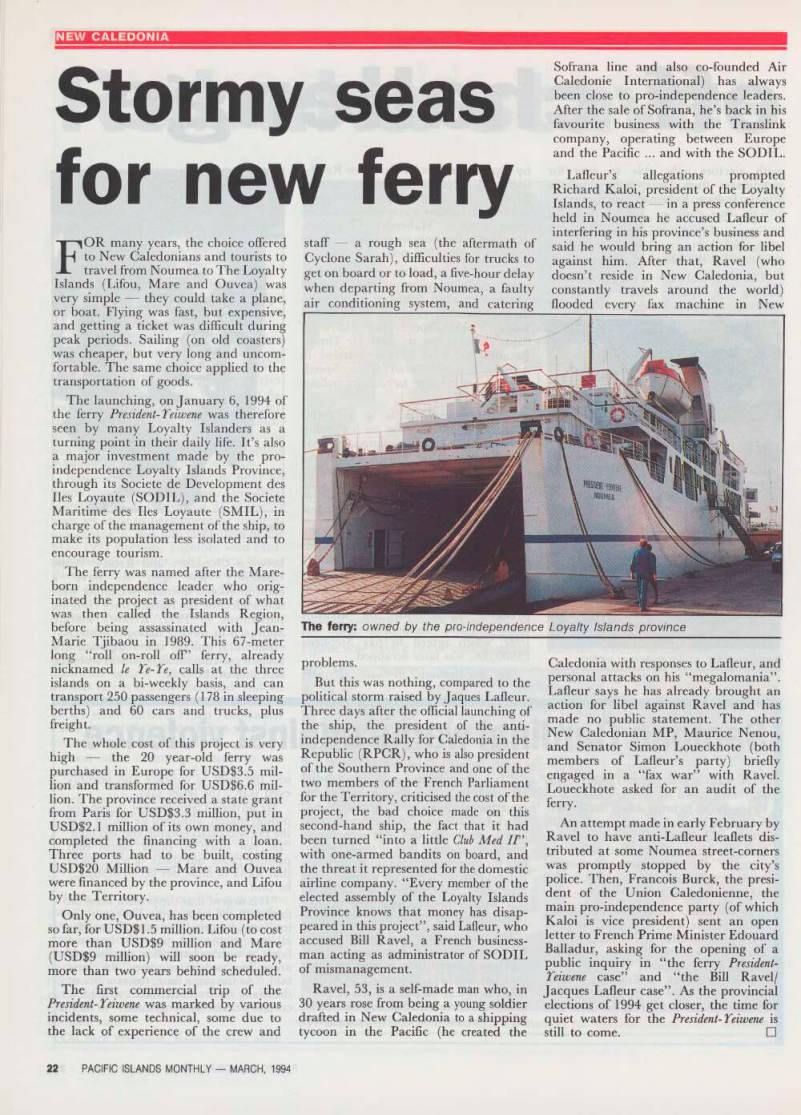
The ferry was named after the Mare born independence leader who orig inated the project as president of what was then called the Islands Region, before being assassinated with Jean- Marie Tjibaou in 1989. This 67-meter long “roll on-roll off’ ferry, already nicknamed le Ye-Ye, calls at the three islands on a bi-weekly basis, and can transport 250 passengers (178 in sleeping berths) and 60 cars and trucks, plus freight.
The whole cost of this project is very high the 20 year-old ferry was purchased in Europe for USDS3.S mil lion and transformed for USDS6.6 mil lion. The province received a state grant from Paris for USDS3.3 million, put in USDS2.I million of its own money, and completed the financing with a loan.
Three ports had to be built, costing USDS2O Million Mare and Ouvea were financed by the province, and Lifou by the Territory.
Only one, Ouvea, has been completed so far, for USDS 1.5 million. Lifou (to cost more than USDS9 million and Mare (USDS9 million) will soon be ready, more than two years behind scheduled.
The first commercial trip of the President- Yeiwene was marked by various incidents, some technical, some due to the lack of experience of the crew and
staff a rough sea (the aftermath of Cyclone Sarah), difficulties for trucks to get on board or to load, a five-hour delay when departing from Noumea, a faulty air conditioning system, and catering
Sofrana line and also co-founded Air
Caledonie International) has always
been close to pro-independence leaders.
After the sale of Sofrana, he’s back in his favourite business with the Translink
company, operating between Europe
and the Pacific ... and with the SODIL.
Lafleur’s allegations prompted
Richard Kaloi, president of the Loyalty Islands, to react in a press conference held in Noumea he accused Lafleur of interfering in his province’s business and said he would bring an action for libel against him. After that, Ravel (who doesn’t reside in New Caledonia, but constantly travels around the world) flooded every fax machine in New
problems.
But this was nothing, compared to the
political storm raised by Jaques Lafleur.
Three days after the official launching of the ship, the president of the anti independence Rally for Caledonia in the
Republic (RPCR), who is also president
of the Southern Province and one of the two members of the French Parliament for the Territory, criticised the cost of the project, the bad choice made on this second-hand ship, the fact that it had been turned “into a little Club Med 77”, with one-armed bandits on board, and the threat it represented for the domestic airline company. “Every member of the elected assembly of the Loyalty Islands Province knows that money has disap peared in this project”, said Lafleur, who accused Bill Ravel, a French business man acting as administrator of SODIL
of mismanagement.
Ravel, 53, is a self-made man who, in 30 years rose from being a young soldier drafted in New Caledonia to a shipping tycoon in the Pacific (he created the
Caledonia with responses to Lafleur, and personal attacks on his “megalomania”.
Lafleur says he has already brought an action for libel against Ravel and has made no public statement. The other New Caledonian MP, Maurice Nenou, and Senator Simon Loueckhote (both members of Lafleur’s party) briefly engaged in a “fax war” with Ravel.
Loueckhote asked for an audit of the
ferry.
An attempt made in early February by Ravel to have anti-Lafleur leaflets dis tributed at some Noumea street-corners
was promptly stopped by the city’s
police. Then, Francois Burck, the presi dent of the Union Caledonienne, the main pro-independence party (of which Kaloi is vice president) sent an open letter to French Prime Minister Edouard Bahadur, asking for the opening of a
public inquiry in “the ferry President-
Teiwene case” and “the Bill Ravel/ Jacques Lafleur case”. As the provincial elections of 1994 get closer, the time for quiet waters for the President- Teiwene is still to come. □
The ferry: owned by the pro-independence Loyalty Islands province