Rabuka staves off chslenge
pp. 20-21 · Read in the full issue
Politics — Fiji
Politics Fiji
Prime Minister wins a torrid battle for Fijian leadership
By Arvind Kumar
SITIVENI Rabuka, returned as Fiji’s prime minister following a snap general election on February 18-25, has promised greater racial harmony in his new-look, leaner government. Rabuka’s Soqosoqo ni Vakavulewa ni Taukei Party (SVT) fought off a challenge from the rival indigenous Fijian party, the Fijian As sociation, formed by former SVT dissi dents who caused the fall of the Rabuka government last November by voting against the 1994 budget; thus prompting Rabuka to call for a snap election.
However, Rabuka failed to fulfil his prediction of an increased majority.
Rabuka’s SVT Party won 31 of the 37 seats set aside in parliament for indigen ous Fijians just one more than at the May 1992 election. Together with exist ing coalition partner, the General Voters Party, and two independents, Rabuka looks set to hold 37 seats in the 70-seat parliament exactly the same majority as his previous government.
Rabuka’s main rival for prime ministership, former deputy prime min ister Josevata Kamikamica, who led the dissidents against the 1994 budget, lost his seat in the heavily-contested Tailevu Fijian Provincial constituency. Kamika mica’s newly-formed Fijian Association Party contested 25 of the Fijian seats but managed to secure only five.
Soon after claiming victory in the capital on the night of February 26, Rabuka, leader of two military coups which ousted the democratically elected Indian-dominated government of Dr Timoci Bavadra in 1987, hinted at plans for a government of national unity by bringing Indians into government. But that would be finalised after meetings of his SVT Party, he said.
Rabuka, who had mooted a govern ment of national unity just a few months into office after the 1992 election, said it was very satisfying to know that people had confidence in his leadership and the party. “We were interrupted in our efforts on a concept of a government of national unity and now we have a clear chance to continue with the work,”
Rabuka said.
On race relations, Rabuka said after
the coups of 1987, indigenous Fijians and Indians, descendants of indentured labourers brought to work sugar plantations more than 100 years ago, now had a better understanding of each other.
Indians comprise almost 50 per cent of the total population. “Indians and Fijians now have a better understanding
of each other after the coups and this augurs well for the future.”
Under Fiji’s con stitution, the presi dent must appoint as prime minister the person he judges to have majority sup port among MPs.
When this edition of PIM went to press at about 2pm on Febru ary 27, Rabuka had not been officially appointed to con tinue as prime minis ter by President Ratu Sir Kamisese Mara.
“It’s very satisfy
ing and comforting
to know people still have confidence in the party,” said Mr
Rabuka as he sat cross-legged at his home, drinking kava with supporters on the night of the election victory.
For the SVT, its only major loss was that of deputy prime minister Filipe Bole, who lost his seat to a Fijian Association candidate. “It’s a big blow for us,” said Rabuka. Voting in Fiji is on racial lines,
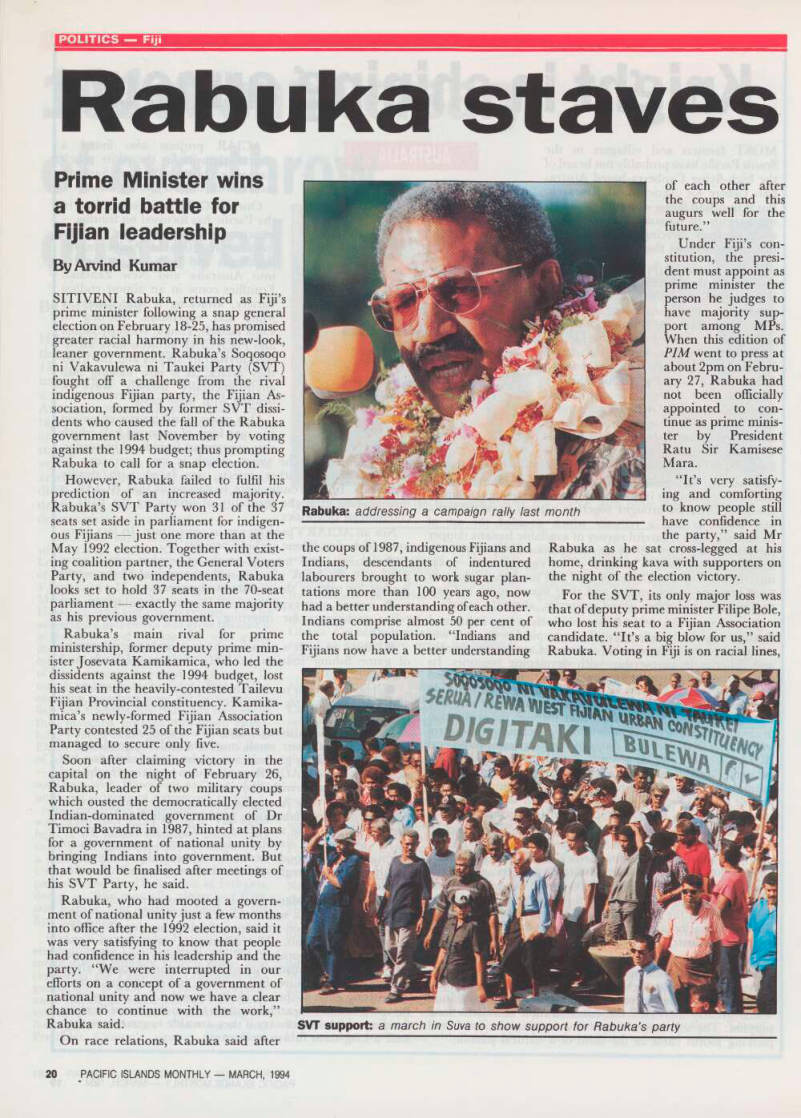
Rabuka: addressing a campaign rally last month
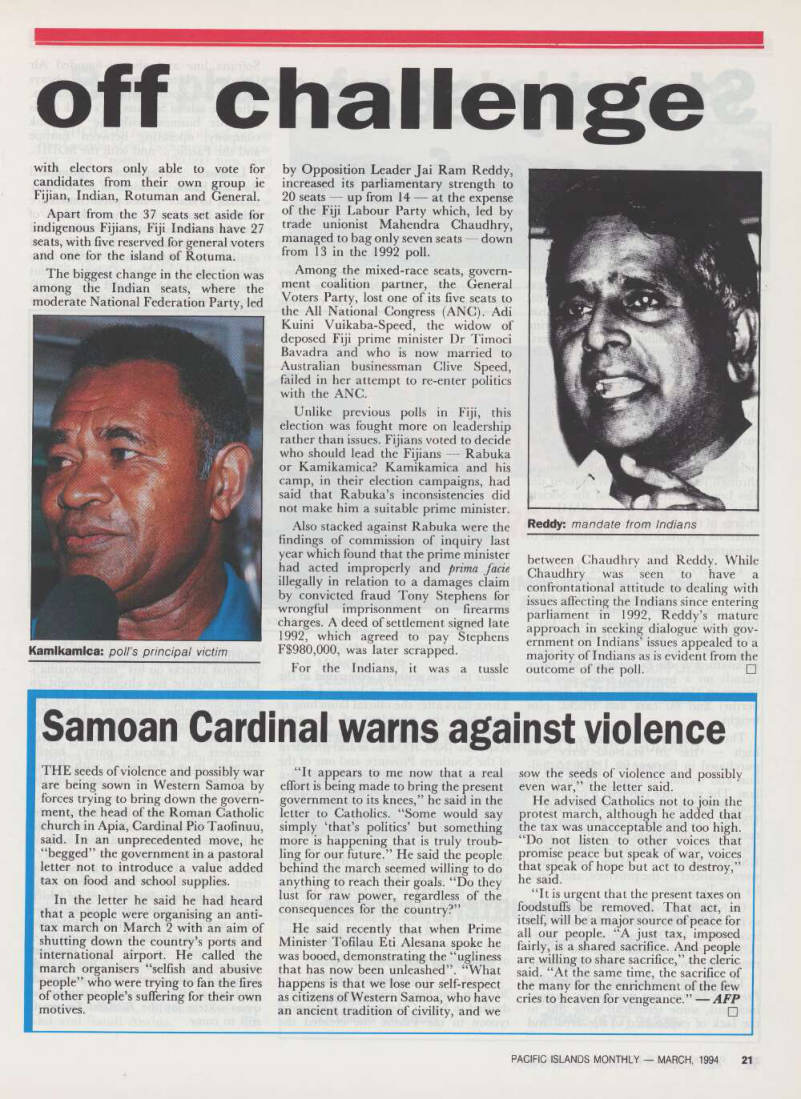
SVT support: a march in Suva to show support for Rabuka’s party
with electors only able to vote for candidates from their own group ie Fijian, Indian, Rotuman and General.
Apart from the 37 seats set aside for indigenous Fijians, Fiji Indians have 27 seats, with five reserved for general voters and one for the island of Rotuma.
The biggest change in the election was among the Indian seats, where the moderate National Federation Party, led
by Opposition Leader Jai Ram Reddy, increased its parliamentary strength to 20 seats up from 14 at the expense of the Fiji Labour Party which, led by trade unionist Mahendra Chaudhry, managed to bag only seven seats down from 13 in the 1992 poll.
Among the mixed-race seats, govern ment coalition partner, the General Voters Party, lost one of its five seats to the All National Congress (ANC). Adi Kuini Vuikaba-Speed, the widow of deposed Fiji prime minister Dr Timoci Bavadra and who is now married to Australian businessman Clive Speed, failed in her attempt to re-enter politics with the ANC.
Unlike previous polls in Fiji, this election was fought more on leadership rather than issues. Fijians voted to decide who should lead the Fijians Rabuka or Kamikamica? Kamikamica and his camp, in their election campaigns, had said that Rabuka’s inconsistencies did not make him a suitable prime minister.
Also stacked against Rabuka were the findings of commission of inquiry last year which found that the prime minister had acted improperly and prima facie illegally in relation to a damages claim by convicted fraud Tony Stephens for wrongful imprisonment on firearms charges. A deed of settlement signed late 1992, which agreed to pay Stephens F 5980,000, was later scrapped.
For the Indians, it was a tussle
between Chaudhry and Reddy. While Chaudhry was seen to have a confrontational attitude to dealing with issues affecting the Indians since entering parliament in 1992, Reddy’s mature
approach in seeking dialogue with gov
ernment on Indians’ issues appealed to a majority of Indians as is evident from the outcome of the poll. □
Kamlkamlca: poll's principal victim
Reddy: mandate from Indians