Faaa zooms ahead
p. 54 · Read in the full issue
Sport
By Ed Rampell
THE Faaa Canoe Club of Tahiti is emerging as the best outrigger team in the world with a series of record breaking triumphs. In one year, Faaa won Tahiti’s first international canoe competition Hawaiki Nui Va’a, November 12-14, 1992. October 10, 1993, Faaa became the first Tahitian team since 1976 to win Hawaii’s renowned Molokai Hoe race.
And November 13, 1993, Faaa went on to win the “Triple Crown” of canoeing by finishing first again in the second Hawaiki Nui Va’a.
In addition to placing first, Faaa has set new records. The crew’s four-hour, 55 minute, 27 second Molokai Hoe time marked the first time the 47.2 mile Molokai to Waikiki, Oahu route was paddled under five hours. And during each leg of the four isle Hawaiki Nui Va’a at Tahiti’s Feeward Islands, Faaa surpassed the records set in 1992.
Hawaiki Nui Va’a’s route starts at Huahine, with a 27.6 mile course to Raiatea. On the second day of the race, paddlers cross 12.4 miles from Raiatea to Tahaa, islands enclosed by the same reef.
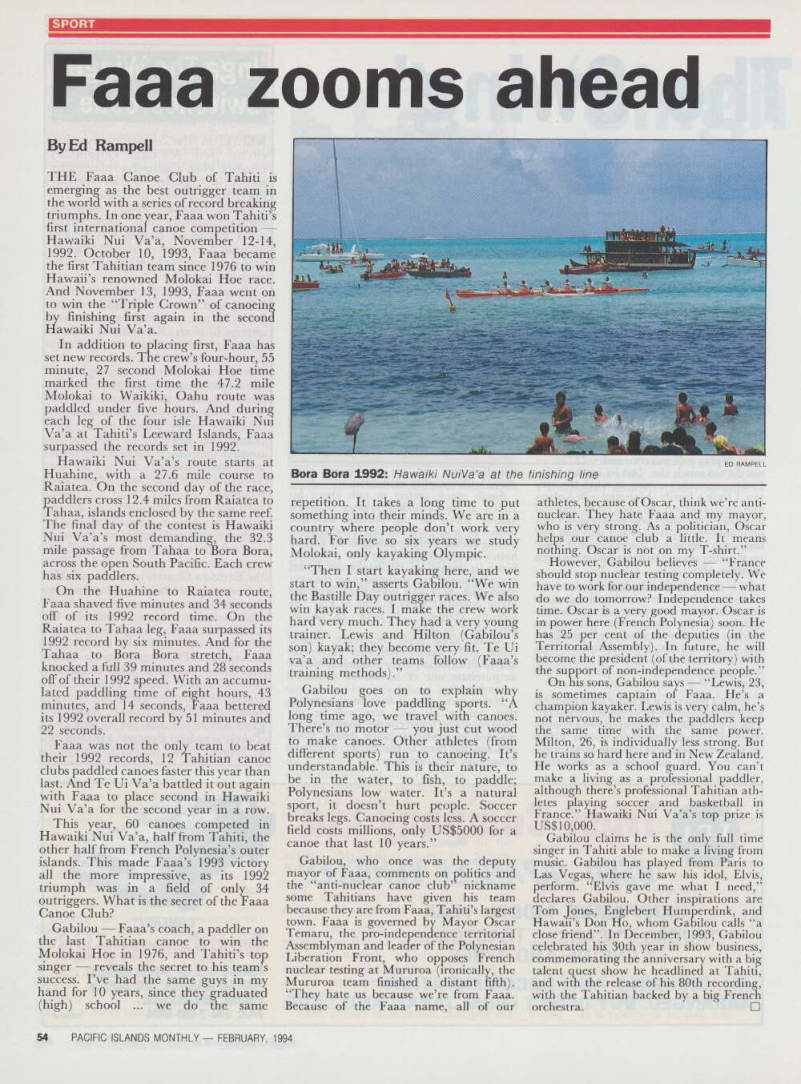
The final day of the contest is Hawaiki Nui Va’a’s most demanding, the 32.3 mile passage from Tahaa to Bora Bora, across the open South Pacific. Each crew has six paddlers.
On the Huahine to Raiatea route, Faaa shaved five minutes and 34 seconds off of its 1992 record time. On the Raiatea to Tahaa leg, Faaa surpassed its 1992 record by six minutes. And for the Tahaa to Bora Bora stretch, Faaa knocked a full 39 minutes and 28 seconds off of their 1992 speed. With an accumu lated paddling time of eight hours, 43 minutes, and 14 seconds, Faaa bettered its 1992 overall record by 51 minutes and 22 seconds.
Faaa was not the only team to beat their 1992 records, 12 Tahitian canoe dubs paddled canoes faster this year than last. And Te Ui Va’a battled it out again with Faaa to place second in Hawaiki Nui Va’a for the second year in a row.
This year, 60 canoes competed in Hawaiki Nui Va’a, half from Tahiti, the other half from French Polynesia’s outer islands. This made Faaa’s 1993 victory all the more impressive, as its 1992 triumph was in a field of only 34 outriggers. What is the secret of the Faaa Canoe Club?
Gabilou Faaa’s coach, a paddler on the last Tahitian canoe to win the Molokai Hoe in 1976, and Tahiti’s top singer reveals the secret to his team’s success. I’ve had the same guys in my hand for 10 years, since they graduated (high) school ... we do the same
repetition. It takes a long time to put something into their minds. We are in a country where people don’t work very hard. For five so six years we study
Molokai, only kayaking Olympic.
t 1 hen 1 start kayaking here, and we start to win, asserts Gabilou. We win the Bastille Day outrigger races. We also win kayak races. I make the crew work hard very much. They had a very young trainer. Fewis and Hilton (Gabilou’s son) kayak; they become very fit. Te Ui va’a and other teams follow (Faaa’s
training methods).”
Gabilou goes on to explain why Polynesians love paddling sports. A long time ago, we travel with canoes.
There’s no motor you just cut wood to make canoes. Other athletes (from different sports) run to canoeing. It’s understandable. This is their nature, to be in the water, to fish, to paddle; Polynesians low water. It’s a natural sport, it doesn’t hurt people. Soccer breaks legs. Canoeing costs less. A soccer field costs millions, only US$5OOO for a canoe that last 10 years.” 1 Gabilou, who once was the deputy mayor of Faaa, comments on politics and the “anti-nuclear canoe nickname some Tahitians have given his team because they are from Faaa, Tahiti’s largest town. Faaa is governed by Mayor Oscar Temaru, the pro-independence territorial Assemblyman and leader of the Polynesian Liberation Front, who opposes French nuclear testing at Mururoa (ironically, the Mururoa team finished a distant fifth).
“They hate us because we’re from Faaa.
Because of the Faaa name, all of our
athletes, because of Oscar, think we’re anti nuclear. They hate Faaa and my mayor, who is very strong. As a politician, Oscar helps our canoe club a little. It means nothing. Oscar is not on my T-shirt.
However, Gabilou believes “France should stop nuclear testing completely. We have to work for our independence what do we do tomorrow? Independence takes time. Oscar is a very good mayor. Oscar is in power here (French Polynesia) soon. He has 25 per cent of the deputies (in the Territorial Assembly). In future, he will become the president (of the territory) with the support of non-independence people.”
On his sons, Gabilou says “Lewis, 23, is sometimes captain of Faaa. He’s a champion kayaker. Lewis is very calm, he’s not nervous, he makes the paddlers keep the same time with the same power, Milton, 26, is individually less strong. But he trains so hard here and in New Zealand, He works as a school guard. You can’t make a living as a professional paddler, although there’s professional Tahitian ath letes P|fy in g soccer basketball in F T r (?^i C n'nnr? aa S to P P r * ze * s
Us$Lo,Ooo. .
. Gabilou claims he is the only full time singer m 1 ahiti able to make a living from music. Gabilou has played from Paris to Las Vegas, where he saw his idol, Elvis, perform. “Elvis gave me what I need,” declares Gabilou. Other inspirations are
Tom Jones, Englebert Humperdink, and
Hawaii’s Don Ho, whom Gabilou calls “a close friend”. In December, 1993, Gabilou celebrated his 30th year in show business,
commemorating the anniversary with a big
talent quest show he headlined at Tahiti, and with the release of his 80th recording, with the Tahitian backed by a big French orchestra. □
Ed Rampell
Bora Bora 1992: Hawaiki NuiVa’a at the finishing line