A colourful past
p. 45 · Read in the full issue
I Focus on AIR PACIFIC
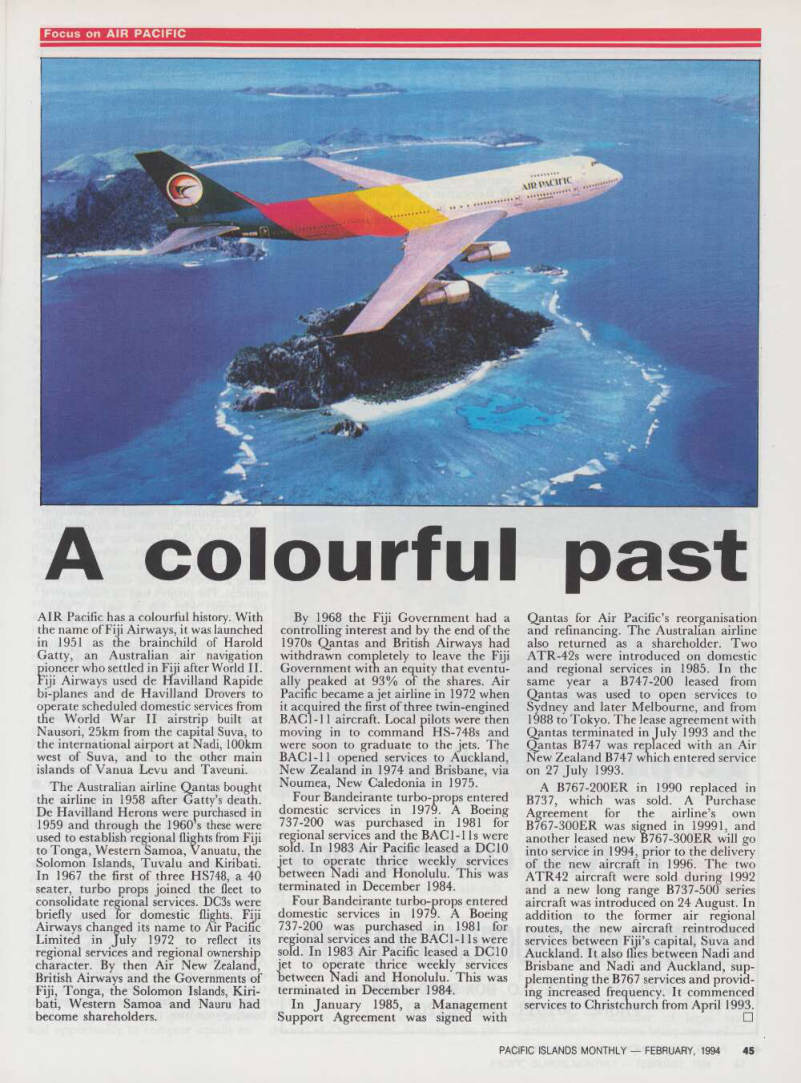
AIR Pacific has a colourful history. With the name of Fiji Airways, it was launched in 1951 as the brainchild of Harold Gatty, an Australian air navigation pioneer who settled in Fiji after World 11.
Fiji Airways used de Havilland Rapide bi-planes and de Havilland Drovers to operate scheduled domestic services from the World War II airstrip built at Nausori, 25km from the capital Suva, to the international airport at Nadi, 100 km west of Suva, and to the other main islands of Vanua Levu and Taveuni.
The Australian airline Qantas bought the airline in 1958 after Gatty’s death.
De Havilland Herons were purchased in 1959 and through the 1960 s these were used to establish regional flights from Fiji to Tonga, Western Samoa, Vanuatu, the Solomon Islands, Tuvalu and Kiribati.
In 1967 the first of three HS74B, a 40 seater, turbo props joined the fleet to consolidate regional services. DC3s were briefly used for domestic flights. Fiji Airways changed its name to Air Pacific Limited in July 1972 to reflect its regional services and regional ownership character. By then Air New Zealand, British Airways and the Governments of Fiji, Tonga, the Solomon Islands, Kiribad, Western Samoa and Nauru had become shareholders.
By 1968 the Fiji Government had a controlling interest and by the end of the 1970 s Qantas and British Airways had withdrawn completely to leave the Fiji Government with an equity that eventually peaked at 93% of the shares. Air Pacific became a jet airline in 1972 when it acquired the first of three twin-engined BACI-11 aircraft. Local pilots were then moving in to command HS-748s and were soon to graduate to the jets. The BACI-11 opened services to Auckland, New Zealand in 1974 and Brisbane, via Noumea, New Caledonia in 1975.
Four Bandeirante turbo-props entered domestic services in 1979. A Boeing 737-200 was purchased in 1981 for regional services and the BAG 1-1 Is were sold. In 1983 Air Pacific leased a DCIO J et to operate thrice weekly services between Nadi and Honolulu. This was terminated in December 1984.
Four Bandeirante turbo-props entered domestic services in 1979. A Boeing 737-200 was purchased in 1981 for regional services and the BAG 1 -11 s were sold. In 1983 Air Pacific leased a DCIO jet to operate thrice weekly services between Nadi and Honolulu. This was terminated in December 1984.
In January 1985, a Management
Support Agreement was signed with
Qantas for Air Pacific’s reorganisation and refinancing. The Australian airline also returned as a shareholder. Two ATR-42s were introduced on domestic and regional services in 1985. In the same year a 8747-200 leased from Qantas was used to open services to Sydney and later Melbourne, and from 1988 to Tokyo. The lease agreement with Qantas terminated in July 1993 and the Qantas 8747 was replaced with an Air New Zealand 8747 wnich entered service on 27 July 1993. a 8767-200 ER in 1990 replaced in 8737, which was sold. A Purchase Agreement for the airline’s own 8767-300 ER was signed in 19991, and another leased new 8767-300 ER will go into service in 1994, prior to the delivery G f the new aircraft in 1996. The two ATR42 aircraft were sold during 1992 and a new long range 8737-500 series aircraft was introduced on 24 August. In addition to the former air regional routes, the new aircraft reintroduced services between Fiji’s capital, Suva and Auckland. It also flies between Nadi and Brisbane and Nadi and Auckland, sup plementing the 8767 services and provid mg increased frequency. It commenced services to Christcnurch from April 1993. □