Special Survey
p. 28 · Read in the full issue
an outsider to suggest that government agencies should reply to letters, the notion here is different if an island wants tourists it would serve its own interests by responding to potential tourists asking about the island in question. Presumably that is why tourist bureaus have been created and staffed.
As noted, the replies ranged all over the place. We worked out a four levels of
response adequacy
First Class, those responding by fax, within a month, who provided accurate information, and who sent us the brocherues we requested only Lord Howe and Norfolk met these standards.
Second Class, as above, but respond ing by airmail; Hawaii, Pitcairn, the Cooks, and Easter Island.
Third Class, islands responding to
the inquiry promptly but not sending
brochures as they promised (Nauru, Western Samoa) or responding to the inquiry more than four weeks after it was made (Tahiti, Galapagos, and Tokelau).
Fourth Class, those responding but
providing misleading information (Am-
erican Samoa and the Commonwealth of the Northern Mariana Islands (see adjacent story).
Several of the replies stood out, for one reason or another.
The Marianas was the first to respond, and sent individually written letters with both the faxed reply and the collection of brochures; I suspect that CNMI re sponds in Japanese as well as in English, given the large number of Japanese visitors to those islands.
Hawaii’s response, as expected, ar rived early but then virtually all mail from the US to the Pacific is routed through Honolulu. The most spectacular brochures were, as one might expect, from Tahiti. There were glorious colour photos and detailed information, in English, on tourist facilities and attrac tions. Tahiti apparently has a large enough number of such requests from the US so that the reply came from an office in Los Angeles. Looking at my letter, which was sent back to me, I could tell from notations on it that it had arrived (in Tahiti) at Presidence du Gouvernement on 22 Nov. 1993, and at Service du Tourisme on 26 Nov. 1993, and then handled, again, in Los Angeles on 6 Dec. 1993. All very organised.
The probable reason for the mailing from Los Angeles related to the costs of airmail, which can be steep if one is sending brochures to people. The packet from Cook Islands, for example, carried a $6 dollar stamp on it, presumably in NZ money, and the one from Norfolk Island carried stamps worth (Aus.) $4.70. Tahiti’s mailing cost only (US) $1.21 but it was also one of the last to arrive.
Speaking of stamps, this recovering stamp collector (one never recovers completely) noticed that virtually none of the tourist bureaus was using the response as a technique to show off their
country’s line of postage stamps, which is another way that islands make money. It would cost the Cooks no more to use half a dozen different stamps adding up to $6 rather than the single $6 one they used.
Similarly, it is odd that the Pitcairn people have not worked out an arragement with New Zealand so that when the UK mails a letter on behalf of Pitcairn it could use Pitcairn stamps in the process.
The responses from both Pitcairn and Nauru, while quite prompt, were slowed by delays beyond their control. Two or three days after mailing the complete batch of 27 inquiries the letter to Nauru came back to my house stamped “re turned for better address”.
I took it to the nearby US post office and asked what I had done wrong, and the clerk said “nothing” and that I should try again. This time I placed a little note on the envelope saying “US Postal Service route via Fiji.” The letter’s departure was delayed by at least four days but apparently made it to Nauru.
The Pitcairn delay was my fault. I had sent the inquiry to the High Com missioner’s office in Wellington. That office had forwarded it to the British consulate-general in Auckland, the en tity that actually handles Pictairn’s affairs, and the reply came to me bearing an Auckland postmark.
The consulate-general sent along two Xeroxed of “Notes For Visitors to Pitcairn Island”, probably the most low key tourism brochure we have ever encountered. It said, among other things, that there are not hotels or guest houses, and that one must make arrangements for private room and board costing about (NZ) 5145 a week before one can apply for the needed visitor’s licence from the consulate-general.
The document states “most of the local inhabitants are members are adher ents of the Seventh Day Adventist
Church. Tobacco smoking, consumption
of liquor and drug-taking are against the tenets of this denomination. Drugs are prohibited by law, and the importation of liquor is permitted only with a licence (presumably from the consulate-general) which must be obtained before any liquor may be landed.”
The Xeroxed material, after telling the prospective tourist how to get to Pitcairn, let it be known that once there it is very difficult, or very expensive, to leave on short notice.
Although I had requested tourist-type literature for the island in question, sometimes the material (unlike that from Pitcairn) was not on target. Although I wrote to Ecuador’s capital seeking tourist information about the Galapagos Islands, the tourist brochures dealt with the Andes. I am sure that tourists are rare enough on Tokelau so that no material has been
Easter Island: reply in Spanish
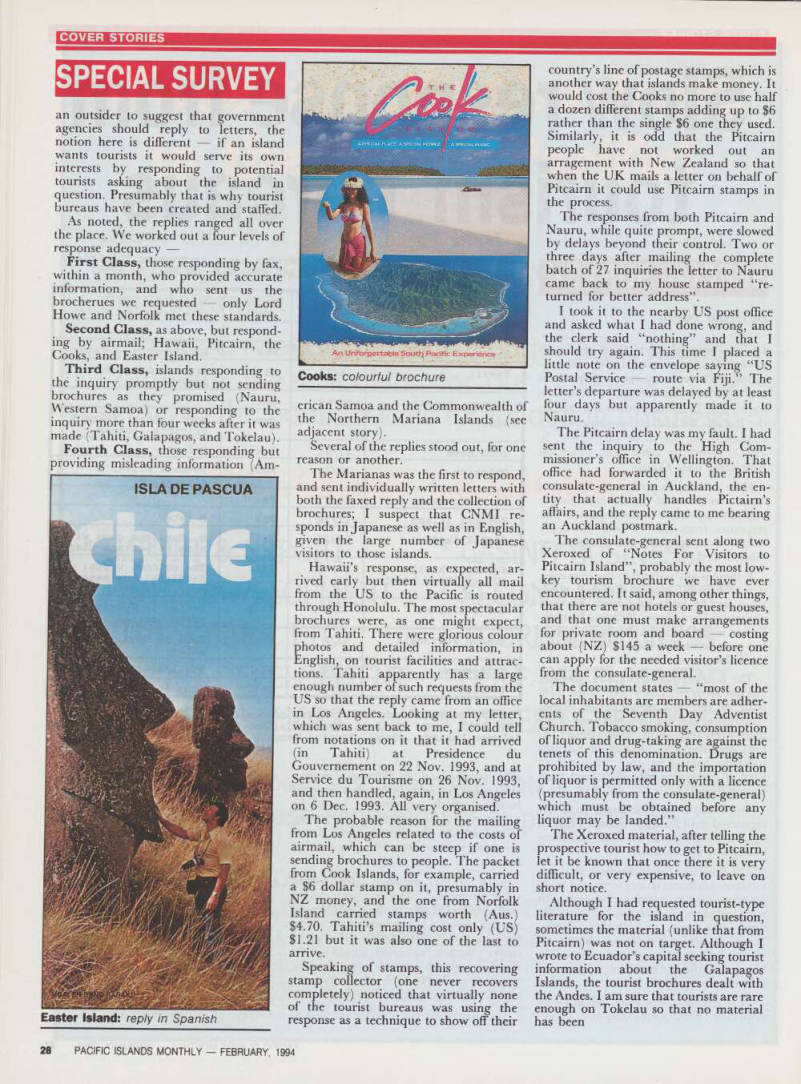
Cooks: colourful brochure