Goodbye Uncle Sam
p. 13 · Read in the full issue
Aid
By Roman Grynberg
THE short announcement that the United States Agency for International Development had given a list to the State department that its Suva office as one of the many that it was intending to close sent shock waves throughout the Pacific in October. While it was not yet whether the US government also In tended to close its aid projects dowfl or at least continue them temporarily was not clear but for many within USAID the announcement meant preparing
their departure from Fiji.
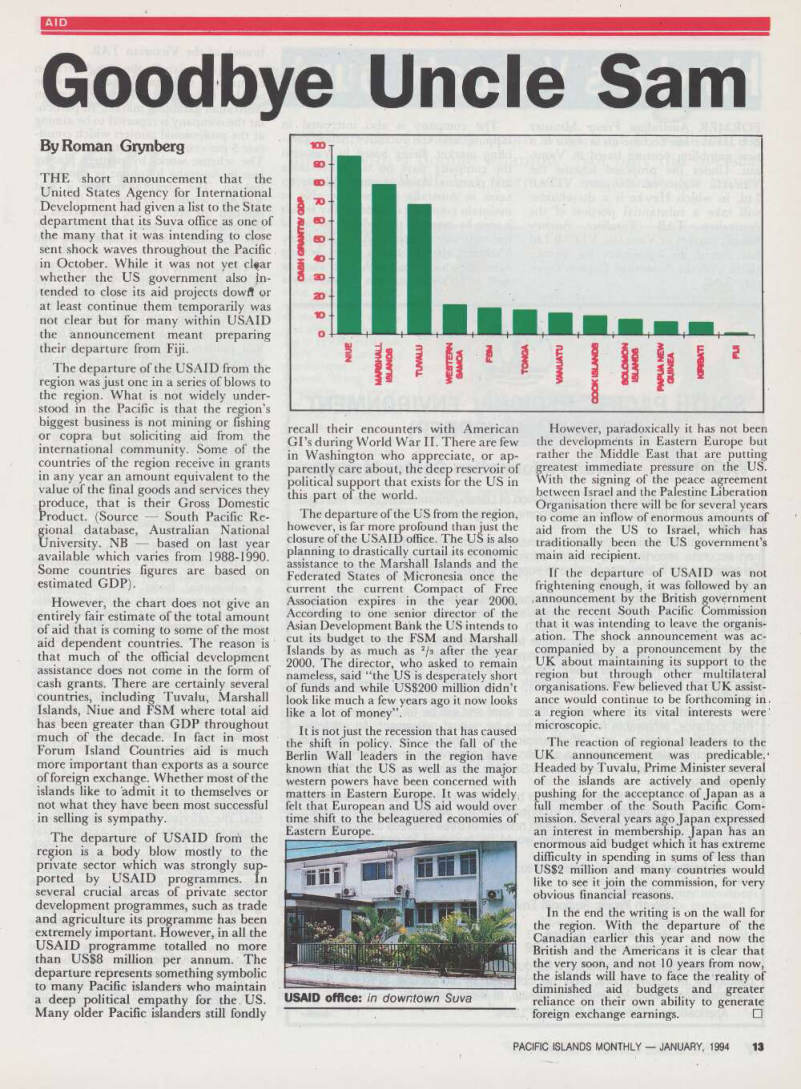
The departure of the USAID from the region was just one in a series of blows to the region. What is not widely under stood in the Pacific is that the region’s biggest business is not mining or fishing or copra but soliciting aid from the international community. Some of the countries of the region receive in grants in any year an amount equivalent to the value of the final goods and services they produce, that is their Gross Domestic Product. (Source South Pacific Re gional database, Australian National University. NB based on last year available which varies from 1988-1990.
Some countries figures are based on
estimated GDP).
However, the chart does not give an entirely fair estimate of the total amount of aid that is coming to some of the most aid dependent countries. The reason is that much of the official development assistance does not come in the form of cash grants. There are certainly several countries, including Tuvalu, Marshall Islands, Niue and FSM where total aid has been greater than GDP throughout much of the decade. In fact in most Forum Island Countries aid is much more important than exports as a source of foreign exchange. Whether most of the islands like to admit it to themselves or not what they have been most successful
in selling is sympathy.
The departure of USAID from the region is a body blow mostly to the private sector which was strongly sup ported by USAID programmes. In several crucial areas of private sector development programmes, such as trade and agriculture its programme has been extremely important. However, in all the USAID programme totalled no more than US$B million per annum. The
departure represents something symbolic
to many Pacific islanders who maintain a deep political empathy for the, US.
Many older Pacific islanders still fondly
recall their encounters with American Gl’s during World War 11. There are few in Washington who appreciate, or ap parently care about, the deep reservoir of political support that exists for the US in this part of the world.
The departure of the US from the region, however, is far more profound than just the closure of the USAID office. The US is also planning to drastically curtail its economic assistance to the Marshall Islands and the Federated States of Micronesia once the current the current Compact of Free Association expires in the year 2000,.
According to one senior director of the Asian Development Bank the US intends to cut its budget to the FSM and Marshall Islands by as much as 2 /s after the year 2000. The director, who asked to remain nameless, said “the US is desperately short of funds and while US$2OO million didn’t look like much a few years ago it now looks like a lot of mpney”.
It is not just the recession that has caused the shift in policy. Since the fall of the Berlin Wall leaders in the region have known that the US as well as the major western powers have been concerned with matters in Eastern Europe. It was widely felt that European and US aid would over time shift to the beleaguered economies of
Eastern Europe.
However, paradoxically it has not been the developments in Eastern Europe but rather the Middle East that are putting greatest immediate pressure on the US.
With the signing of the peace agreement between Israel and the Palestine Liberation Organisation there will be for several years to come an inflow of enormous amounts of aid from the US to Israel, which has traditionally been the US government’s main aid recipient.
If the departure of USAID was not frightening enough, it was followed by an announcement by the British government at the recent South Pacific Commission that it was intending to leave the organis ation. The shock announcement was ac
companied by a pronouncement by the
UK about maintaining its support to the region but through other multilateral organisations. Few believed that UK assist ance would continue to be forthcoming in, a region where its vital interests were
microscopic.
The reaction of regional leaders to the UK announcement was predicable.' Headed by Tuvalu, Prime Minister several of the islands are actively and openly pushing for the acceptance of Japan as a full member of the South Pacific Com mission. Several years ago Japan expressed an interest in membership. Japan has an enormous aid budget which it has extreme difficulty in spending in sums of less than US$2 million and many countries would like to see it join the commission, for very obvious financial reasons.
In the end the writing is on the wall for the region. With the departure of the Canadian earlier this year and now the British and the Americans it is clear that the very soon, and not 10 years from now, the islands will have to face the reality of diminished aid budgets and greater reliance on their own ability to generate
foreign exchange earnings. □
USAID office: in downtown Suva