Poisoning paradise
Many reports filter through PlM’s head office in Suva. After a quick analysis they are either put aside for later reading, filed for reference purposes or passed on to the relevant person. Very few reports are stopped in their tracks for immediate
scrutiny.
Poisons in Paradise was one report that came to a dead halt when it reached PIM. We feel it deals with something that needs to be looked into now.
The Greenpeace report has re vealed South Pacific islands are
being slowly poisoned by pesticides
which are banned and not regis tered in more developed countries.
The report, prepared in collabor ation with the Pesticides Action Network, also shows that a lack of knowledge of the effects of pesticides on the fragile ecosystems of Pacific islands has led to contamination of drinking water wells, soils, rivers and the marine environment.
While numerous human deaths from exposure to toxic pesticides have been reported, the limited data available suggests the actual rate of exposure and related health problems may be much higher,
according to Greenpeace.
The report cites alarming cases of DDT being used in some areas to catch fish. In another case high lighting the vulnerability of Pacific
island ecosystems, a cyclone in Tokelau in 1966 swept the pesticides dieldrin and DDT into a lagoon killing all surround ing coral, which are only now beginning to grow back.
There are at least 286 pesticide active ingredients available in the Pacific islands region and 57 of these are
regarded as being particularly hazard
ous. Yet, according to the report stores of obsolete pesticides lie scattered through-
out the region. Some have been lying around for more than 30 years.
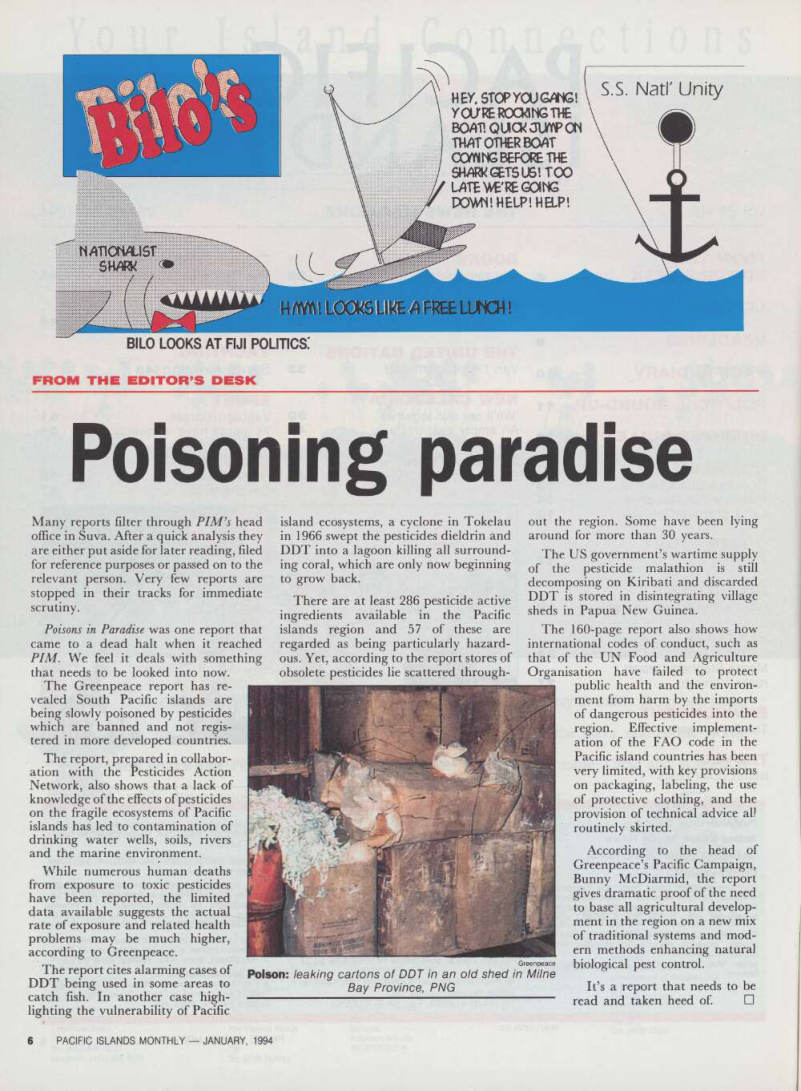
The US government’s wartime supply of the pesticide malathion is still decomposing on Kiribati and discarded DDT is stored in disintegrating village sheds in Papua New Guinea.
The 160-page report also shows how international codes of conduct, such as that of the UN Food and Agriculture Organisation have failed to protect
public health and the environ ment from harm by the imports of dangerous pesticides into the region. Effective implement ation of the FAO code in the Pacific island countries has been very limited, with key provisions on packaging, labeling, the use of protective clothing, and the provision of technical advice all routinely skirted.
According to the head of Greenpeace’s Pacific Campaign, Bunny McDiarmid, the report gives dramatic proof of the need to base all agricultural develop ment in the region on a new mix of traditional systems and mod ern methods enhancing natural biological pest control.
It’s a report that needs to be read and taken heed of. □
Greenpeace Poison: leaking cartons of DDT in an old shed in Milne Bay Province, PNG