Whither now, Tuvalu?
p. 40 · Read in the full issue
Tuvalu
By Norman Douglas
TINY Tuvalu, consisting of nine low lying and widely scattered coral islands located a few degrees below the equator, faces an even greater set of obstacles to economic growth and development than the majority of Pacific islands nations.
With a total land area of only 26 square kilometres making it, after Nauru, the smallest independent Pacific state, and a resident populating of 9300, pressures on living space and the limited resources are great.
To compound its difficulties, about 43 per cent of Tuvalu’s population lives on
one island, the administrat ive centre Funafuti where density is 1400 people per square kilometre and the population is growing at the rate of 5.1 per cent annually.
It is not much comfort to know that the crowding would be worse, but for the fact that as many as 1200 Tuvaluans at any one time are working overseas.
These unsettling details are part of the introduction to a study of the economic situation and development prospects of Tuvalu by noted
Pacific economist Te’o lan Fairbairn, in the series International Development Issues.
Some years ago, another writer with a keen interest in the Pacific, the late Peter Hastings, wrote a gloomy article on the smaller island nations, in which he asked “What possible hope can there be for Tuvalu?” and implied that the acqui sition of independence by it and its one time “sister’ colony, Kiribati, might have been a mistake.
Would they not have been better off continuing as someone else’s responsibil ity? Apart from the fact that this was
historically unlikely, Hasting’s sugges
tion that “good government” might be better in the long run that self government was considered offensive by many.
Fairbairn doesn’t suggest anything of the kind, although some of the problems that Hastings summarised are the same ones that are given extended treatment in this study, which is to say, after about 15 years, they have not gone away. In fact there is now an awareness of difficulties which were perhaps not of fully appreciated before; the delicate quality of the environment and the possibility of inundation caused by rising sea-levels. The natural “environment”, says the study, “is extremely fragile”.
There are no streams, droughts are
common, and the atoll soils highly saline and porous.
There are many other constraints to development, including those of trans- Eort and communication, perennial bug ears in the Pacific but being overcome by the larger island countries. Not yet in Tuvalu, whose only international ship ping service provided by a Forum Micronesia vessel was terminated and had not been replaced at the time of the study. Inter-island shipping services and erratic and inter-island air services are non-existent although there is a three weekly international air service. In socio economic terms, the small nation faces considerable problems inadequate
infrastructure, a weak entrepreneurial base and a shortage of both viable projects and the skills to implement them.
That Tuvalu is extremely vulnerable to international influences completely outside its control, such as commodity prices and inflationary trends, hardly needs to be said. It is also largely aid dependent, to the extent of A|)996 per capita in 1989, with Japan the largest donor that year. In 1990 GDP per capita was AS 1300, by no means tne lowest among independent island states (Kiri bati’s was A 5696) but nothing to get really excited about. Exports are limited mainly to garments (the manufacturing staple of the Pacific?) and stamps; in 1989 total exports amounted to all of A 5312,000. The import bill was A 55.2 million. Wage levels are among the lowest in the region, essentially because they are set by the government, the largest employer, and reliance on over
seas remittances is fairly high, although
since the main source of remittances is from Tuvaluans working in Nauru the future for this income looks less than bright. The absence of providing males has led to a gender imbalance at home.
Health problems such as diabetes and hypertension, resulting from a 75 per cent dependence on imported food, have increased, as had vitamin deficiency.
If all this sounds like a scenario for oblivion rather than merely disaster, there are actually hopeful signs, although one gets the impression that Professor Fairbairn might have had to dig fairly hard to find them. Economic growth between 1986 and 1990 is described as “fairly impressive” although it began from a very low base, and economic activity was influenced far more by aid flows than from income generated within the country. Social indicators give some grounds for optimism, despite Tu valu’s listing as one of the UN’s least developed countries. The largely subsistence nature of the economy has helped to avert extreme poverty and off-set the threat of widespread malnutrition, and
social services have made valuable progress.
Tuvaluans, while living for fewer years than Tongans or Fijians, have a higher ratio of medical practitioners and facilities than these neigh bours. They are also fairly well educated, with a liter acy rate in advance of Fiji’s although what they can achieve with their education is not clear.
What are the prospects then, and which areas show the most promise? Certainly not tourism, which one writer recently described not
as the Pacific’s greatest hope but as its “greatest hoax”. In both manufacturing and tourism, says Fairbairn, with appropri ate restraint, “scope for significant expan sion seems limited”; this notwithstanding the 235-page master plan for Tuvalu tourism drawn up last year by the ever starry-eyed Tourism Council of the South Pacific, a document Fairbairn evidently didn’t consider worth consulting. But what might be described as the “traditional sectors”, agriculture and fisheries, “seem capable of contributing to Tuvalu’s growth objectives”, although it is the latter which should receive top priority, especially in artisanal commercial fishing and the optimising of benefits from the leasing of fishing rights. The development of aquacul ture is possible but the study warns that some projects are highly technical in nature.
Overseas employment must necessarily continue as a major income source al though with the depletion of Nauru’s phosphate reserves other areas need to be sought fairly soon. The Tuvalu Trust Fund, established in 1987 and invested overseas, mainly in Australia, continues to “perform well”. Additional attention to the manage ment of human resources, including the growth significance of women in the country’s development, and an improved capacity to deal with environmental prob lems should ensure that Tuvalu faces a stable, if unspectacular, future. □
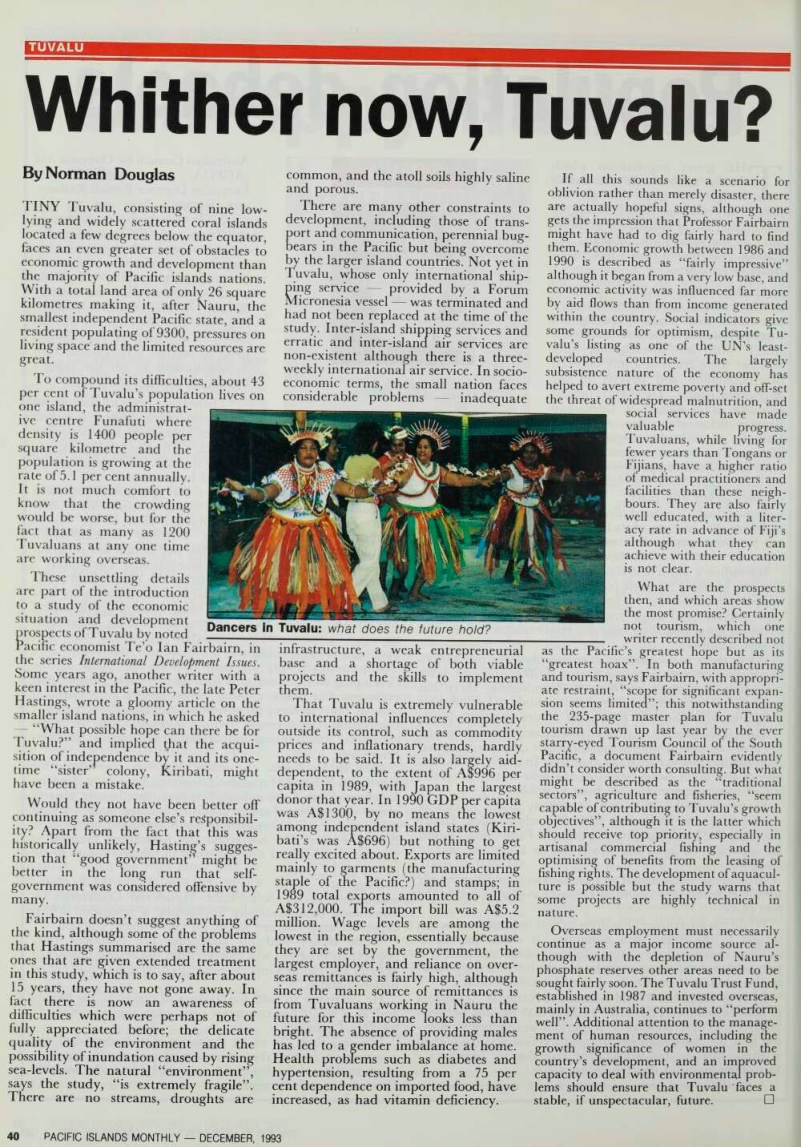
Dancers in Tuvalu: what does the future hold?