speaks
p. 27 · Read in the full issue
Hilda Lini
speaks out
By lan Williams
VANUATU’S Hilda Lini is in an invidious position. She is now an inter national prize winner without honour in her won country - or at least not with the government of Maxim Carlot Korman who dismissed her and her colleagues from the cabinet in August. PIM spoke to her in New York, where she had come after receiving the Sean Mcßride Inter national Peace prize in London. On her way to Britain, she was invited to the International Association of Physicians for the Prevention of Nuclear War conference in Mexico, and now she was returning to Vanuatu via New York at the invitation of the International As sociation of Lawyers against Nuclear Arms.
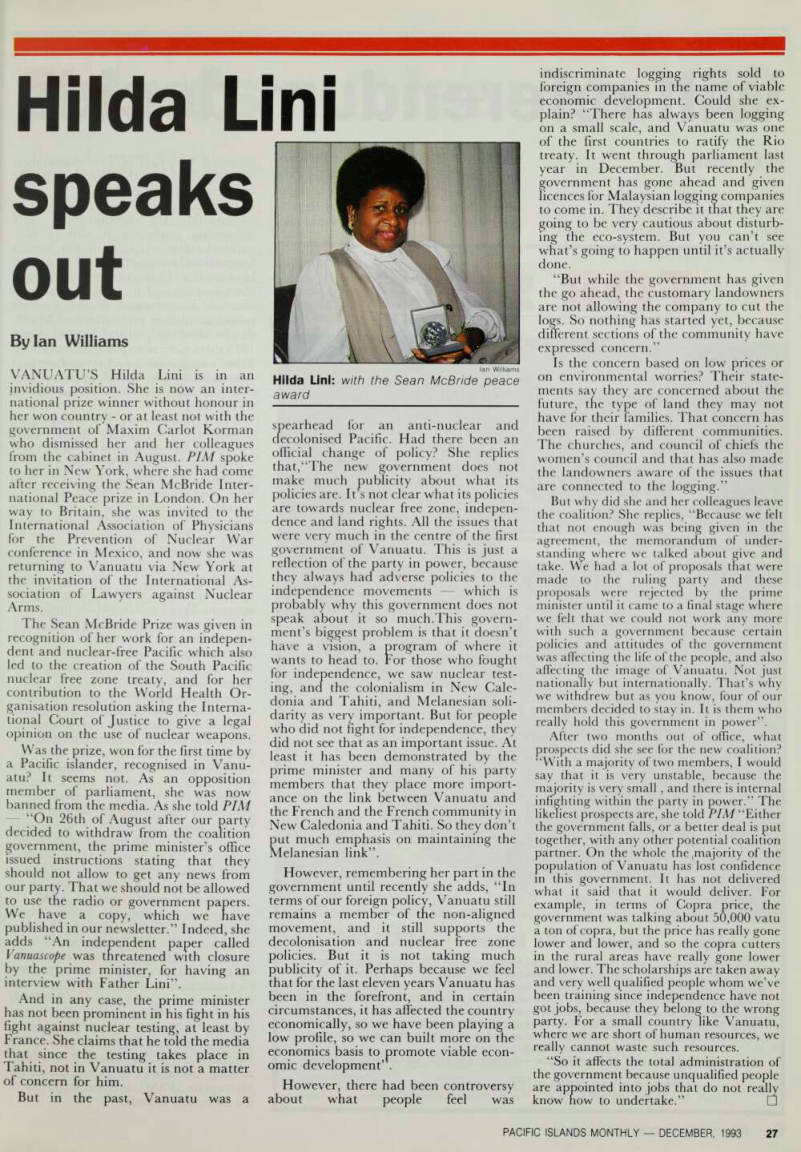
The Sean Mcßride Prize was given in recognition of her work for an indepen dent and nuclear-free Pacific which also led to the creation of the South Pacific nuclear free zone treaty, and for her contribution to the World Health Or ganisation resolution asking the Interna tional Court of Justice to give a legal opinion on the use of nuclear weapons.
Was the prize, won for the first time by a Pacific islander, recognised in Vanu atu? It seems not. As an opposition member of parliament, she was now banned from the media. As she told PIM “On 26th of August after our party decided to withdraw from the coalition government, the prime minister’s office issued instructions stating that they should not allow to get any news from our party. That we should not be allowed to use the radio or government papers.
We have a copy, which we nave published in our newsletter.” Indeed, she adds “An independent paper called Vanuascope was threatened with closure by the prime minister, for having an interview with Father Lini”.
And in any case, the prime minister has not been prominent in his fight in his fight against nuclear testing, at least by France. She claims that he told the media that since the testing takes place in Tahiti, not in Vanuatu it is not a matter of concern for him.
But in the past, Vanuatu was a
spearhead for an anti-nuclear and decolonised Pacific. Had there been an official change of policy? She replies that,“The new government does not make much publicity about what its policies are. Its not clear what its policies are towards nuclear free zone, indepen dence and land rights. All the issues that were very much in the centre of the first government of Vanuatu. This is just a reflection of the party in power, because they always had adverse policies to the independence movements which is probably why this government does not speak about it so much. This govern ment’s biggest problem is that it doesn’t have a vision, a program of where it wants to head to. For those who fought for independence, we saw nuclear test ing, and the colonialism in New Cale donia and Tahiti, and Melanesian soli darity as very important. But for people who did not fight for independence, they did not see that as an important issue. At least it has been demonstrated by the prime minister and many of his party members that they place more import ance on the link between Vanuatu and the French and the French community in New Caledonia and Tahiti. So they don’t put much emphasis on maintaining the Melanesian link”.
However, remembering her part in the government until recently she adds, “In terms of our foreign policy, Vanuatu still remains a member of the non-aligned movement, and it still supports the decolonisation and nuclear free zone policies. But it is not taking much publicity of it. Perhaps because we feel that for the last eleven years Vanuatu has been in the forefront, and in certain circumstances, it has affected the country economically, so we have been playing a low profile, so we can built more on the economics basis to promote viable econ
omic development”.
However, there had been controversy about what people feel was
indiscriminate logging rights sold to foreign companies in the name of viable economic development. Could she ex
plain? “There has always been logging
on a small scale, and Vanuatu was one of the first countries to ratify the Rio treaty. It went through parliament last year in December. But recently the government has gone ahead and given
licences for Malaysian logging companies
to come in. They describe it that they are going to be very cautious about disturb ing the eco-system. But you can’t see what’s going to happen until it’s actually done.
“But while the government has given the go ahead, the customary landowners are not allowing the company to cut the logs. So nothing has started yet, because different sections of the community have
expressed concern.”
Is the concern based on low prices or on environmental worries? Their state ments say they are concerned about the future, tne type of land they may not have for their families. That concern has been raised by different communities.
The churches, and council of chiefs the women’s council and that has also made the landowners aware of the issues that are connected to the logging.”
But why did she and her colleagues leave the coalition? She replies, “Because we felt that not enough was being given in the agreement, the memorandum of under standing where we talked about give and take. We had a lot of proposals that were made to the ruling party and these proposals were rejected by the prime minister until it came to a final stage where we felt that we could not work any more with such a government because certain policies and attitudes of the government was affecting the life of the people, and also affecting the image of Vanuatu. Not just nationally but internationally. That’s why we withdrew but as you know, four of our members decided to stay in. It is them who really hold this government in power”.
After two months out of office, what prospects did she see for the new coalition?
“With a majority of two members, I would say that it is very unstable, because the majority is very small, and there is internal infighting within the party in power.” The likeliest prospects are, she told PIM “Either the government falls, or a better deal is put together, with any other potential coalition partner. On the whole the .majority of the population of Vanuatu has lost confidence m this government. It has not delivered what it said that it would deliver. For example, in terms of Copra price, the government was talking about 50,000 vatu a ton of copra, but the price has really gone lower and lower, and so the copra cutters in the rural areas have really gone lower and lower. The scholarships are taken away and very well qualified people whom we’ve been training since independence have not got jobs, because they belong to the wrong party. For a small country like Vanuatu, where we are short of human resources, we really cannot waste such resources.
“So it affects the total administration of the government because unqualified people are appointed into jobs that do not really know now to undertake.” □
lan Williams Hilda Uni: with the Sean Mcßride peace award