Abuse
pp. 24-25 · Read in the full issue
Issue
By Karen Mangnall
SAMOAN children in hospital with broken bones. Samoan girls forced to seek abortions. And their families have put them there. It’s the darkest side of life in New Zealand, a life of economic and social struggle which has helped to produce the Samoan community’s silent shame child abuse. Now, the Samoan community in Wellington has launched a unique project to combat child abuse.
“The community can no longer sit by while many young lives are destroyed,” says project spokesman and Samoan Advisory Council chairman Lualemana Tino Pereira. “We have got to wake up
and see this has gone too far. We shouldn’t ever use culture as an excuse for any abuse physical, sexual or emotional.”
The project was born out of contro versy in October last year, when Social Welfare Minister, Jenny Shipley linked the rising Pacific island population with what she called a “dramatic” rise in reported child abuse 24,861 cases in the year to June 1992. “We know that culturally as the Pacific island popu lation increases in New Zealand, there may be a factor there that is unspoken,”
Shipley said. “But it is an issue that must be spoken about in New Zealand socity.”
To back up her claims, Shipley’s office released an ethnic breakdown of family
group conferences held in 1990-91 under the Children, Young Persons and Their Families Act to deal with specific cases of child abuse. The October 16 Evening Post headlined the story: “Outrage at child abuse figures”. The report stated “Pacific islanders accounted for nearly 8 per cent of the 4972 family conferences, although they are only 3.6 per cent of the population.” Outrage there certainly was, with the talkback radio running hot.
But the greatest outrage came from the Pacific island communities; outrage at Shipley’s insensitivity and at the minis ter’s figures because they were wrong.
Somehow the minister’s office had in flated the June ’9l quarterly figures by 70 per cent for Pacific islanders (and by 79 per cent for Maori). Then, journalists had used outdated 1986 population figures for drawing their comparisons.
When the Children and Young Persons Service belatedly released the correct figures, they showed Pacific islanders accounted for 6.9 per cent of family group conference in 1990-91 and com prised five per cent of the New Zealand population in the same year.
“The community hurt,” says Pereira.
“It’s a fragile community and it’s a painful process beiing dragged through the media as sex abusers when the evidence doesn’t show Pacific islanders or Samoans are the main offenders.” Per eira subsequently hauled Shipley over the coals on Wellington’s Samoan radio, challenging her to do something positive over the Pacific island communities.
“She replied we should come up with something and she’d listen,” Pereira.
The Samoans held public meetings in Wellington, Lower Hutt and Porirua.
“We asked a basic question is the minister right that there is a child abuse problem and what can we do about it?
The overwhelming response was we admitted there’s a problem and decided we should take the initiative.” Samoan leaders visited Shipley with two main demands an apology for the inaccur ate figures and her public comments, and funding for a Samoan run programme to combat child abuse. The apology never came but Shipley intervened with the Community Funding Agency to give $244,000 for a three-month pilot scheme ending in December to train Samoans in Wellington to identify and prevent child abuse and provide professional support for survivors and perpetrators.
Given the Pacific island outcry over her earlier comments, Jenny Shipley would probably be surprised to find general agreement among the leaders of the pilot project that Samoan culture
NZ Samoans face up
to child abuse
does encourage child abuse. Curiously, it’s the male leaders matai and church minister who most readily point the finger at Samoan culture, or rather at what Samoan culture has become in a foreign country. The minister at Welling ton’s Samoan Congregational Church, the Reverend Risati Ete, believes sexual abuse is much less common than excess ive discipline, the most common form of child abuse which, he says, is widespread in the Samoan community. In fact, justice department statistics show 310 family group conferences on child abuse in 1990-91 out of a Pacific island population of 167,073 that’s 0.2 per cent per capita.
“Ours is a hierarchical type of society in which children are seen, not heard. It is in Samoan culture for the parents to discipline their children,” says Rev. Ete.
“The parents go overboard because they are anxious for their children to succeed.
They don’t know they’re devastating the child. Beating is not the way to deal with children; it only creates more disrespect if you try to force children to respect you.”
Tino Pereira says Samoan parents’ harsher approach to discipline puts them in a dilemma. “Samoans believe they have to discipline the kids to become upstanding citizens here but New Zea land laws say if you hit your kids that’s assault. People in the Samoan commun ity here have argued it’s part of their culture that if a kid misbehaves you bang him on the head, whether or not that causes significant harm, because that’s how they were raised in Samoa. Well, those days are gone.” Pereira believes the churches carry a big responsibility for allowing this abuse, even reinforcing it.
“The church has taken over Samoan culture in New Zealand,” says Pereira.
“The attitude that if you spare the rod you’ll spoil the child has become an enforced part of child-rearing.” Rev. Ete agrees the churches sometimes fail to look after the children in their care. “Some times the church is more concerned about its reputation and sweeps the reality of the problem under the carpet.”
Confronting a subject as taboo as sexual abuse is even more difficult. “The pride of being Samoan means there’s a nush-hush attitude towards things that are sexual,” says Rev. Ete. Pereira believes life in New Zealand provides two main contributors to sexual abuse by Samoan men. “Firstly, in New Zealand the homes are all enclosed with walls. In
Samoa the whole fale is open and everyone can see. Secondly, many Sam oan men are becoming unemployed while the women are out working, often at night. The man at home gets frus trated because he can’t fill the role as the head of the family. You can see it in the alcohol and abuse statistics.” There’s evidence a significant number of those sexually abused are young Samoan girls, brought to New Zealand to complete .their education and left in the care of their uncles. Pereira says he’s been told by Samoan rape counsellors of teenage Samoan girls needing abortions because of such abuse. “Some of these cases are referred to Samoan counsellors by the schools because the kids have got no where else to go.”
The pilot project itself has been created from scratch by a core group of professional Samoan counsellors.
“There’s nothing like it that we’re aware
of anywhere in the world,” says one counsellor, Kiwi Tamasese. “It’s not a counselling programme, it’s a training program for people to look at all the levels of abuse, from the individual to the family to society.” The program is unique firstly because it targets a specific community and enrols its members in training, and secondly, because it separ ates out the sexes men from women, young from old. The first step was to train the trainers to deliver a program covering covering issues worked out by the Samoan public meetings. Next, to train Samoan counsellors in various focal service groups so cases of abuse could be referred to them. Then the church
ministers got special training so they
could run training sessions among their congregations. The churches in each area band together to run three separate
seminars. “If we get a thousand people through the program by December, that will be great, says Pereira. “If each Samoan family has about five members, at least we’ll probably reach someone in each household. It will have a multiplier effect.”
Kiwi Tamasese says the beauty of this program is it asks the participants to define abuse, pinpoint its causes and find ways of preventing it in future. Walk The Tal k is a key phrase. So is Drawing the Line. “Violation is when bodies or emotions become wounded,” says Tamasese. “Smacking is not the issue.
They’ve been drawing the line where discipline leaves off and becomes viol ation. And that line is very clear.”
Another clear message from participants is abuse is directly related to economic hardship, and that the government must do its share to help reduce abuse by
providing adequate welfare benefits,
affordable housing and education, re duced taxes for lower income earners and permanent jobs for Pacific islanders.
That flies in the face of Shipley’s doubts that there is “any researcher who is able to say that there is a direct correlation”. The statistics are clear Pacific islanders’ unemployment rate is 20.9 per cent, twice the national average. Nearly 38 per cent of Pacific islanders work in factories, double the national average. Their mortality rate is 25 per cent higher than for non- Polynesians, their admission rate for mental health problems is twice the national average. More than half the Pacific island ers aged over 15 years have no school qualifications; more than half live in rented accommodation and only eight per cent own their homes mortgage-free. Samoans make up more than half the Pacific island population in New Zealand.
Kiwi Tamasese says for too long Pacific island immigrants have internalised the stresses of their new life. “This program expects them to respond differently to those pressures, by not going overboard,” she says. Samoan immigrants, especially the women, have endured an enormous “cul tural dislocation”, says another counsellor, Luamanuvao Winnie Laban. “This pro gram gives our people perhaps their first chance to stop and reflect on history, on what they’ve survived and contributed, what they’ve lost and gained from the transition.”
Samoan women in New Zealand no longer have traditional support groups, like the aualuma, which also gave them a voice in community decisions. In New Zealand, European culture and the church combine to push Samoan women into the role of wife and mother. Winnie Laban says the word which is most often raised in the abuse saminars is “sacred”, particularly feagaiga, the fundamental gender relationship of Samoan culture between a brother and sister, and their descendants. “In history the boundaries were very, very clear between the genders and if those bound aries were broken, they were conse quences,” she says. “They all come to the program because they’re Samoan, so straight away they’re locked into the culture. □
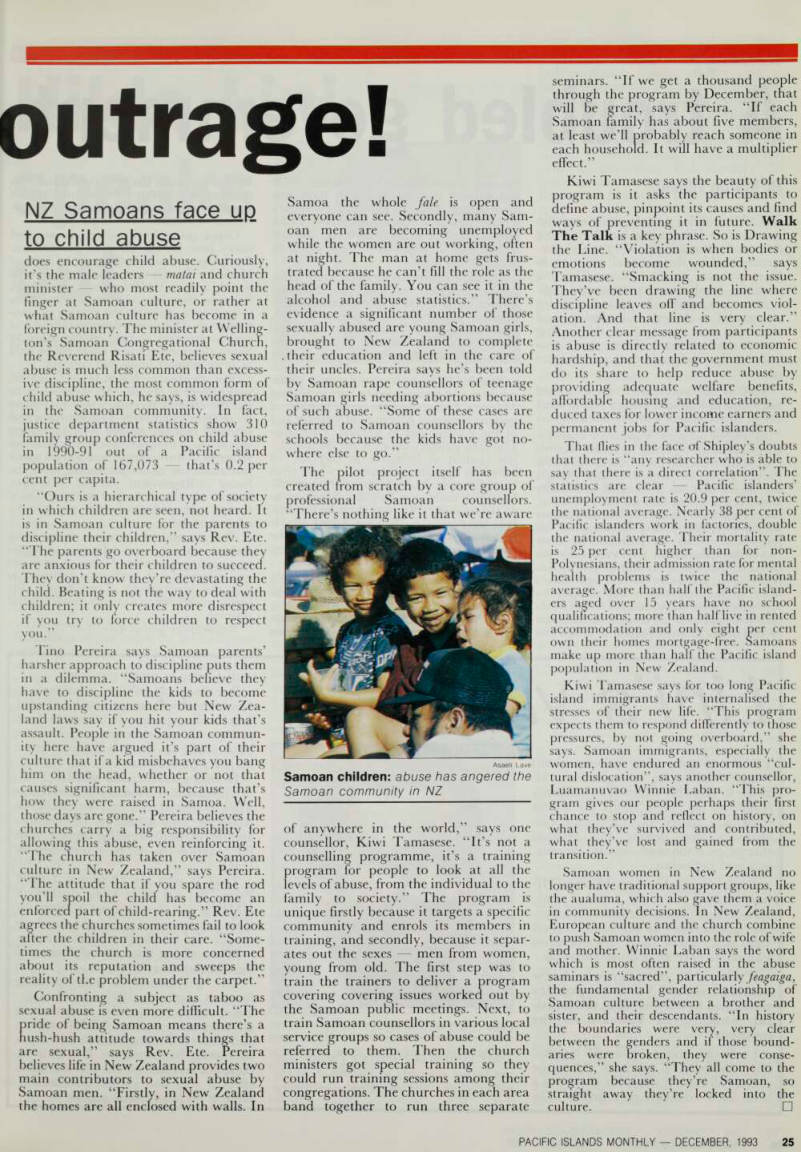
Asaeli Lave Samoan children: abuse has angered the Samoan community in NZ