Growing
pp. 20-22 · Read in the full issue
Population
By David North
NEWLY-RELEASED 1990 Census data shows that nearly two out of three workers on US flag islands were born off islands. And close to half of the residents of these four island groupings were born somewhere else. The US Department of Commerce recently issued its tradition ally thick volumes of census data, with at least 200 pages of stastics for each of the US flag islands.
The reports cover American Samoa, Guam, the Commonwealth of the North ern Mariana Islands, and the Republic of Palau. Given their Associated state status, neither the Marshalls or FSM
were covered by the most recent US census.
Most heavily impacted by labour migration is CNMI, where less than one fifth of the work done in the Common wealth is performed by peopleborn there.
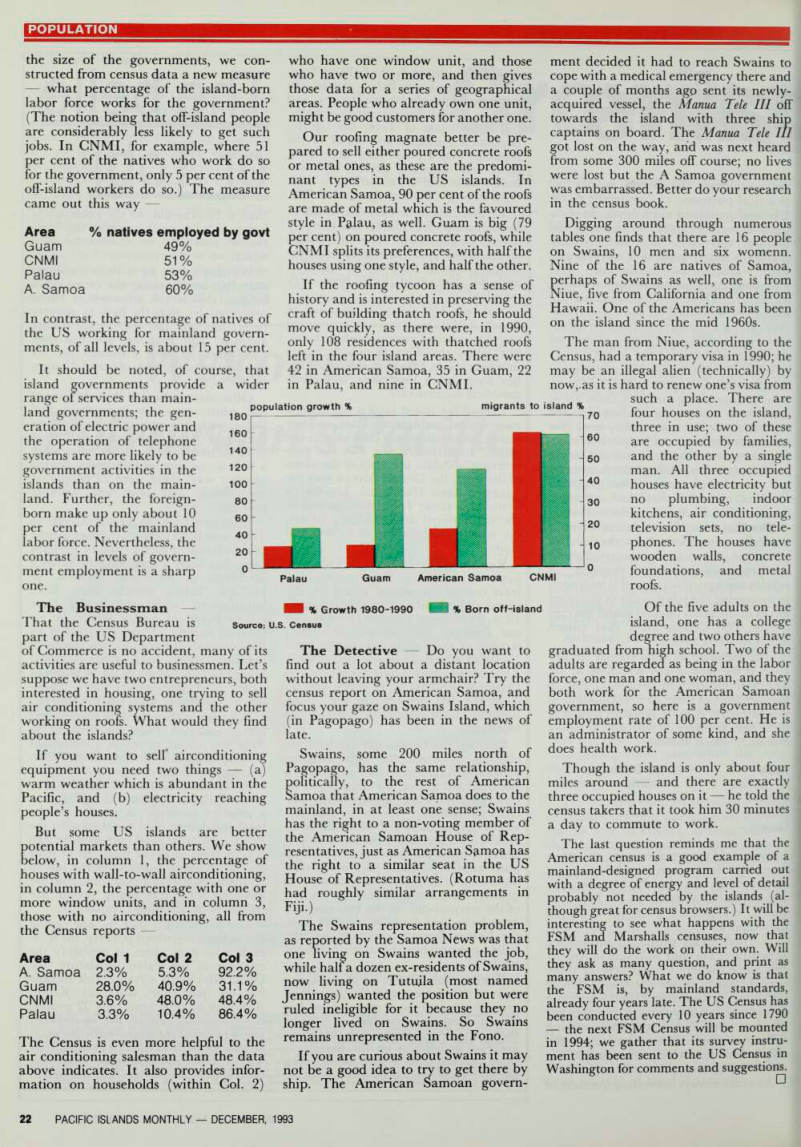
Further, 61 per cent of the population was born elsewhere. Among the four
jurisdictions only lightly-developed Pa
lau had a native-born majority in its work force.
Typically there is a higher precentage of off-island workers than off-island residents; in many cases the off-island workers do not bring family members with them often, at least in CNMI, they are prohibited from doing so.
Of CNMTs work force, 82 per cent were born elsewhere, with the Philip pines contributing 59 per cent of that population. Of American Samoa’s work ers, 62 per cent are off-island-born, and of these 74 per cent came from nearby Western Samoa.
On Guam, 61 per cent of the workers are from other places, but there is a greater variety than in the other jurisdic tions. Of the off-island workers 47 per cent are from the Philippines and 24 per cent, including some servicemen, are from the mainland. Palau, with 34 per cent of its work force from overseas, also depends heavily on Filipinos who consti tute 71 per cent of her foreign work force.
Naturally it is the islands with the greatest influx of foreign workers whose population increased the most; CNMI population increased by more than 15 per cent in the 1980 s.
Although the foreign workers expand the labor force, and thus production, in all of the islands, and presumably have a dampening effect on wages of all similarly placed workers, they play different roles on the different islands, partially because of differing immigra tion schemes. Guam lives under Main land immigration rules, while the other three juridsictions control their own immigration policies.
The starkest contrast between the fate of island-born and foreign-born workers can be seen in CNMI, as illustrated by the ongoing charges of exploitation of Asian Workers in Saipan’s garment factories. (See PIM April, ’92 p2B).
CNMI policies do not permit most foreign workers to become permanent residents, much less citizens, so the citizen minority continues to dominate business and political life.
Matters are less explosive in American Samoa; while immigrant workers from Western Samoa cannot become Ameri can Samoan citizens (the technical term is US National), they speak the same language as the host population, are unlikely to be deported, and their American Samoa-born children will be come citizens of the US territory.
An immigrant to Guam is, for all practical purposes, an immigrant to the US, and mainland rules apply, so some foreign workers stay in Guam and become voters. As a result, Guam’s politics is much more of a melting pot, with Chamorros, Filipinos and mainlanders all sitting in the territorial legislature. These developments are not uniformly welcomed on the island, how ever, and a Chamorro nationalist move ment wants Chamorros only to vote on the political future of the island.
While the 1000 pages or so of census tabulations can appear to be little more than mid-numbing numbers, there are at least three reasons for wading into the reports: as a citizen or a policy nerd (the new mainland term of people interested in government programs) one can secure many insights; as a businessman, one can get sound information on potential markets; and as a statistical detective, one can find fascinating information.
The Citizen Let us assume that our citizen is concerned about the level of education in the islands, is worried about
the remaining people engaged in
subsistence agriculturre, and is interested in measuring the relative size of the labor forces in the often bloated island govern ments. The Census gives that citizen much to think about.
One measure of educational attain ment is the lack of any schooling at all.
The four jurisdiction each have one to two per cent of their 25+ population in this category. A more sensitive measurre is the per cent over 25 with a high school diploma, which shows:
Interestingly these percentages, except in American Samoa are raised, sometimes considerably (as in Palau), by the educational attainments of the Filipinos, which are greater than those of the native-born.
Worried about people in subsistence agriculture? Do your worrying in Ameri can Samoa where 7.7 per cent of those over the age of 16 are so engaged, full or part-time, or better in Palau, where the percentage is 8.9 per cent. Palau with 4.4 per cent of its 16+ population working full time in subsistence activities is the only jurisdiction where this number rises above 2 per cent.
As to the always interesting question of
Area % HS Diploma A. Samoa 55% Palau 58%
Cnmi
66% Guam 73%
the size of the governments, we con structed from census data a new measure what percentage of the island-born labor force works for the government? (The notion being that off-island people are considerably less likely to get such jobs. In CNMI, for example, where 51 per cent of the natives who work do so for the government, only 5 per cent of the off-island workers do so.) The measure came out this way
In contrast, the percentage of natives of the US working for mainland govern ments, of all levels, is about 15 per cent.
It should be noted, of course, that island governments provide a wider
range of services than main land governments; the gen eration of electric power and
the operation of telephone
systems are more likely to be government activities in the islands than on the main land. Further, the foreign born make up only about 10 per cent of the mainland labor force. Nevertheless, the contrast in levels of govern ment employment is a sharp one.
The Businessman That the Census Bureau is part of the US Department
of Commerce is no accident, many of its activities are useful to businessmen. Let’s suppose we have two entrepreneurs, both interested in housing, one trying to sell air conditioning systems and the other working on roofs. What would they find about the islands?
If you want to self airconditioning equipment you need two things (a) warm weather which is abundant in the Pacific, and (b) electricity reaching
people’s houses.
But some US islands are better potential markets than others. We show below, in column 1, the percentage of houses with wall-to-wall airconditioning, in column 2, the percentage with one or more window units, and in column 3, those with no airconditioning, all from the Census reports
The Census is even more helpful to the air conditioning salesman than the data above indicates. It also provides infor mation on households (within Col. 2)
who have one window unit, and those who have two or more, and then gives those data for a series of geographical areas. People who already own one unit, might be good customers for another one.
Our roofing magnate better be pre pared to sell either poured concrete roofs or metal ones, as these are the predomi nant types in the US islands. In American Samoa, 90 per cent of the roofs are made of metal which is the favoured style in Palau, as well. Guam is big (79 per cent) on poured concrete roofs, while CNMI splits its preferences, with half the houses using one style, and half the other.
If the roofing tycoon has a sense of history and is interested in preserving the craft of building thatch roofs, he should move quickly, as there were, in 1990, only 108 residences with thatched roofs left in the four island areas. There were 42 in American Samoa, 35 in Guam, 22 in Palau, and nine in CNMI.
The Detective Do you want to find out a lot about a distant location without leaving your armchair? Try the census report on American Samoa, and focus your gaze on Swains Island, which (in Pagopago) has been in the news of late.
Swains, some 200 miles north of Pagopago, has the same relationship, politically, to the rest of American Samoa that American Samoa does to the mainland, in at least one sense; Swains has the right to a non-voting member of the American Samoan House of Rep resentatives, just as American Samoa has the right to a similar seat in the US House of Representatives. (Rotuma has had roughly similar arrangements in
Fiji.)
The Swains representation problem,
as reported by the Samoa News was that one living on Swains wanted the job, while half a dozen ex-residents of Swains, now living on Tutujla (most named Jennings) wanted the position but were ruled ineligible for it because they no longer lived on Swains. So Swains remains unrepresented in the Fono.
If you are curious about Swains it may not be a good idea to try to get there by ship. The American Samoan govern
ment decided it had to reach Swains to cope with a medical emergency there and a couple of months agp sent its newly acquired vessel, the Mama Tele 111 off towards the island with three ship captains on board. The Mama Tele 111 got lost on the way, and was next heard from some 300 miles off course; no lives were lost but the A Samoa government was embarrassed. Better do your research in the census book.
Digging around through numerous tables one finds that there are 16 people on Swains, 10 men and six womenn.
Nine of the 16 are natives of Samoa, perhaps of Swains as well, one is from Niue, five from California and one from Hawaii. One of the Americans has been on the island since the mid 19605.
The man from Niue, according to the Census, had a temporary visa in 1990; he may be an illegal alien (technically) by now,.as it is hard to renew one’s visa from
such a place. There are four houses on the island, three in use; two of these are occupied by families, and the other by a single man. All three occupied houses have electricity but no plumbing, indoor kitchens, air conditioning, television sets, no tele phones. The houses have wooden walls, concrete foundations, and metal roofs.
Of the five adults on the island, one has a college degree and two others have
graduated from high school. Two of the adults are regarded as being in the labor force, one man and one woman, and they both work for the American Samoan government, so here is a government employment rate of 100 per cent. He is an administrator of some kind, and she does health work.
Though the island is only about four miles around and there are exactly three occupied houses on it he told the census takers that it took him 30 minutes a day to commute to work.
The last question reminds me that the American census is a good example of a mainland-designed program carried out with a degree of energy and level of detail probably not needed by the islands (al though great for census browsers.) It will be interesting to see what happens with the FSM and Marshalls censuses, now that they will do the work on their own. Will they ask as many question, and print as many answers? What we do know is that the FSM is, by mainland standards, already four years late. The US Census has been conducted every 10 years since 1790 the next FSM Census will be mounted in 1994; we gather that its survey instru ment has been sent to the US Census in Washington for comments and suggestions.
Area % natives employed by govt Guam 49%
Cnmi
51% Palau 53% A. Samoa 60%
Area Col 1 Col 2 Col 3 A. Samoa 2.3% 5.3% 92.2% Guam 28.0% 40.9% 31.1%
Cnmi 3.6% 48.0% 48.4%
Palau 3.3% 10.4% 86.4%