The Compere
pp. 18-19 · Read in the full issue
Cover Stories
By Martin Tiffany
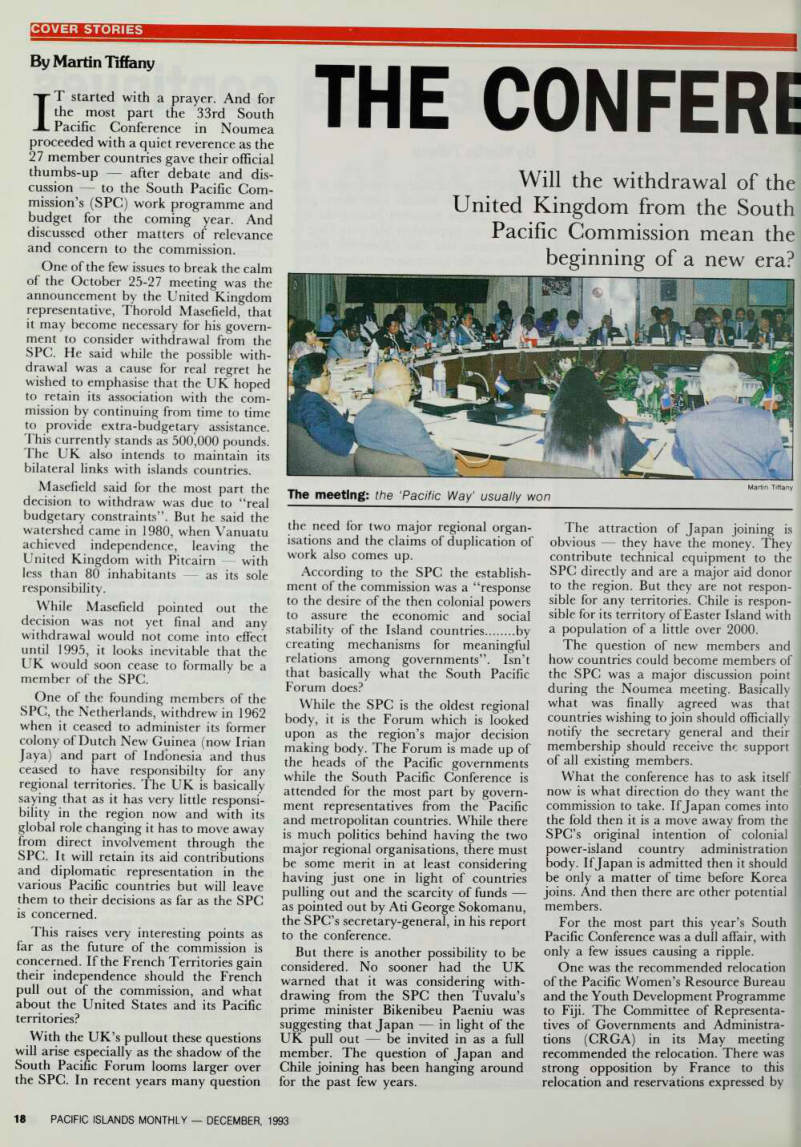
IT started with a prayer. And for the most part the 33rd South Pacific Conference in Noumea proceeded with a quiet reverence as the 27 member countries gave their official thumbs-up after debate and dis cussion to the South Pacific Com mission’s (SPC) work programme and budget for the coming year. And discussed other matters of relevance and concern to the commission.
One of the few issues to break the calm of the October 25-27 meeting was the announcement by the United Kingdom representative, Thorold Masefield, that it may become necessary for his govern ment to consider withdrawal from the SPC. He said while the possible with drawal was a cause for real regret he wished to emphasise that the UK hoped to retain its association with the com mission by continuing from time to time to provide extra-budgetary assistance.
This currently stands as 500,000 pounds.
The UK also intends to maintain its bilateral links with islands countries.
Masefield said for the most part the decision to withdraw was due to “real budgetary constraints”. But he said the watershed came in 1980, when Vanuatu
achieved independence, leaving the
United Kingdom with Pitcairn with less than 80 inhabitants as its sole
responsibility.
While Masefield pointed out the decision was not yet final and any withdrawal would not come into effect until 1995, it looks inevitable that the UK would soon cease to formally be a member of the SPC.
One of the founding members of the SPC, the Netherlands, withdrew in 1962 when it ceased to administer its former colony of Dutch New Guinea (now Irian Jaya) and part of Indonesia and thus ceased to have responsibilty for any regional territories. The UK is basically saying that as it has very little responsi bility in the region now and with its global role changing it has to move away from direct involvement through the SPC. It will retain its aid contributions and diplomatic representation in the various Pacific countries but will leave them to their decisions as far as the SPC is concerned.
This raises very interesting points as far as the future of the commission is concerned. If the French Territories gain their independence should the French pull out of the commission, and what about the United States and its Pacific territories?
With the UK’s pullout these questions will arise especially as the shadow of the South Pacific Forum looms larger over the SPC. In recent years many question
Will the withdrawal of the United Kingdom from the South Pacific Commission mean the beginning of a new era?
the need for two major regional organ isations and the claims of duplication of work also comes up.
According to the SPC the establish ment of the commission was a “response to the desire of the then colonial powers to assure the economic and social stability of the Island countries by creating mechanisms for meaningful relations among governments”. Isn’t that basically what the South Pacific Forum does?
While the SPC is the oldest regional body, it is the Forum which is looked upon as the region’s major decision making body. The Forum is made up of the heads of the Pacific governments while the South Pacific Conference is attended for the most part by govern ment representatives from the Pacific and metropolitan countries. While there is much politics behind having the two major regional organisations, there must be some merit in at least considering having just one in light of countries pulling out and the scarcity of funds as pointed out by Ati George Sokomanu, the SPC’s secretary-general, in his report to the conference.
But there is another possibility to be considered. No sooner had the UK warned that it was considering with drawing from the SPC then Tuvalu’s prime minister Bikenibeu Paeniu was suggesting that Japan in light of the UK pull out be invited in as a full member. The question of Japan and Chile joining has been hanging around for the past few years.
The attraction of Japan joining is obvious they have the money. They contribute technical equipment to the SPC directly and are a major aid donor to the region. But they are not respon sible for any territories. Chile is respon sible for its territory of Easter Island with a population of a little over 2000.
The question of new members and how countries could become members of the SPC was a major discussion point during the Noumea meeting. Basically what was finally agreed was that countries wishing to join should officially notify the secretary general and their membership should receive the support of all existing members.
What the conference has to ask itself now is what direction do they want the commission to take. If Japan comes into the fold then it is a move away from the SPC’s original intention of colonial power-island country administration body. If Japan is admitted then it should be only a matter of time before Korea joins. And then there are other potential members.
For the most part this year’s South Pacific Conference was a dull affair, with only a few issues causing a ripple.
One was the recommended relocation of the Pacific Women’s Resource Bureau and the Youth Development Programme to Fiji. The Committee of Representa tives of Governments and Administra tions (CRGA) in its May meeting recommended the relocation. There was strong opposition by France to this relocation and reservations expressed by
The meeting: the 'Pacific Way’ usually won
Martin Tiffany
New Caledonia and French Polynesia.
They feel that the proposed relocation would isolate the programme from the
SPC headquarters.
The conference was divided on the issue. While the majority favoured the move a number were against it. Two who were against it were Papua New Guinea and the Solomon Islands who felt the move would further disadvantage the Melanesian Kanaks in New Caledonia.
The outcome of this episode was PNG convincing the conference that a review of the situation funded by them was the solution.
Despite some disagreement the ‘Pacific Way’, of trying to reach agreement by consensus, prevailed for the most part of
the meeting.
Next year’s conference will be hosted and chaired by Tuvalu with Niue providing the vice-chairperson. □