Polynesian expands routes
p. 37 · Read in the full issue
AVIATION is coming of age in Samoa as the flag carrier of this tiny, developing Pacific island challenges the big boys with an ambitious plan to turn Western Samoa into a major Pacific airline hub.
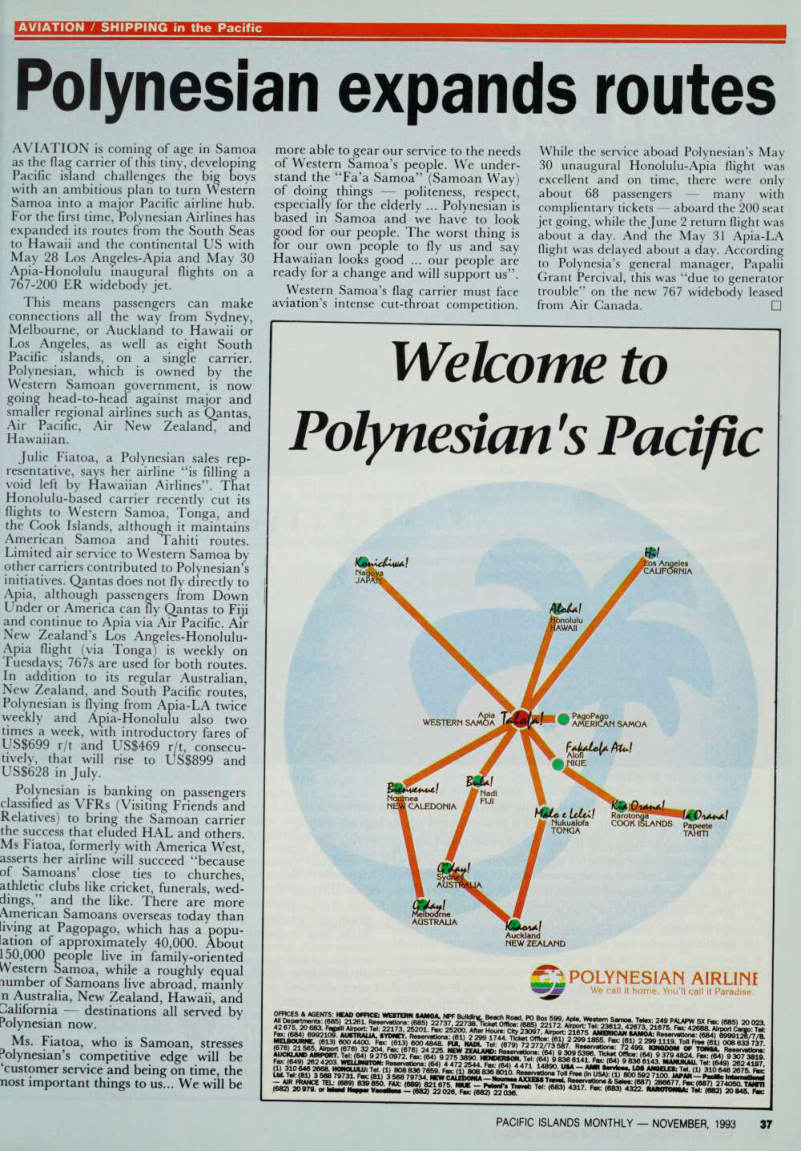
For the first time, Polynesian Airlines has expanded its routes from the South Seas to Hawaii and the continental US with May 28 Los Angeles-Apia and May 30 Apia-Honolulu inaugural flights on a 767-200 ER widebody jet.
This means passengers can make connections all the way from Sydney, Melbourne, or Auckland to Hawaii or Los Angeles, as well as eight South Pacific islands, on a single carrier, Polynesian, which is owned by the Western Samoan government, is now going head-to-head against major and smaller regional airlines such as Qantas, Air Pacific, Air New Zealand, and Hawaiian.
Julie Fiatoa, a Polynesian sales rep resentative, says her airline “is filling a void left by Hawaiian Airlines”. That Honolulu-based carrier recently cut its flights to Western Samoa, Tonga, and the Cook Islands, although it maintains American Samoa and Tahiti routes.
Limited air service to Western Samoa by other carriers contributed to Polynesian’s initiatives. Qantas does not fly directly to Apia, although passengers from Down Under or America can fly Qantas to Fiji and continue to Apia via Air Pacific. Air New Zealand’s Los Angeles-Honolulu- Apia flight (via Tonga) is weekly on Tuesdays; 767 s are used for both routes.
In addition to its regular Australian, New Zealand, and South Pacific routes,
Polynesian is flying from Apia-LA twice
weekly and Apia-Honolulu also two times a week, with introductory fares of US$699 r/t and US$469 r/t, consecu tively, that will rise to US$B99 and US$62B in July.
Polynesian is banking on passengers classified as VFRs (Visiting Friends and Relatives) to bring the Samoan carrier the success that eluded HAL and others.
Ms Fiatoa, formerly with America West, asserts her airline will succeed “because of Samoans’ close ties to churches, athletic clubs like cricket, funerals, wed dings,” and the like. There are more American Samoans overseas today than living at Pagopago, which has a popu lation of approximately 40,000. About
150,000 people live in family-oriented
Western Samoa, while a roughly equal
lumber of Samoans live abroad, mainly n Australia, New Zealand, Hawaii, and California destinations all served by Polynesian now.
Ms. Fiatoa, who is Samoan, stresses Polynesian’s competitive edge will be ‘customer service and being on time, the nost important things to us... We will be
more able to gear our service to the needs of Western Samoa’s people. We under stand the “Fa’a Samoa” (Samoan Way) of doing things politeness, respect, especially for the elderly ... Polynesian is based in Samoa and we have to look good for our people. The worst thing is for our own people to fly us and say Hawaiian looks good ... our people are ready for a change and will support us”.
Western Samoa’s flag carrier must face aviation’s intense cut-throat competition.
While the service aboad Polynesian’s May
30 unaugural Honolulu-Apia flight was
excellent and on time, there were only about 68 passengers many with complientary tickets aboard the 200 seat jet going, while the June 2 return flight was about a day. And the May 31 Apia-LA flight was delayed about a day. According
to Polynesia’s general manager, Papalii
Grant Percival, this was “due to generator trouble” on the new 767 widebody leased from Air Canada. □