Hot air
pp. 25-26 · Read in the full issue
The United Nations
THE problem of global warm ing was highlighted in many ways at the Preparatory Com mittee for next April’s Barba dos Global Conference on the Sustainable Development of Small Island Developing States, “the Islands Summit,” to be held in Barbados. The problem was perhaps too much hot air rising over the UN building in New York from the ten days preparatory committee meeting in September.
The delegates now feel that they need another meeting to sort out the question left unanswered by the session, not least because of a flood of amendments introduced by the Americans on the next to last day. The islands are now big enough bloc in the UN to force accept ance of a reconvened meeting.
Despite the problem of unfinished business, one experienced UN watcher described the meeting as “the most harmonious and relaxed preparatory conference ever held by the UN.” Any delays were not because of lack of effort; delegates set late night after night to try to complete the business before the close of the session.
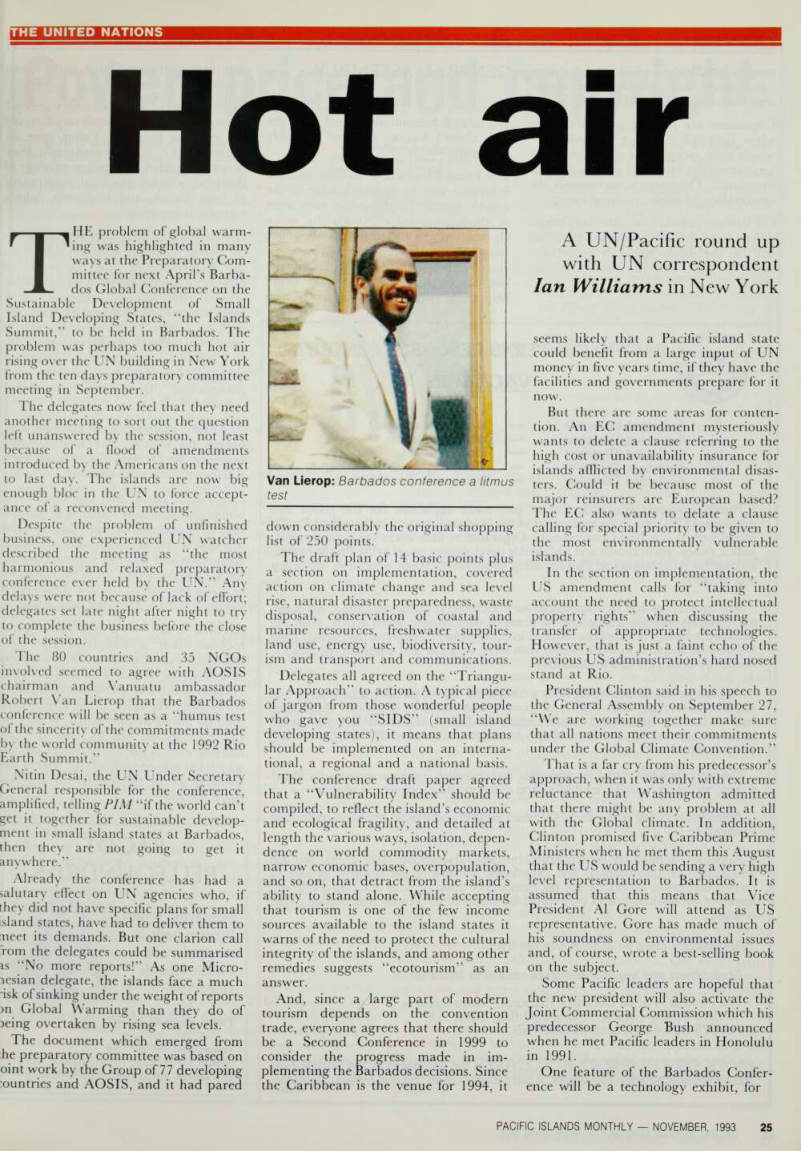
The 80 countries and 35 NGOs involved seemed to agree with AOSIS chairman and Vanuatu ambassador Robert Van Lierop that the Barbados conference will be seen as a “humus test of the sincerity of the commitments made by the world community at the 1992 Rio Earth Summit.”
Nitin Desai, the UN Under Secretary General responsible for the conference, amplified, telling PIM “if the world can’t get it together for sustainable develop ment in small island states at Barbados, then they are not going to get it anywhere.”
Already the conference has had a salutary effect on UN agencies who, if they did not have specific plans for small island states, have had to deliver them to meet its demands. But one clarion call rom the delegates could be summarised is “No more reports!” As one Micro icsian delegate, the islands face a much 'isk of sinking under the weight of reports m Global Warming than they do of Deing overtaken by rising sea levels.
The document which emerged from he preparatory committee was based on oint work by the Group of 77 developing mmtries and AOSIS, and it had pared
down considerably the original shopping list of 250 points.
The draft plan of 14 basic points plus a section on implementation, covered action on climate change and sea level rise, natural disaster preparedness, waste disposal, conservation of coastal and marine resources, freshwater supplies, land use, energy use, biodiversity, tour ism and transport and communications.
Delegates all agreed on the “Triangu lar Approach” to action. A typical piece of jargon from those wonderful people who gave you “SIDS” (small island developing states), it means that plans should be implemented on an interna tional, a regional and a national basis.
The conference draft paper agreed that a “Vulnerability Index” should be compiled, to reflect the island’s economic and ecological fragility, and detailed at length the various ways, isolation, depen dence on world commodity markets, narrow economic bases, overpopulation, and so on, that detract from the island’s ability to stand alone. While accepting that tourism is one of the few income sources available to the island states it warns of the need to protect the cultural integrity of the islands, and among other remedies suggests “ecotourism” as an answer.
And, since a large part of modern tourism depends on the convention trade, everyone agrees that there should be a Second Conference in 1999 to consider the progress made in im plementing the Barbados decisions. Since the Caribbean is the venue for 1994, it
A UN/Pacific round up
with UN correspondent
lan Williams in New York
seems likely that a Pacific island state could benefit from a large input of UN money in five years time, if they have the facilities and governments prepare for it now.
But there are some areas for conten tion. An EC amendment mysteriously wants to delete a clause referring to the high cost or unavailability insurance for islands afflicted by environmental disas ters. Could it be because most of the major reinsurers are European based?
The EC also wants to delate a clause calling for special priority to be given to the most environmentally vulnerable islands.
In the section on implementation, the US amendment calls for “taking into account the need to protect intellectual property rights” when discussing the transfer of appropriate technologies.
However, that is just a faint echo of the previous US administration’s hard nosed stand at Rio.
President Clinton said in his speech to the General Assembly on September 27, “We are working together make sure that all nations meet their commitments under the Global Climate Convention.”
That is a far cry from his predecessor’s approach, when it was only with extreme reluctance that Washington admitted that there might be any problem at all with the Global climate. In addition, Clinton promised five Caribbean Prime Ministers when he met them this August that the US would be sending a very high level representation to Barbados. It is assumed that this means that Vice President A 1 Gore will attend as US representative. Gore has made much of his soundness on environmental issues and, of course, wrote a best-selling book on the subject.
Some Pacific leaders are hopeful that the new president will also activate the Joint Commercial Commission which his predecessor George Bush announced when he met Pacific leaders in Honolulu in 1991.
One feature of the Barbados Confer ence will be a technology exhibit, for
Van Lierop: Barbados conference a litmus test
small island states, which could garner some world wide business for Pacific companies with particular expertise.
Organisers are looking particularly for what they all “fugitive technologies” which have escaped the attention of the large countries but could prove useful for the islands. They gave as an example the exploitation of ocean thermal energy.
On the less commercial side, conference officer Lelei Lelaulu promises that this will be the most open UN conference over for Non Governmental Organis ations.
General Assembly
No sooner had the Prep Comm for the first Islands Summit adjourned, than the 48th United Nations General Assembly convened.
The Prime Ministers of Samoa, and the Solomons will be speaking later in the month, but the Pacific got an early start in the session with a move by seven Central American countries to admit Taiwan as an independent state a move supported by many Taiwanese, but not by the governments in either Beijing or Taipei, each of which claim
that there is only one China, and Taiwan is part of it.
More successfully, the secretary general Boutros Ghali made a small step forward on resolving the East Timor issue on September 17. He met separately, then brought together the foreign minister of Portugal, which is the legal government of East Timor, and Indonesia, which
actually occupies it.
One hopes that there were no tongues in the cheeks when the ministers agreed on the importance of “the promotion of respect for human rights in all indivisible aspects (civil, political, economic, social and cultural) and fundamental freedoms in East Timor.” In a general spirit of good will “Both ministers agreed to continue to promote a balanced
exchange of visits by journalists and
personalities from their respective countries.”
The East Timorese should not hold their breath for results. The next meeting between the SG and the two ministers will be in May next year.
One Pacific Island that got an early, if unfair mention, was Palau. The Ameri can TVG programme Sixty Minutes did an expose of what it alleged to be corruption and waste of US taxpayers at the United Nations. One of the examples of waste mentioned was the Trusteeship Council and its meetings over Palau.
Needless to say, the programme did not mention that it has been the US’s insistence that it needs nuclear weapons to defend the 16,000 Palauans that has ensured that the Republic remains under trusteeship. However, if the referendum does go ahead as threatened, it may be that this session will see that the last meeting ever of the Trusteeship Council, which has played such a large part in the political life of the Pacific for the last three decades. □