Freeway
p. 24 · Read in the full issue
Hawaii
Freeway protest
By Ed Rampell
NATIVE Hawaiians protested the con troversial H-3 Freeway construction project with a commemorative demon stration and ceremony at Halawa Valley, Oahu, on August 29. The Halawa Coalition marched in the Valley near Honolulu to hold a religious observance and vigil marking the one year anniver sary of a major land and religion struggle. Hawaiians chanted to ancient gods and offered them hookupu{g ifts) at what some believe are unique heiaus precontact temples. Some marchers were traditionally dressed as warriors. The demonstrators were met by Ella Paguya, who has been allowed to maintain a vigil at the site.
The activists say they oppose the desecration of up to 26 sacred sites and burial grounds. “As this unholy road progresses, we’re going to see a lot of this destroyed,” declared Lilikala Kame’elehiwa, acting director of the University of Hawaii’s Center for Ha waiian Studies. The Coalition contends the Hawaii state government tried to cover-up the discovery of a rare
prechristian temple site found in the Valley. The Coalition believes the heiaus are a male and female temple complex, or luakini and hale o papa. If true, this would be a unique archaeological find in Hawaii, where so much Polynesian culture has been lost. The problem is that the remains were found directly in the path of a huge freeway construction project backed by the Hawaii state government and federal funds. The Halawa Coalition alleges that the long under-construction billion dollar road is per mile the most expensive freeway project ever. They also charge that the H-3 Freeway’s main purpose is to link Pearl Harbour with a U!S Marine base on the other side of Oahu.
On March 23, 1992, Bishop Museum anthropologist Barry Nakamura charged that the museum and state “deliberately covered-up” information about the pur ported Halawa heiaus. Nakamura con tended that the alleged cover-up was intended to allow the freeway project to continue unimpeded at a press confer
ence. The museum and Nakamura were contracted by the state government to survey the land for historic sites in accordance with preservation laws.
Nakamura was fired by the museum.
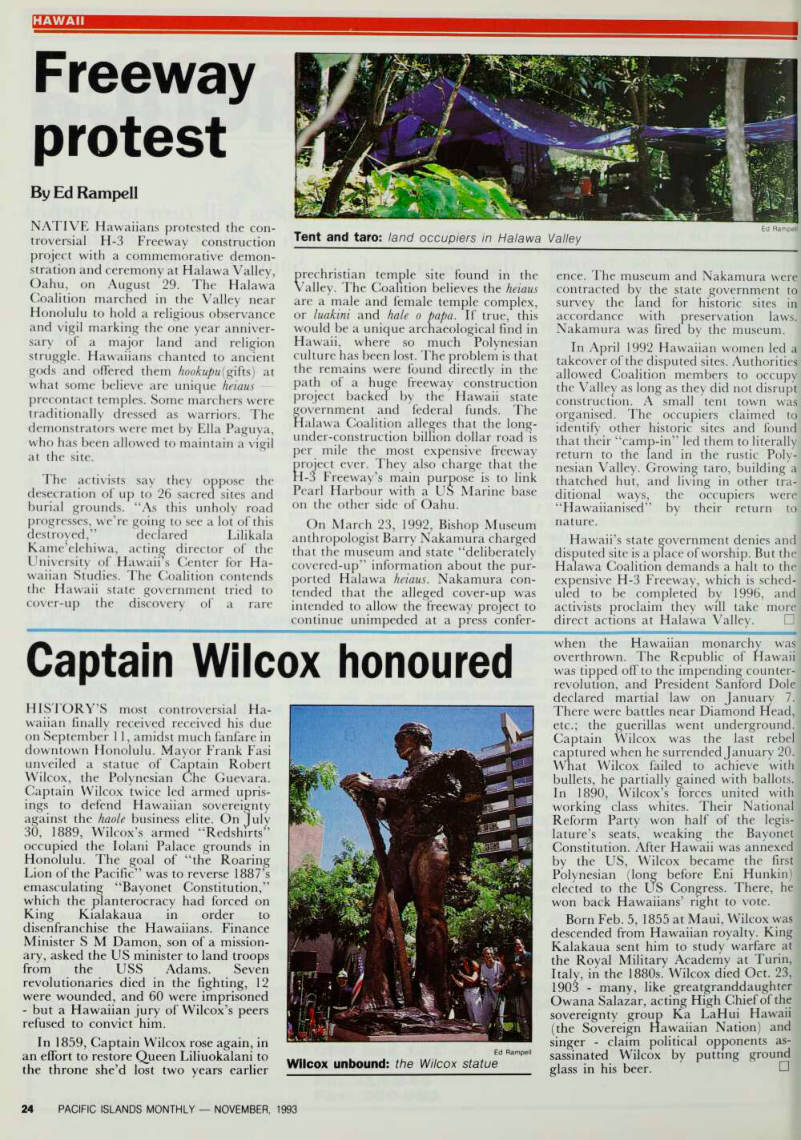
In April 1992 Hawaiian women led a takeover of the disputed sites. Authorities allowed Coalition members to occupy the Valley as long as they did not disrupt construction. A small tent town was organised. The occupiers claimed to identify other historic sites and found that their “camp-in” led them to literally return to the land in the rustic Poly
nesian Valley. Growing taro, building a
thatched hut, and living in other tra ditional ways, the occupiers were “Hawaiianised” by their return to nature.
Hawaii’s state government denies and disputed site is a place of worship. But the Halawa Coalition demands a halt to the expensive H-3 Freeway, which is sched uled to be completed by 1996, and activists proclaim they will take more direct actions at Halawa Valley. □
Tent and taro: land occupiers in Halawa Valley
Ed Rampell