Law and tradition
From The Editor’S Desk
TO an outsider the killing of Nuutai Mafulu in Western Samoa in late September (see story page 17) would be nothing short of murder. Plain and
simple, cut and dry.
Indeed, under the Western system of justice stipulated in Western Samoa’s post-independence constitution it would be premeditated murder. But the fact that it could be a matai (chiefs) ordered execution is causing a dilemma in the country. A dilemma that needs to be sorted out now. Or its implications are going to have far-reaching effects on life (and death) in Western Samoa in the future.
Mafulu’s crime was he refused to contrib ute to his village affairs, resisted council
decisions, and played cricket for and trans ported players of an other village. On the orders of the matai the villagers burnt the de ceased shop, bus and jeep although state ments conflict over who ordered the
shooting.
But the fact remains that under the guise of traditional law the matai have broken the constitutional law and therefore should be
charged accordingly.
However, it is not that
simple and police seem
to talking a softly, softly approach as they
try to figure out what to do for the best.
Life in Western Samoa is based for the most part on fa’aSamoa (the Samoan way). If you are Samoan you obey Samoan laws as laid down by matai although they often clash with consti tutional law and the issue of individual rights versus traditional authority raises its head.
Traditional law is enshrined in the Western Samoa constitution as long as the traditional way is confined to the limits of the constitution. One drawback of having two laws is offenders have sometimes been charged twice once by the matai and again by the court for the same crime But Matai councils play a large part in
keeping villages orderly and villagers
respect their authority. Even the Com missioner of Police, Galuvad Tanielu, realises matai perform the vital task of keeping the country in order. A task that saves the country the expense of increas ing the size of the relatively small police force. Matai authority has also been given some legal basis as the present government changed the law to allow judges to take village fines into account when passing sentence.
But this overlap of laws is dangerous as seen in this case as where does traditional law end and constitutional law begin. Especially as the matai now have been given some legal recognition, I The killing of Mafulu and the burning of his property ultimately involves almost the whole village. So far 36 villagers have i pleaded guilty to arson, wilful damage
and throwing stones. It is a delicate matter that needs to be given a lot of thought as it will affect the future of West ern Samoan life.
Meanwhile, the Western Samoa situ ation could and should be studied by many other Pacific countries where custom ary law exists.
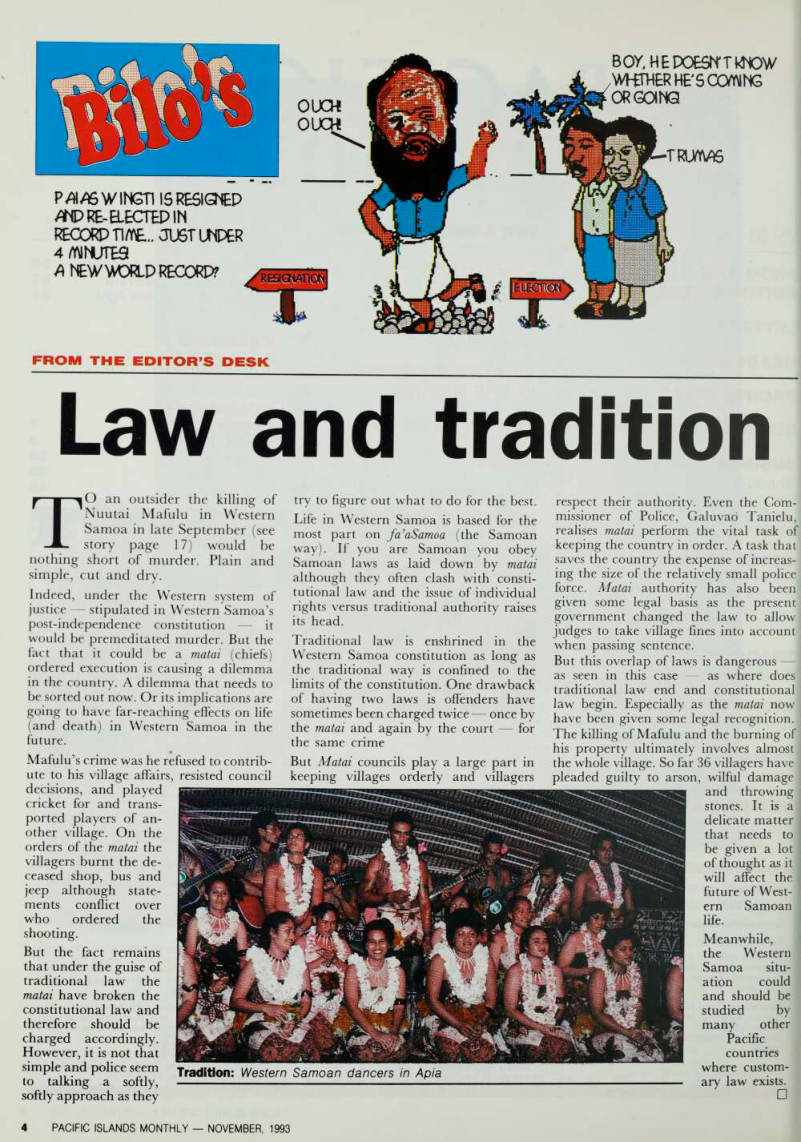
Tradition: Western Samoan dancers in Apia