Magic
pp. 54-55 · Read in the full issue
Yachting
Magic of the reefs
By Sally Andrew
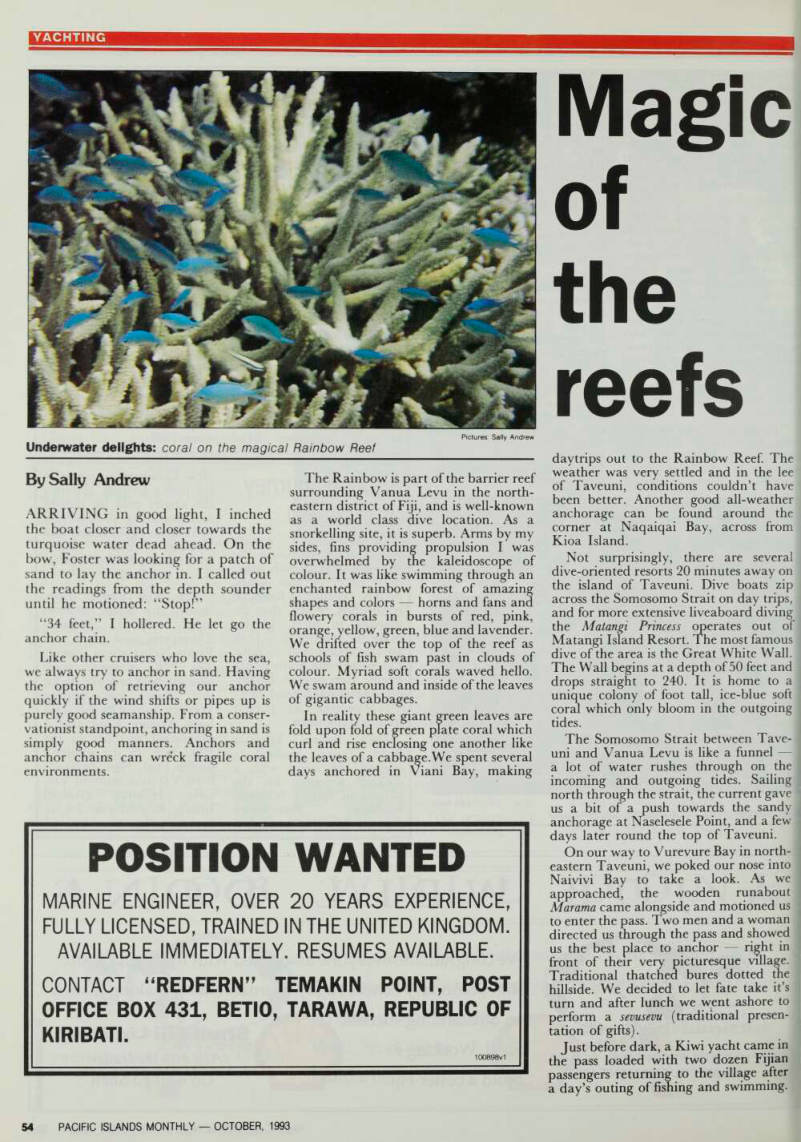
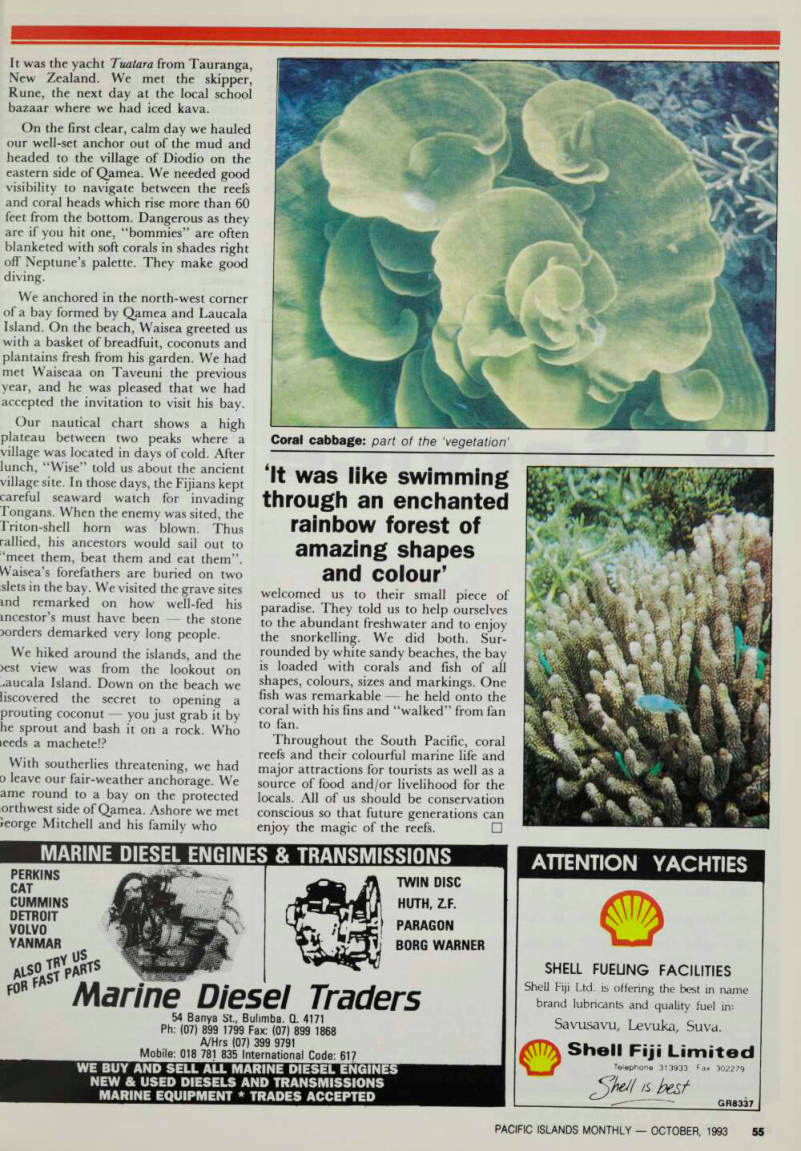
The Rainbow is part of the barrier reef surrounding Vanua Levu in the north eastern district of Fiji, and is well-known as a world class ive i ocation . A s a snorkelling site, it is superb. Arms by my sides, fins providing propulsion I was overwhelmed by the kaleidoscope of colour. It was like swimming through an enchanted rainbow forest of amazing shapes and colors horns and fans and flowery corals in bursts of red, pink, orang e, yellow, green, blue and lavender We § nf [ ed ove “ the top Q f the reef as schools of fish swam past in clouds of colour. Myriad soft corals waved hello, We swam around and inside of the leaves of gigantic cabbages, In reality these giant green leaves are fold upon fold of green plate coral which curl and rise enclosing one another like the leaves of a cabbage. We spent several days anchored in Viani Bay, making
a r> r» • .1-1 Tii ARRIVING in good light, I inched the boat closer and closer towards the turquoise water dead ahead. On the bow, Foster was looking for a patch of sand to lay the anchor in. I called out the readings from the depth sounder until he motioned: “Stop!” uoA r „ T > n . tt , , 34 feet, I hollered. He let go the anchor chain.
Like other cruisers who love the sea, we always try to anchor in sand. Having the option of retrieving our anchor quickly if the wind shifts or pipes up is
purely good seamanship. From a conser
vationist standpoint, anchoring in sand is simply good manners. Anchors and anchor chains can wreck fragile coral environments.
daytrips out to the Rainbow Reef. The weather was very settled and in the lee of Taveuni, conditions couldn’t have been better. Another good all-weather anchorage can be found around the corner at Naqaiqai Bay, across from Kioa Island.
Not surprisingly, there are several dive-oriented resorts 20 minutes away on the island of Taveuni. Dive boats zip across the Somosomo Strait on day trips, and for more extensive liveaboard diving the Matangi Princess operates out of Matangi Island Resort. The most famous dive of the area is the Great White Wall.
The Wall begins at a depth of 50 feet and drops straight to 240. It is home to a unique colony of foot tall, ice-blue soft coral which only bloom in the outgoing tides.
The Somosomo Strait between Tave uni and Vanua Levu is like a funnel — a lot of water rushes through on the incoming and outgoing tides. Sailing north through the strait, the current gave us a bit of a push towards the sandy anchorage at Naselesele Point, and a few days later round the top of Taveuni.
On our way to Vurevure Bay in north eastern Taveuni, we poked our nose into Naivivi Bay to take a look. As we approached, the wooden runabout Marama came alongside and motioned us to enter the pass. Two men and a woman directed us through the pass and showed us the best place to anchor — right in front of their very picturesque village.
Traditional thatched bures dotted the hillside. We decided to let fate take it’s turn and after lunch we went ashore to perform a sevusevu (traditional presen tation of gifts).
Just before dark, a Kiwi yacht came in the pass loaded with two dozen Fijian passengers returning to the village after a day’s outing of fishing and swimming.
Underwater delights: coral on the magical Rainbow Reef
Pictures: Sally Andrew
It was the yacht Tuatara from Tauranga, New Zealand. We met the skipper, Rune, the next day at the local school bazaar where we had iced kava.
On the first clear, calm day we hauled our well-set anchor out of the mud and headed to the village of Diodio on the eastern side of Qamea. We needed good visibility to navigate between the reefs and coral heads which rise more than 60 feet from the bottom. Dangerous as they are if you hit one, “bommies” are often blanketed with soft corals in shades right off Neptune’s palette. They make good diving.
We anchored in the north-west corner of a bay formed by Qamea and Laucala Island. On the beach, Waisea greeted us with a basket of breadfuit, coconuts and plantains fresh from his garden. We had met Waiseaa on Taveuni the previous year, and he was pleased that we had accepted the invitation to visit his bay.
Our nautical chart shows a high plateau between two peaks where a village was located in days of cold. After lunch, “Wise” told us about the ancient village site. In those days, the Fijians kept careful seaward watch for invading Tongans. When the enemy was sited, the Triton-shell horn was blown. Thus rallied, his ancestors would sail out to ‘meet them, beat them and eat them”.
Waisea’s forefathers are buried on two slets in the bay. We visited the grave sites md remarked on how well-fed his mcestor’s must have been the stone demarked very long people.
We hiked around the islands, and the >est view was from the lookout on lsland. Down on the beach we liscovered the secret to opening a prouting coconut you just grab it by he sprout and bash it on a rock. Who iceds a machete!?
With southerlies threatening, we had d leave our fair-weather anchorage. We ame round to a bay on the protected orthwest side of Qamea. Ashore we met Jeorge Mitchell and his family who
‘lt was like swimming through an enchanted rainbow forest of amazing shapes and colour’
welcomed us to their small piece of paradise. They told us to help ourselves to the abundant freshwater and to enjoy the snorkelling. We did both. Sur rounded by white sandy beaches, the bay is loaded with corals and fish of all shapes, colours, sizes and markings. One fish was remarkable he held onto the coral with his fins and “walked” from fan to fan.
Throughout the South Pacific, coral reefs and their colourful marine life and major attractions for tourists as well as a source of food and/or livelihood for the locals. All of us should be conservation conscious so that future generations can enjoy the magic of the reefs. □
Coral cabbage: part of the ‘vegetation’