the move
pp. 35-37 · Read in the full issue
FIJI - Into the Third Decade
A nation on the move
ON the 10th of this month, Fiji marks its 23rd year of independence from its colonial ruler, Britain.
Since those years the country has grown from strength to strength, be coming the hub of the South Pacific. Indepen dent Fiji’s first prime minister Ratu Sir Kami sese Mara then said
“What independence
does is put our future destiny firmly in our own hands and gives us the opportunity to solve our own problems for our selves and develop our own country to providee
a better and happier life for our people.
We are already, through our rural development programme, giving our people in the country the opportunity to participate in planning and their ready response augurs well for participation by all on a wider scale. For we all have our own part to play. To follow the words of the late President Kennedy, ‘let us not think what my country can do for me but what I can do for my country. And then let us proceed to do it’.”
Mara and his Fijian-dominated Al liance Party remained in power for 17 y'ears from independence. It was ousted in the April 1987 general election by the Labour-National Federation Party co ition which was dominated by Indians descendents of indentured labourers Irst brought from India by the British government in 1879 to work on cotton ind sugar cane plantations. The co dition government, headed by prime ninister Dr Timoci Bavadra, was re noved at gunpoint by soldiers led by hen Lieutenant-Colonel Sitiveni Ra )uka who became prime minister follow ng the 1992 general election. Mara is iow one of the two vice-presidents to lead of state Ratu Sir Penaia Ganilau governor-general before the coups). Fiji •ecame a republic on October 7, 1987 fter Rabuka’s two military coups (May 4, September 25) abrogated the 1970
constitution and removed Queen Eliza beth II as head of state.
In July 1990, president Ganilau prom ulgated a new constitution which gave
indigenous Fijians, who make up slightly
more than half the 760,000 population, a permanent majority in the 70-seat parliament with 37 seats. This did not go well with the Indians who were allocated only 27 seats although they number almost 46 per cent of the population.
Five seats were for other races and one for Rotumans. The controversial 1990 constitution is still the major bone of contention for the Indian parties, Labour and NFP, in their quest for equal rights and unity among all communities. . The Indian parties, which could well remain on the opposition benches perma nently, are seeking a review of the constitution. Labour entered parliament after last year’s election following a pact with Rabuka; promising him support for prime ministership in return for a review of the constitution, the Agricultural Landlords and Tenants Act, Value- Added Tax and the Labour Refrom Laws. The party walked out of parlia ment in June and withdrew its support for Rabuka, claiming the prime minister had not kept his word on the promised reviews. Rabuka has since set up an extended cabinet sub-committee, which includes opposition leader Jai Ram
Reddy, to look into the review of the consti tution.
Fiji is regarded as the most active South Pa cific nation in interna tional affairs. From 1970 to 1975, it was the first and only Pacific island member of the United Nations Gen eral Assembly. British colonialism from 1874 to 1970 left a legacy of peace, law, government institutions and econ omic infrastructure.
The rising standard of living was a conse quence of the introduc tion of the Indian in
dentured labourers to cultivate sugar for export. Taxes from this and other
foreign-oriented enterprises financed
health and education facilities. The harmonious colonial relationship with
Britain-led Fiji on independence to join
the Commonwealth.
Trade, aid and investment flows from Britain were predominant during the 1960 s but have declined relatively as Fiji diversified its economic relations with other bilateral and international part ners. The country’s international econ omic policies are geared to its national
development objectives which stress
growth of production and jobs; equitable distribution; improved social conditions; financial stability; and unity between ethnic groups.
Savenaca Siwatibau, former governor of the Reserve Bank of Fiji and currently the head of the Pacific Operations Centre, ESCAP, in Port Vila, had this to say in a report in The Future of Asia-Pacific Economies Pacific Islands at the Cross roads?: “the Fiji economy was subjected to a series of domestic and external shocks in 1987. The domestic shocks came in the wake of the two coups of that year. The economic and psychological
climate changed dramatically following
these events. Investment and consumer
confidence evaporated quickly. Capital
flight became the preoccupation of many.
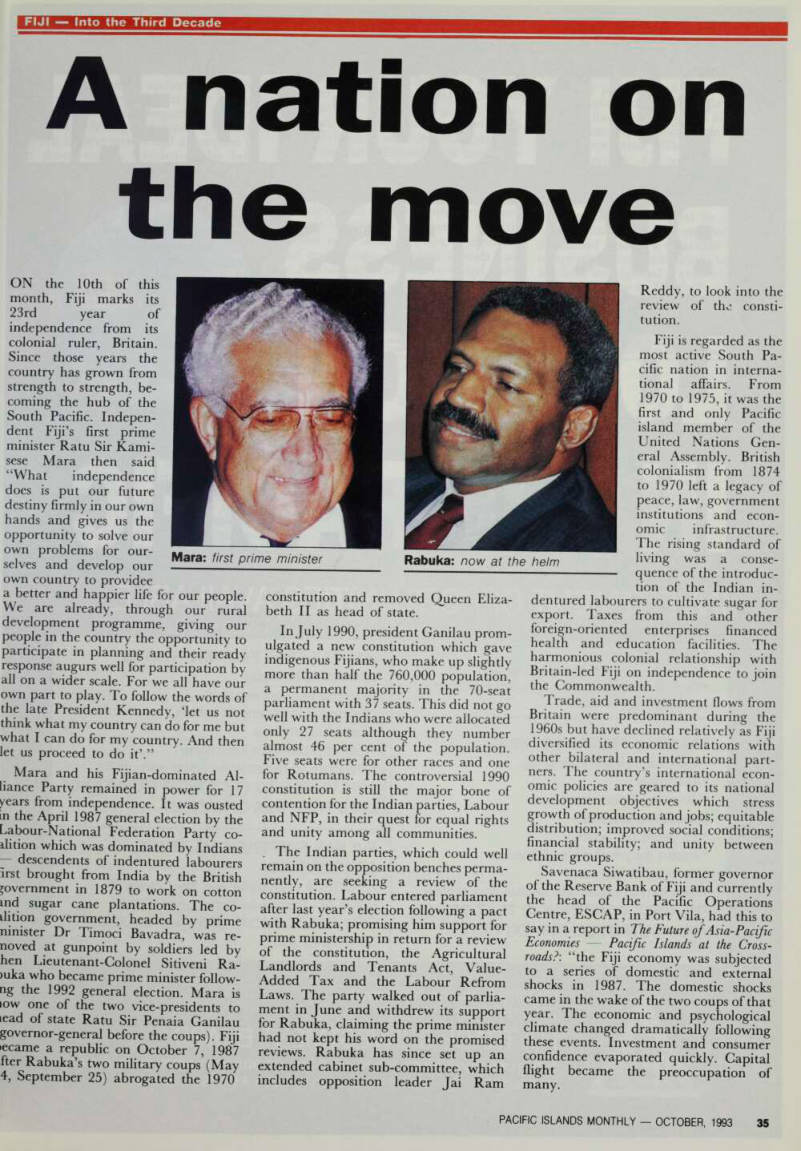
Mara: first prime minister
Rabuka: now at the helm
Most attempted capital flight through the banks but others sought avenues outside the banking system. Exporters deferred the repatriation of foreign exchange receipts but importers, because of expected falling consumer spending, delayed import orders and attempted to run down stocks. Residents who held short-term external debts sought accom modation from their banks to settle them early.
“The number of tourists declined sharply as their home governments advised them to avoid visiting Fiji until further notice. Sugar harvests were delayed through a strike and export products were black-banned in a number of economies of destination. Foreign exchange receipts fell dramatically ac companied by falling imports. The import substituting businesses soon re alised it would be difficult to survive within a contracting market and that long-term survival required a change in attitude and reorientation towards ex porting. Many business firms were forced to lay off workers and/or reduce salaries and wages.
“The overall deficit in the balance of payments widened sharply. External financing sources were effectively closed.
The government, which used to have long queues of international bankers wishing to lend to it, found its overtures for external accommodation politely ignored. Only two banks, both with branches in Fiji, responded positively and concluded stand-by arrangements, each for Aslo million, with the Reserve Bank of Fiji.
“The government and public sector enterprises whose financial positions had deteriorated rapidly sought accommo dation from the Reserve Bank. The bank’s claims from the public sector increased from zero in April to over $5O million in October 1987. That trend needed to be reversed quickly through drastic expenditure policies. The govern ment announced a 15 per cent reduction in public service salanes and the public sector enterprises had their budgetary allocations cut by 50 per cent. They were required to reduce operating expendi tures, including salaries, and were in formed that further requests for govern ment assistance would not be accommo dated.”
Traditionally, Fiji’s most valuable "esource has been sugar, generating up to :hree-fourths of export earnings, followed 3y coconut products and gold, generat ng up to half the remainder (Fiji government 1985, appendix D). The government’s policies of diversification md industrialisation have modified the >attem by raising fish products from zero n 1970 to six per cent in 1990, and imber products from less than one per ent to five per cent, and by exporting lew manufactured goods such as cement. iaint and boats. Garment exports
doubled and redoubled in the 1980 s.
The success of Fiji’s post-coup policies has been mixed. No state broke off diplomatic relations with Fiji save India, whose mission in Suva was expelled in 1990. Relations with international or ganisations not affiliated with the Com monwealth continued uninterrupted.
The island state leaders of the South Pacific Forum were disinclined to put Fiji’s deviation from constitutional gov ernment on the Forum agenda, regard ing this as a domestic, not a regional, issue and Tonga, Marshall Islands and the Melanesian states early stated their intention to work with the new govern ment in spite of Australia and New
Zealand’s disapproval. South-east and East Asian governments likewise dealt with Fiji pragmatically. By the end of 1987, Indonesian and Malaysian del egations had visited Fiji and entered into negotiations to enhance trade and econ omic cooperation with Fiji.
The return to constitutional and elected government last year has sal vaged Fiji’s standing in the eyes of democratic partners, and raised its chances of reinstatement in the Com monwealth. Fiji will continue to be a significant trader, a desirable venue for
international organisations, an import
ant hub for regional transportation and a strong player in South Pacific foreign affairs. □