Nauru’s Forum
p. 29 · Read in the full issue
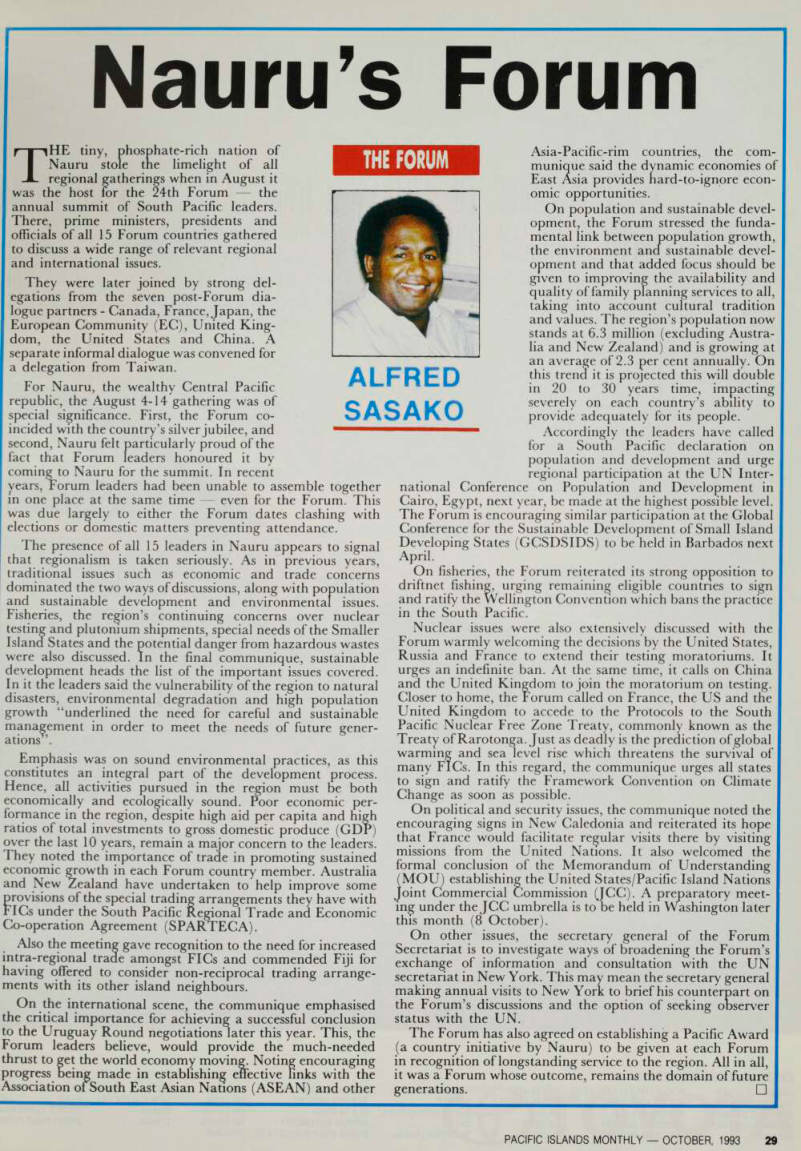
THE tiny, phosphate-rich nation of Nauru stole the limelight of all regional gatherings when in August it was the host for the 24th Forum the annual summit of South Pacific leaders.
There, prime ministers, presidents and officials of all 15 Forum countries gathered to discuss a wide range of relevant regional and international issues.
They were later joined by strong del egations from the seven post-Forum dia logue partners - Canada, France, Japan, the European Community (EC), United King dom, the United States and China. A separate informal dialogue was convened for a delegation from Taiwan.
For Nauru, the wealthy Central Pacific republic, the August 4-14 gathering was of special significance. First, the Forum co incided with the country’s silver jubilee, and second, Nauru felt particularly proud of the fact that Forum leaders honoured it by coming to Nauru for the summit. In recent
years, Forum leaders had been unable to assemble together in one place at the same time even for the Forum. This was due largely to either the Forum dates clashing with elections or domestic matters preventing attendance.
The presence of all 15 leaders in Nauru appears to signal that regionalism is taken seriously. As in previous years, traditional issues such as economic and trade concerns dominated the two ways of discussions, along with population and sustainable development and environmental issues.
Fisheries, the region’s continuing concerns over nuclear testing and plutonium shipments, special needs of the Smaller Island States and the potential danger from hazardous wastes were also discussed. In the final communique, sustainable development heads the list of the important issues covered.
In it the leaders said the vulnerability of the region to natural
disasters, environmental degradation and high population
growth “underlined the need for careful and sustainable management in order to meet the needs of future gener ations’’.
Emphasis was on sound environmental practices, as this constitutes an integral part of the development process.
Hence, all activities pursued in the region must be both economically and ecologically sound. Poor economic per formance in the region, despite high aid per capita and high ratios of total investments to gross domestic produce (GDP) over the last 10 years, remain a major concern to the leaders.
They noted the importance of trade in promoting sustained economic growth in each Forum country member. Australia and New Zealand have undertaken to help improve some provisions of the special trading arrangements they have with FICs under the South Pacific Regional Trade and Economic
Co-operation Agreement (SPARTECA).
Also the meeting gave recognition to the need for increased intra-regional trade amongst FICs and commended Fiji for having offered to consider non-reciprocal trading arrange ments with its other island neighbours.
On the international scene, the communique emphasised the critical importance for achieving a successful conclusion to the Uruguay Round negotiations later this year. This, the Forum leaders believe, would provide the much-needed thrust to get the world economy moving. Noting encouraging progress being made in establishing effective finks with the Association of South East Asian Nations (ASEAN) and other
Asia-Pacific-rim countries, the com munique said the dynamic economies of East Asia provides nard-to-ignore econ omic opportunities.
On population and sustainable devel opment, the Forum stressed the funda mental link between population growth, the environment and sustainable devel opment and that added focus should be given to improving the availability and quality of family planning services to all, taking into account cultural tradition and values. The region’s population now stands at 6.3 million (excluding Austra lia and New Zealand) and is growing at an average of 2.3 per cent annually. On this trend it is projected this will double in 20 to 30 years time, impacting severely on each country’s ability to provide adequately for its people.
Accordingly the leaders have called for a South Pacific declaration on population and development and urge regional participation at the UN Inter
national Conference on Population and Development in Cairo, Egypt, next year, be made at the highest possible level.
The Forum is encouraging similar participation at the Global Conference for the Sustainable Development of Small Island Developing States (GCSDSIDS) to be held in Barbados next April.
On fisheries, the Forum reiterated its strong opposition to driftnet fishing, urging remaining eligible countries to sign and ratify the Wellington Convention which bans the practice in the South Pacific.
Nuclear issues were also extensively discussed with the Forum warmly welcoming the decisions by the United States, Russia and France to extend their testing moratoriums. It urges an indefinite ban. At the same time, it calls on China and the United Kingdom to join the moratorium on testing.
Closer to home, the Forum called on France, the US and the United Kingdom to accede to the Protocols to the South Pacific Nuclear Free Zone Treaty, commonly known as the Treaty of Rarotonga. Just as deadly is the prediction of global warming and sea level rise which threatens the survival of many FICs. In this regard, the communique urges all states to sign and ratify the Framework Convention on Climate Change as soon as possible.
On political and security issues, the communique noted the encouraging signs in New Caledonia and reiterated its hope that France would facilitate regular visits there by visiting missions from the United Nations. It also welcomed the formal conclusion of the Memorandum of Understanding (MOU) establishing the United States/Pacific Island Nations Joint Commercial Commission (JCC). A preparatory meet ing under the JCC umbrella is to be held in Washington later this month (8 October).
On other issues, the secretary general of the Forum Secretariat is to investigate ways of broadening the Forum’s exchange of information and consultation with the UN secretariat in New York. This may mean the secretary general making annual visits to New York to brief his counterpart on the Forum’s discussions and the option of seeking observer status with the UN.
The Forum has also agreed on establishing a Pacific Award (a country initiative by Nauru) to be given at each Forum in recognition of longstanding service to the region. All in all, it was a Forum whose outcome, remains the domain of future generations. □