America on trial
pp. 26-27 · Read in the full issue
Hawaii
By Ed Rampell
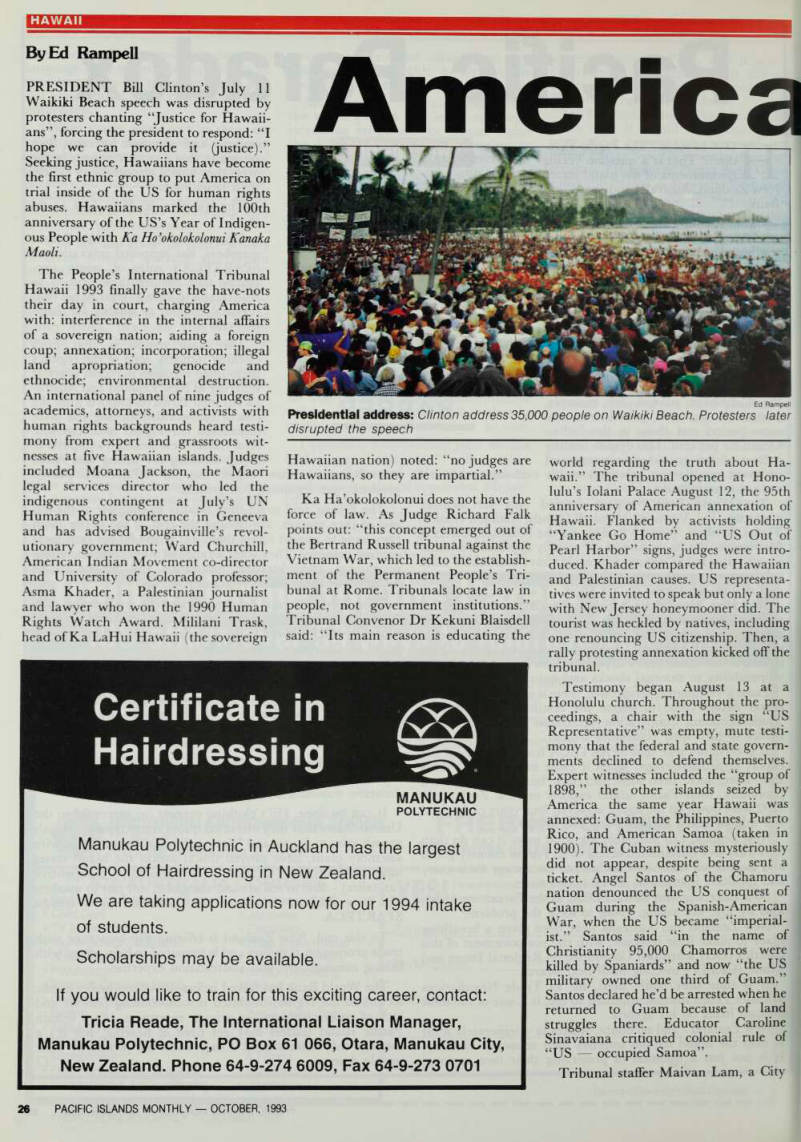
PRESIDENT Bill Clinton’s July 11 Waikiki Beach speech was disrupted by protesters chanting “Justice for Hawaii ans”, forcing the president to respond: “I hope we can provide it (justice).”
Seeking justice, Hawaiians have become the first ethnic group to put America on trial inside of the US for human rights abuses. Hawaiians marked the 100th anniversary of the US’s Year of Indigen ous People with Ka Ho’okolokolonui Kanaka Maoli.
The People’s International Tribunal Hawaii 1993 finally gave the have-nots their day in court, charging America with: interference in the internal affairs of a sovereign nation; aiding a foreign coup; annexation; incorporation; illegal land apropriation; genocide and ethnocide; environmental destruction.
An international panel of nine judges of academics, attorneys, and activists with human rights backgrounds heard testi mony from expert and grassroots wit nesses at five Hawaiian islands. Judges included Moana Jackson, the Maori legal services director who led the indigenous contingent at July’s UN Human Rights conference in Geneeva and has advised Bougainville’s revol utionary government; Ward Churchill, American Indian Movement co-director and University of Colorado professor; Asma Khader, a Palestinian journalist and lawyer who won the 1990 Human Rights Watch Award. Mililani Trask, head of Ka LaHui Hawaii (the sovereign
Hawaiian nation) noted: “no judges are Hawaiians, so they are impartial.”
Ka Ha’okolokolonui does not have the force of law. As Judge Richard Falk points out: “this concept emerged out of the Bertrand Russell tribunal against the Vietnam War, which led to the establish ment of the Permanent People’s Tri bunal at Rome. Tribunals locate law in people, not government institutions.”
Tribunal Convenor Dr Kekuni Blaisdell said; “Its main reason is educating the
world regarding the truth about Ha waii.” The tribunal opened at Hono lulu’s lolani Palace August 12, the 95th anniversary of American annexation of Hawaii. Flanked by activists holding “Yankee Go Home” and “US Out of Pearl Harbor” signs, judges were intro duced. Khader compared the Hawaiian and Palestinian causes. US representa tives were invited to speak but only a lone with New Jersey honeymooner did. The tourist was heckled by natives, including one renouncing US citizenship. Then, a rally protesting annexation kicked off the tribunal.
Testimony began August 13 at a Honolulu church. Throughout the pro ceedings, a chair with the sign “US Representative” was empty, mute testi mony that the federal and state govern ments declined to defend themselves.
Expert witnesses included the “group of 1898,” the other islands seized by America the same year Hawaii was annexed: Guam, the Philippines, Puerto Rico, and American Samoa (taken in 1900). The Cuban witness mysteriously did not appear, despite being sent a ticket. Angel Santos of the Chamoru nation denounced the US conquest of Guam during the Spanish-American War, when the US became “imperial ist.” Santos said “in the name of Christianity 95,000 Chamorros were killed by Spaniards” and now “the US military owned one third of Guam.”
Santos declared he’d be arrested when he returned to Guam because of land struggles there. Educator Caroline Sinavaiana critiqued colonial rule of “US occupied Samoa”.
Tribunal staffer Maivan Lam, a City
Ed Rampell Presidential address: Clinton address 35,000 people on Waikiki Beach. Protesters later disrupted the speech
International tribunal
finds mainland guilty
on eight counts
University of New York law professor, testified “Let the Australian high
court Mabo ruling (granting Aborigine
land title) guide you. Mabo proves Western courts can change and reverse their minds and policies.” Attorney Mililani Trask attacked annexation and statehood, declaring “the US Congress could not pass a law to annex Hawaii (via a two-thirds Senate vote) so a Joint Resolution by both Houses of Congress was used instead. Unlike Texas, the only other formal nation-state to become a part of the union, Hawaiians were not allowed a plebiscite to approve annex ation ... international law was violated by statehood ... The US made fraudulent claims to the United Nations in order to have Hawaii removed from the UN’s list of non-self-goveming territories in 1959.
Natives were not given a referendum on statehood ... To remain a territory or
become a state were the only options on the federal ballot. Independence and other choices were never presented ...
There’s no evidence the UN committee on decolonisation ever met to consider
Hawaii. Only the Hawaii records are missing. The US just withdrew Hawaii from UN consideration”.
Trask also charged America with “breach of trust” regarding two Ha waiian land trusts, and alleged “half a million acres are unaccounted for”.
But perhaps the most moving testi mony came from grassroots Hawaiians.
Illiterate Raymond Kamaka claimed the US military used his Windward Oahu land for target practice and then reneged on promises to clean the land, that were deemed too expensive. Marie Beltran brought onlookers to tears, testifying police posted eviction notices on her North Shore campsite. Breaking down, Beltran said “What really hurts is when they call me ‘squatter’. How can I be a squatter when I’m a Hawaiian living on my native land? It’s the government who’s the squatter.”
Mary-Ann Bennett’s account was even more heartbreaking. Testfying that the authorities separated her from her parents upon birth because they suffered from leprosy, the 51-year-old Hawaiian said the government neglected to provide her with medical and other care and gave her to a relative who sexually abused her. Bennett is suing the govern ment for millions.
The tribunal travelled to Maui, Molokai, Kauai, and the Big Island to hear more testimony. It returned to Honolulu to render its unanimous ver dict August 20, read by the panel’s only Polynesian, Moana Jackson: America was guilty as charged on all 8 counts.
The tribunal recommendation that all Hawaiian trust lands “should be re turned to control of Hawaiians” brought applauding onlookers to their feet.
August 21, 34th anniversary of Ha waii’s admission to the union, the tribal tribunal closed with an anti-statehood rally. Blaisdell declared “we’re not Americans. Statehood is theft”. Social outcasts, the homeless, poor, lepers, and arrested, found their court of last resort as the judged became judges. The People’s International Tribunal Hawai’i created an indigenous record of wrongs which Hawaiians could bring to bear on America in international bodies like the UN, as Hawaii seeks reinscription on the list of non-self-governing territories, like New Caledonia was. Pacific islanders have found a new decolonising tool. As an Aotearoa chief observing the people’s court told PIM: “I came to observe the tribunal because Maoris intend to make a claim, too.”
So far, Presidents Harrison, Cleveland, McKinley, and now Clinton have failed to provide the justice the tribunal Dromises.
rotesters: Hawaiian flags flying upside down as a mark of distress
Production: tribunal judges and witnesses being introduced in downtown Honolulu
Ed Rampell Protest: Academic Lilikala Kame'eleihiwa addressing a rally
Ed Rampell