Security or humanity?
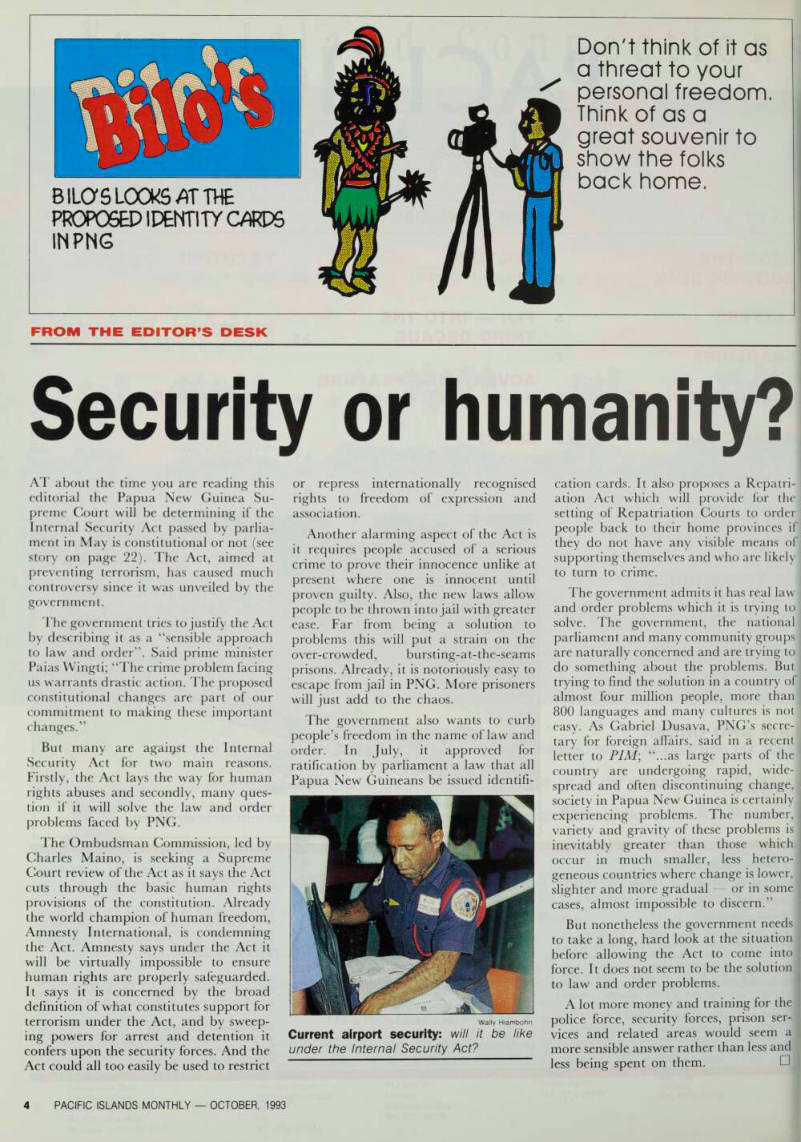
From The Editor’S Desk
AT about the time you are reading this editorial the Papua New Guinea Su preme Court will be determining if the
Internal Security Act passed by parlia
ment in May is constitutional or not (see story on page 22). The Act, aimed at preventing terrorism, has caused much controversy since it was unveiled by the government.
The government tries to justify the Act by describing it as a “sensible approach to law and order”. Said prime minister Paias Wingti; “The crime problem facing us warrants drastic action. The proposed constitutional changes are part of our commitment to making these important changes.”
But many are agairjst the Internal Security Act for two main reasons.
Firstly, the Act lays the way for human rights abuses and secondly, many ques tion if it will solve the law and order problems faced by PNG.
The Ombudsman Commission, led by Charles Maino, is seeking a Supreme Court review of the Act as it says the Act cuts through the basic human rights provisions of the constitution. Already the world champion of human freedom, Amnesty International, is condemning the Act. Amnesty says under the Act it will be virtually impossible to ensure human rights are properly safeguarded.
It says it is concerned by the broad definition of what constitutes support for terrorism under the Act, and by sweep ing powers for arrest and detention it confers upon the security forces. And the Act could all too easily be used to restrict
or repress internationally recognised rights to freedom of expression and association.
Another alarming aspect of the Act is it requires people accused of a serious crime to prove their innocence unlike at present where one is innocent until proven guilty. Also, the new laws allow people to be thrown into jail with greater ease. Far from being a solution to problems this will put a strain on the
over-crowded, bursting-at-the-seams
prisons. Already, it is notoriously easy to escape from jail in PNG. More prisoners will just add to the chaos.
The government also wants to curb people’s freedom in the name of law and order. In July, it approved for ratification by parliament a law that all Papua New Guineans be issued identifi-
cation cards. It also proposes a Repatri ation Act which will provide for the setting of Repatriation Courts to order j people back to their home provinces if they do not have any visible means of supporting themselves and who are likely to turn to crime.
The government admits it has real law and order problems which it is trying to solve. The government, the national parliament and many community groups are naturally concerned and are trying to I do something about the problems. But trying to find the solution in a country of almost four million people, more than 800 languages and many cultures is not I easy. As Gabriel Dusava, PNG’s secre-i tary for foreign affairs, said in a recent letter to PIM; “...as large parts of the country are undergoing rapid, wide- i spread and often discontinuing change, J society in Papua New Guinea is certainly! experiencing problems. The number, I variety and gravity of these problems is inevitably greater than those which occur in much smaller, less hetero-1 geneous countries where change is lower, slighter and more gradual or in some cases, almost impossible to discern.”
But nonetheless the government needs to take a long, hard look at the situation before allowing the Act to come into I force. It does not seem to be the solution ; to law and order problems.
A lot more money and training for the police force, security forces, prison ser- I vices and related areas would seem a more sensible answer rather than less and less being spent on them.
Wally Hiambohn Current airport security: will it be like under the Internal Security Act?