Toothbrushes
pp. 62-63 · Read in the full issue
Yachting
American cruisers bring oral care supplies to isolated Northern Cook Islands
By Sally Andrew
CRUISERS have joined the fight against tooth decay in the South Pacific.
This year, toothbrushes, toothpaste and transportation were donated by several American yachties transiting the Cook Islands.
At the Rarotonga Hospital in January, American yachtie Roy Ciappmi pres ented Dr Wolfgang Losacker, of the Cook Islands Ministry of Health, with 300 toothbrushes and two cases of toothpaste. Ciappini had read Toothbrushes for Paradise, a report pub lished in an American yachting maga zine which recommended that cruisers bring basic medical and personal health supplies as gifts for the islanders.
Ciappini thought the advice was good, and so he contacted several American companies and told them of the situation in the northern group of the Cook Islands. The donated products were brought over with him on his recent visit.
Two other Americans, Fred and Jean Shaw from a boating club in Washington state, also donated toothbrushes and
toothpaste.
Donations will go to school children on the islands of Penrhyn, Pukapuka and Manihiki, according to' the Cook Islands News. Sadly, “Cook Islanders living in the northern group do not come by the luxury of owning their own toothbrush as easily as those living in the southern
group ... toothbrushes and paste are not available for purchase in the islands’ stores, [so] the donation has been received like gold”.
Helping with the delivery of medical supplies and services is John Neal, owner of the 42-foot Hallberg Rassy ketch Mahina Tiare an expedition sail training vessel. Neal has been sailing in the South Pacific for nearly two decades.
He met Dr Wolfgang Losacker last year on Manihiki Island. At that time Dr Losacker initiated a World Health Organisation-sponsored medical survey of the outer islands checking for
tuberculosis, leprosy, heart disease, skin diseases and dental problems. Last year, Dr Losacker was given the opportunity of joining Neal aboard Mahina Tiare and selecting which island in the Northern Cooks they should visit. Thanks to Neal, Dr Losacker was able to personally meet all 750 inhabitants on Penrhyn, all 950 residents of Pukapuka, and other pa tients on Manihiki.
On Penrhyn Island, Dr Losacker was assisted by Dr Art Vall-Spinosa, one of Mahina Tiare’s expedition members.
Dorit, a Danish cruising woman and registered nurse aboard the yacht Ondine lent a helping hand. Crew member A 1 Maher, of San Francisco, brought a gross toothbrushes and toothpaste which he donated to the school principal on Penrhyn. Crew woman T C Vollum, of Portland, Oregon, donated a case of Betadine antibacterial scrub solution which was split up among six clinics.
The program was such a success that Mahina Tiare and Dr Losacker will team up again this winter. This visit will mark the fifth time in 10 years that Mahina Tiare has brought needed and requested medical supplies to the isolated Northern Cook islands.
Inter-island traffic in the Cook Islands is difficult. Only a few of the islands have sporadic air service, and contact on other islands, such as Pukapuka, is by freighter
John NEAL
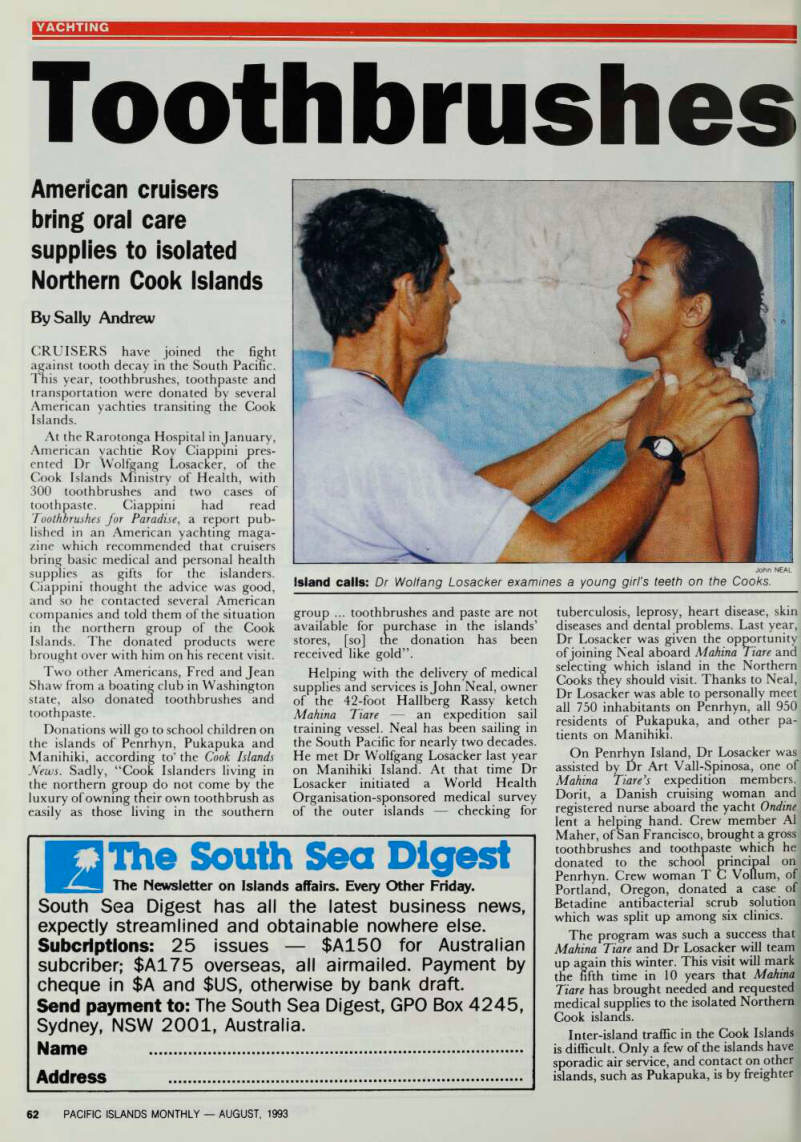
Island calls: Dr Wolfang Losacker examines a young girl’s teeth on the Cooks.
only with up to six months between visits which are gen erally of too short a duration to provide adequate health care for the island ers.
Dr Losacker’s goal for 1993 was to provide a tooth brush for each child in the Northern Cook Islands. He asks yachties sailing to Rarotonga bring their donation to him at the
Rarotonga Hos
pital, P O Box 109, Rarotonga, Cook Islands. Telephone 682-26-664. Ten years ago Dr Losacker started a program where each school child had his own tooth brush and every day after lunch students would brush their teeth for several minutes.
Dental health was
nuch better among children who were able ;o continue the program. Unfortunately, nany of the schools ran out of toothbrushes icveral years ago.
In addition to toothbrushes and oothpaste, the isolated Northern Cooks are n need of oral antibiotics such as penicillin, impicillin, tetracycline, bactrim, loxacillin, augmentin, cephalosporin, fentamycin, prednisone, hydrocortisone,
Panadol and sterile dressings, gauze and other items. Contributions can be shipped to Dr Wolfgang Losacker via airmail in care of Rarotonga Hospital, or to Mahina Tiare Sailing Expeditions, Box 1596, Fri day Harbor, WA 98250 206-378-6131.
Used school textbooks are another item of great value to the Cook islanders.
FIJI experience
JIM and Ann Cate of the yacht Insatiable, out of San Francisco, have been cruising in the Pacific for nearly 10 years. They love it. But what to do while cruising to help the locals?
“The best gift is to simply bring along whatever skills you have and teach them to others, or perform a service they can’t.
People are genuinely grateful and you can really feel like you’ve helped them. The business about taking gifts is tricky. Sure, everybody likes to give them and the locals like to receive them, but it doesn’t really cure anything or have a long term impact.
I got involved with a school in Fiji where the entire power grid for the island consisted of two small Honda generators, both of which were broken I told the people I’d be happy to try and fix them. They showed me their “tool kit” which consisted of a Phillips screwdriver, a crescent wrench and a couple of box wrenches. A gift of a few appropriate tools to these people was
far more significant than a couple of T-shirts.”
At another village in Fiji, Jim let on that he was pretty good at fixing things.
“During the next few days I never saw so many outboards and generators in my life. These people don’t have much money, and for many of them an outboard is a lifetime investment. I fixed one for a chap whose outboard hadn’t run in two years.
When it started up, he had tears in his eyes.
It was a big thing for him and for me.”
[?]Dental health: a priority with Penrhyn’s chool children.
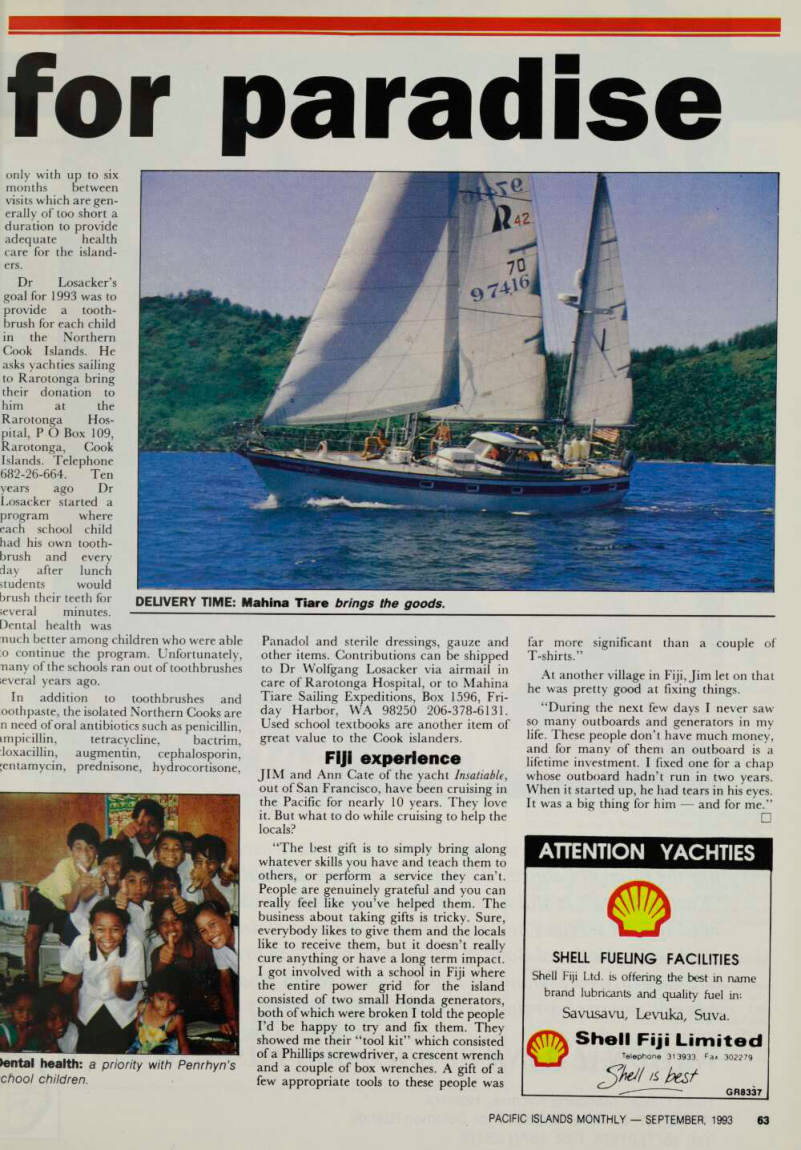
DELIVERY TIME: Mahina Tiare brings the goods.