South Sea guano
pp. 50-51 · Read in the full issue
Theatre
Nauru’s $2.9 million London musical, Leonardo, suffers at the hands of the critics.
But is there hope at the box-office?
By David North
NAURU’S theatrical investment, the London musical production Leonardo: A Portrait of Love, is doing badly.
A headline in the London Times says it all : “Critics compare Leonardo musical to South Sea guano.”
While the show was still running (and
probably depleting Nauru’s phosphate
rich treasure in the process) the signs were not encouraging; the Times placed it in its lowest of three popularity categories (you can buy a ticket any night in any price range); at one point it was the only show in the West End advertising half-price tickets, and the box office will accept no orders for perform ances after September 25.
Nauru had high hopes for the musical, and thought it had found another fortune-making blockbuster, like Cats or Phantom of the Opera. It decided to be the only investor in the show, and put up two
million pounds (U 552,900,000) to bring
it to the Strand Theatre.
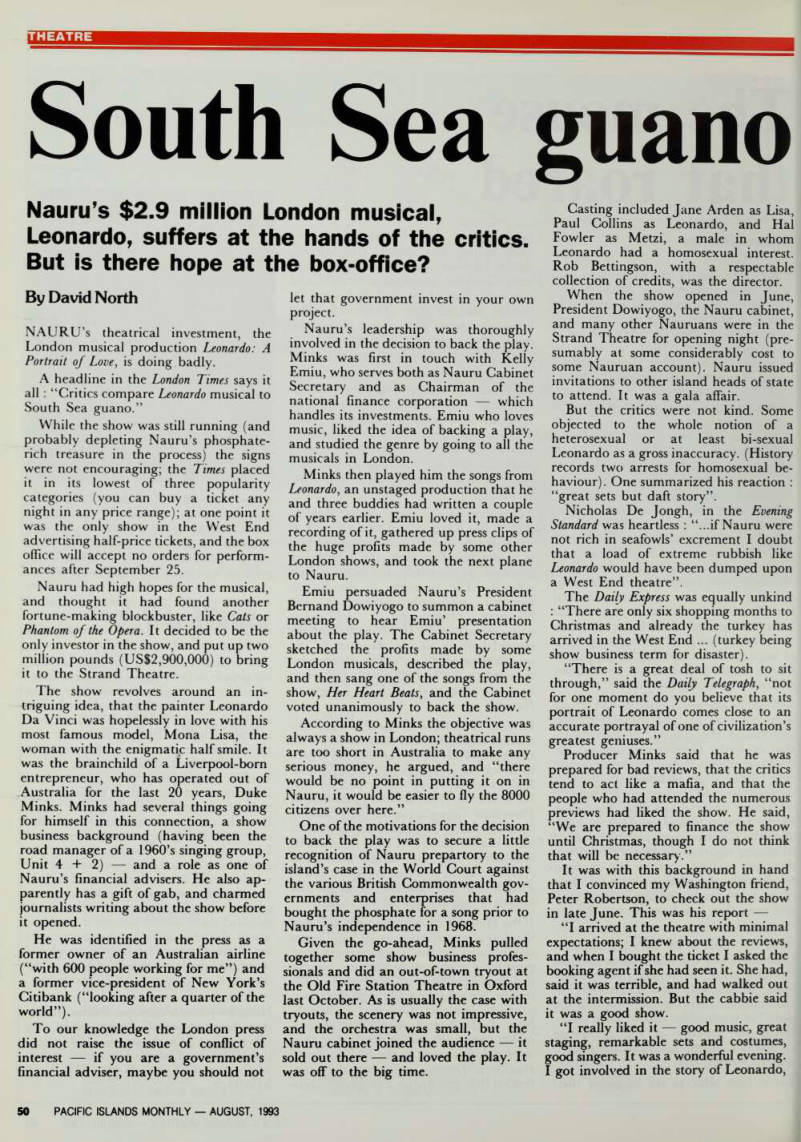
The show revolves around an in triguing idea, that the painter Leonardo Da Vinci was hopelessly in love with his most famous model, Mona Lisa, the woman with the enigmatic half smile. It was the brainchild of a Liverpool-born entrepreneur, who has operated out of Australia for the last 20 years, Duke Minks. Minks had several things going for himself in this connection, a show business background (having been the road manager of a 1960’s singing group, Unit 4 + 2) and a role as one of Nauru’s financial advisers. He also ap parently has a gift of gab, and charmed journalists writing about the show before it opened.
He was identified in the press as a former owner of an Australian airline (“with 600 people working for me”) and a former vice-president of New York’s Citibank (“looking after a quarter of the world”).
To our knowledge the London press did not raise the issue of conflict of interest if you are a government’s financial adviser, maybe you should not
let that government invest in your own project.
Nauru’s leadership was thoroughly
involved in the decision to back the play.
Minks was first in touch with Kelly Emiu, who serves both as Nauru Cabinet Secretary and as Chairman of the national finance corporation which handles its investments. Emiu who loves music, liked the idea of backing a play, and studied the genre by going to all the musicals in London.
Minks then played him the songs from Leonardo , an unstaged production that he and three buddies had written a couple of years earlier. Emiu loved it, made a recording of it, gathered up press clips of the huge profits made by some other London shows, and took the next plane to Nauru.
Emiu persuaded Nauru’s President Bcrnand Dowiyogo to summon a cabinet meeting to hear Emiu’ presentation about the play. The Cabinet Secretary sketched the profits made by some London musicals, described the play, and then sang one of the songs from the show, Her Heart Beats , and the Cabinet voted unanimously to back the show.
According to Minks the objective was always a show in London; theatrical runs are too short in Australia to make any serious money, he argued, and “there would be no point in putting it on in Nauru, it would be easier to fly the 8000 citizens over here.”
One of the motivations for the decision to back the play was to secure a little recognition of Nauru prepartory to the island’s case in the World Court against the various British Commonwealth gov ernments and enterprises that had bought the phosphate for a song prior to Nauru’s independence in 1968.
Given the go-ahead, Minks pulled together some show business profes sionals and did an out-of-town tryout at the Old Fire Station Theatre in Oxford last October. As is usually the case with tryouts, the scenery was not impressive, and the orchestra was small, but the Nauru cabinet joined the audience it sold out there and loved the play. It was off to the big time.
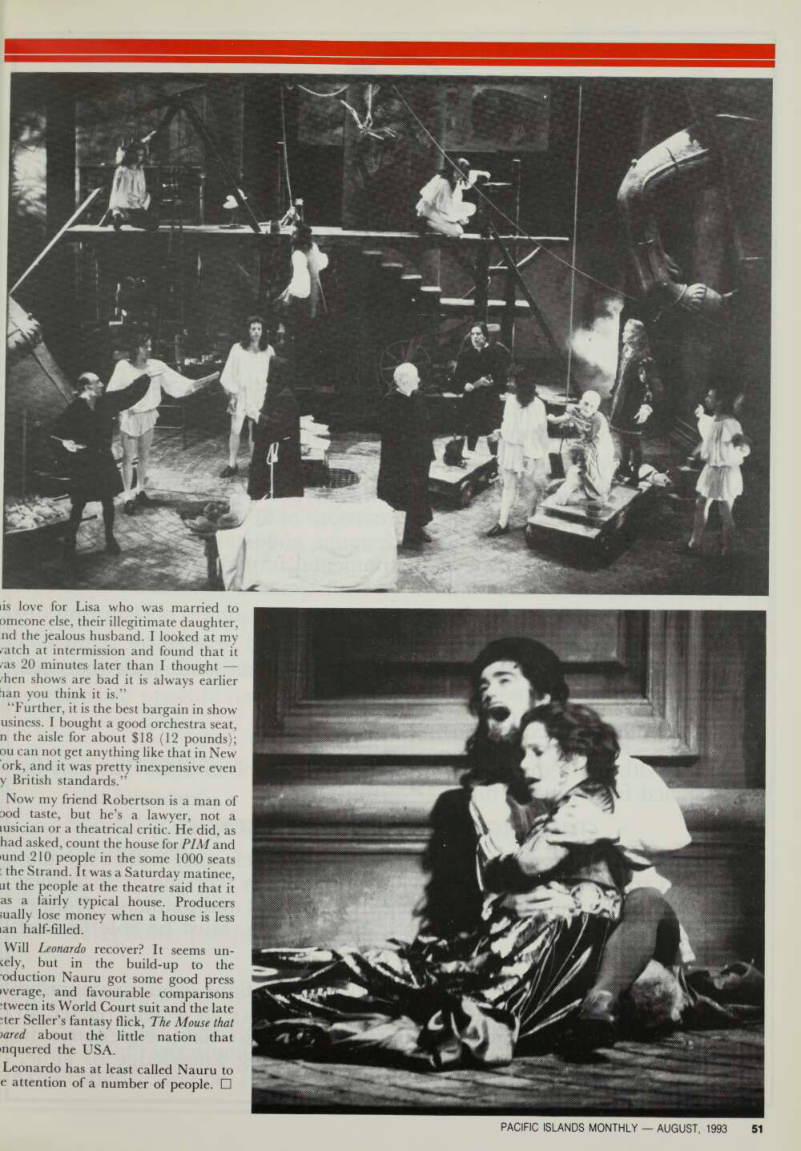
Casting included Jane Arden as Lisa, Paul Collins as Leonardo, and Hal Fowler as Metzi, a male in whom Leonardo had a homosexual interest.
Rob Bettingson, with a respectable collection of credits, was the director.
When the show opened in June, President Dowiyogo, the Nauru cabinet, and many other Nauruans were in the Strand Theatre for opening night (pre sumably at some considerably cost to some Nauruan account). Nauru issued invitations to other island heads of state to attend. It was a gala affair.
But the critics were not kind. Some objected to the whole notion of a heterosexual or at least bi-sexual Leonardo as a gross inaccuracy. (History records two arrests for homosexual be haviour). One summarized his reaction : “great sets but daft story”.
Nicholas De Jongh, in the Evening Standard was heartless : “...if Nauru were not rich in seafowls’ excrement I doubt that a load of extreme rubbish like Leonardo would have been dumped upon a West End theatre”.
The Daily Express was equally unkind : “There are only six shopping months to Christmas and already the turkey has arrived in the West End ... (turkey being show business term for disaster).
“There is a great deal of tosh to sit through,” said the Daily Telegraph , “not for one moment do you believe that its portrait of Leonardo comes close to an accurate portrayal of one of civilization’s
greatest geniuses.”
Producer Minks said that he was prepared for bad reviews, that the critics tend to act like a mafia, and that the people who had attended the numerous previews had liked the show. He said, “We are prepared to finance the show until Christmas, though I do not think that will be necessary.”
It was with this background in hand that I convinced my Washington friend, Peter Robertson, to check out the show in late June. This was his report “I arrived at the theatre with minimal expectations; I knew about the reviews, and when I bought the ticket I asked the booking agent if she had seen it. She had, said it was terrible, and had walked out at the intermission. But the cabbie said it was a good show, “I really liked it good music, great staging, remarkable sets and costumes, good singers. It was a wonderful evening.
I got involved in the story of Leonardo,
lis love for Lisa who was married to omeone else, their illegitimate daughter, nd the jealous husband. I looked at my /atch at intermission and found that it 'as 20 minutes later than I thought 'hen shows are bad it is always earlier tian you think it is.”
“Further, it is the best bargain in show usiness. I bought a good orchestra seat, n the aisle for about $lB (12 pounds); ou can not get anything like that in New ork, and it was pretty inexpensive even y British standards.”
Now my friend Robertson is a man of Dod taste, but he’s a lawyer, not a msician or a theatrical critic. He did, as had asked, count the house for PIM and •und 210 people in the some 1000 seats ; the Strand. It was a Saturday matinee, nt the people at the theatre said that it as a fairly typical house. Producers >ually lose money when a house is less tan half-filled.
Will Leonardo recover? It seems un tely, but in the build-up to the eduction Nauru got some good press ►verage, and favourable comparisons its World Court suit and the late 'ter Seller’s fantasy flick, The Mouse that lared about the little nation that •nquered the USA.
Leonardo has at least called Nauru to e attention of a number of people. □