The mouse
p. 49 · Read in the full issue
Books
The mouse that roared
By Ian Williams
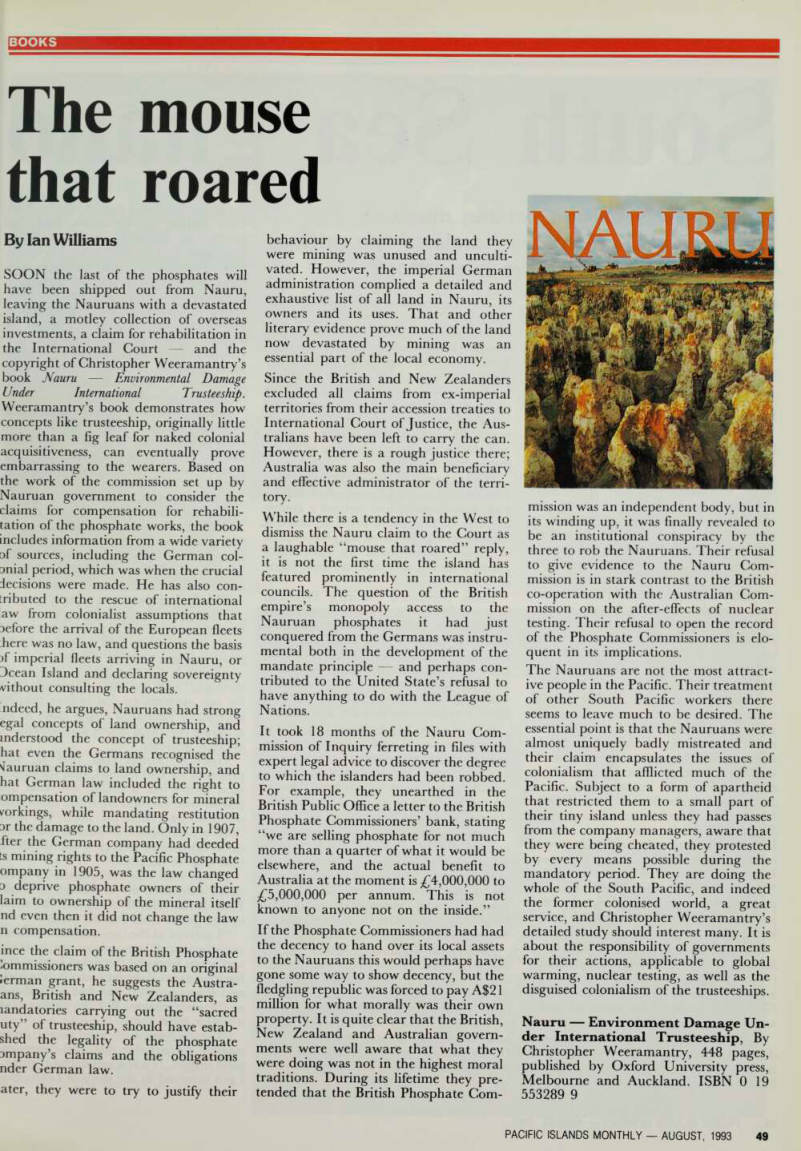
SOON the last of the phosphates will have been shipped out from Nauru, leaving the Nauruans with a devastated island, a motley collection of overseas investments, a claim for rehabilitation in the International Court and the
copyright of Christopher Weeramantry’s
book Nauru Environmental Damage Under International Trusteeship.
Weeramantry’s book demonstrates how concepts like trusteeship, originally little more than a fig leaf for naked colonial acquisitiveness, can eventually prove embarrassing to the wearers. Based on the work of the commission set up by Nauruan government to consider the claims for compensation for rehabili tation of the phosphate works, the book includes information from a wide variety of sources, including the German col onial period, which was when the crucial decisions were made. He has also con tributed to the rescue of international aw from colonialist assumptions that oefore the arrival of the European fleets here was no law, and questions the basis )f imperial fleets arriving in Nauru, or Dcean Island and declaring sovereignty
vithout consulting the locals.
ndeed, he argues, Nauruans had strong egal concepts of land ownership, and mderstood the concept of trusteeship; hat even the Germans recognised the Nauruan claims to land ownership, and hat German law included the right to ompensation of landowners for mineral
workings, while mandating restitution
dt the damage to the land. Only in 1907, fter the German company had deeded ts mining rights to the Pacific Phosphate ompany in 1905, was the law changed
3 deprive phosphate owners of their
laim to ownership of the mineral itself nd even then it did not change the law n compensation, ince the claim of the British Phosphate Commissioners was based on an original lerman grant, he suggests the Austra ans, British and New Zealanders, as landatories carrying out the “sacred uty” of trusteeship, should have estab
shed the legality of the phosphate
Dmpany’s claims and the obligations nder German law. a ter, they were to try to justify their
behaviour by claiming the land they were mining was unused and unculti vated. However, the imperial German administration complied a detailed and exhaustive list of all land in Nauru, its owners and its uses. That and other literary evidence prove much of the land now devastated by mining was an essential part of the local economy.
Since the British and New Zealanders excluded all claims from ex-imperial territories from their accession treaties to International Court of Justice, the Aus tralians have been left to carry the can.
However, there is a rough justice there; Australia was also the main beneficiary and effective administrator of the terri tory.
While there is a tendency in the West to dismiss the Nauru claim to the Court as a laughable “mouse that roared” reply, it is not the first time the island has featured prominently in international councils. The question of the British empire’s monopoly access to the Nauruan phosphates it had just conquered from the Germans was instru mental both in the development of the mandate principle and perhaps con tributed to the United State’s refusal to have anything to do with the League of Nations.
It took 18 months of the Nauru Com mission of Inquiry ferreting in files with expert legal advice to discover the degree to which the islanders had been robbed.
For example, they unearthed in the British Public Office a letter to the British
Phosphate Commissioners’ bank, stating
“we are selling phosphate for not much more than a quarter of what it would be elsewhere, and the actual benefit to Australia at the moment is £4,000,000 to £5,000,000 per annum. This is not known to anyone not on the inside.”
If the Phosphate Commissioners had had the decency to hand over its local assets to the Nauruans this would perhaps have gone some way to show decency, but the fledgling republic was forced to pay AS2I million for what morally was their own property. It is quite clear that the British, New Zealand and Australian govern ments were well aware that what they were doing was not in the highest moral traditions. During its lifetime they pre tended that the British Phosphate Com-
mission was an independent body, but in its winding up, it was finally revealed to be an institutional conspiracy by the three to rob the Nauruans. Their refusal to give evidence to the Nauru Com mission is in stark contrast to the British co-operation with the Australian Com mission on the after-effects of nuclear testing. Their refusal to open the record of the Phosphate Commissioners is elo quent in its implications.
The Nauruans are not the most attract ive people in the Pacific. Their treatment of other South Pacific workers there seems to leave much to be desired. The essential point is that the Nauruans were almost uniquely badly mistreated and their claim encapsulates the issues of colonialism that afflicted much of the Pacific. Subject to a form of apartheid that restricted them to a small part of their tiny island unless they had passes from the company managers, aware that they were being cheated, they protested by every means possible during the mandatory period. They are doing the whole of the South Pacific, and indeed the former colonised world, a great
service, and Christopher Weeramantry’s
detailed study should interest many. It is about the responsibility of governments for their actions, applicable to global warming, nuclear testing, as well as the disguised colonialism of the trusteeships.
Nauru Environment Damage Un
der International Trusteeship, By
Christopher Weeramantry, 448 pages,
published by Oxford University press, Melbourne and Auckland. ISBN 0 19 553289 9