mirrors trick
pp. 45-47 · Read in the full issue

Forestry
The glass beads and mirrors trick
By Wally Hiambohn
PAPUA NEW GUINEA’S Forest Minis ter Tim Neville went on national radio to reveal his life had been threatened because of his moves to overhaul the forest industry and clean it of corruption.
He also told journalists later he turned down a bribe of up to K 2 million from one forest company.
Days later the Premier of Manus Province said he was offered K 25,000 and his forest officer K3OOO, sealed in two envelopes and hand-delivered to them by a senior official of a foreign timber zompany. The province had only just egislated to make drastic reductions to
annual log harvest.
Provincial Affairs Minister John Vilkare has been complaining about zorruption in the industry, about how ogs are being harvested at a very fast
pace and how landowners are being bought off with trips to Port Moresby, hotel accommodation, cartons of beer and maybe a four-wheeled vehicle just so that foreign companies can have access to forest resources.
These and many other concerns re cently have shown the controversy sur rounding PNG’s forest industry has not died down. If anything, it shows the extent of corruption in the industry may be greater than was exposed in a 1987-88 commission of inquiry where a large number of Asian companies were impli cated, and which eventually led to the conviction of former deputy Prime Min ister Ted Diro and another government minister Gerard Sigulogo by a leadership tribunal.
A report recently put out by the
Rabaul-based Pacific Heritage Foun dation indicates the government, the province and landowners need to protect their resources from exploitation.
Neville has expressed his determi nation to address the issue “I’ve had my life personally threatened. If I have to die for something I think is right for my country, I will do it. My family has asked if it is worth it and I’ve said, ‘at the end of the day I’ll protect the future generation.”’
PNG and the Solomon Islands have now become a supply source for foreign logging companies, especially from Asia, because a worldwide ban on log exports has caused a sharp increase in log prices.
The Bank of PNG’s latest quarterly economic bulletin said the volume of log exports increased by 33.7 per cent to 443,000 cubic metres in the first three
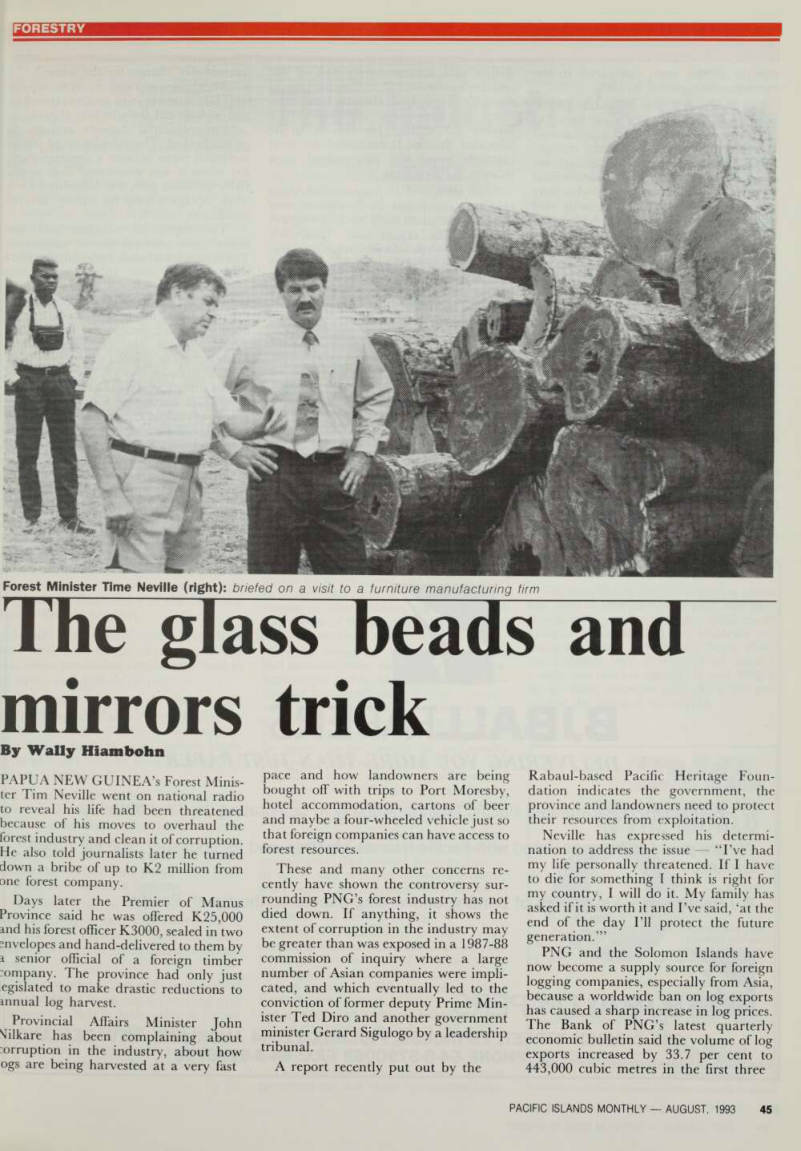
Forest Minister Time Neville (right): briefed on a visit to a furniture manufacturing firm
months of the year, compared to the corresponding period m 1992.
Neville’s new Forest Resources Development Guidelines, which he hopes to get Cabinet approval on soon, are aimed at achieving sustainable yields, encouraging downstream processing and increasing local revenue generation and benefit. A Cabinet colleague who fully supports it is John Nilkare, who said logging was out of control and causing a trail of environmental and social disruphons.
According to Nilkare, landowners were being duped into handing over their forests for a few quick bucks by a few foreign companies who were making millions of kina by exporting a rapidly increasing number of logs back to their own countries for processing. “The timber prices are now high/and the industry is now undertaking 24-hour logging and shipping to ensure they take out as much as possible before the government comes down and imposes toueh new rules ” tough new rules.
Forest resources would be wiped out m ess than 10 years if exploitation contmued at the current rate, a recent private study has warned.
In a startling 30-page report released recently, the Pacific Heritage Foun-
dation said approximately half of the country’s estimated 15 million hectares of operable forest had already been allo cated for harvesting, and believed a further 2.5 million hectares is to be allocated shortly. It estimated the total operable forest was now valued at a massive KlOO billion.
“For all practical purposes, all these resources controlled by foreigners, and the gigantic profits will be in foreigners pockets,” the report said. It further stated, “If the forest resource was sustainably managed and harvested by Papua New Guineans or PNG com panies, the annual income to the country would be as high as K 3.1 billion or nearly KBOOO for every man, woman and child amongst the highest per capita income in the world.”
Calling for drastic measures, including another inquiry into the forest industry, the report said the devastating transfor mation of PNG’s forest was continuing and increasing, despite a wide-ranging and thorough investigation by the Barnett Inquiry in 1989. “The investi gation revealed almost universal corrup tion, mismanagement and malpractice,” the report said.
It said, following the Barnett Inquiry there had been a “qualitative and
quantitative change for the worse”
The abuses exposed by the inquiry continue, and are even more entrenched and widespread than before, it said, “Environmental damage appears to go unchecked. The submission of envir onmental plans became a separate scan dal when it was discovered that essen tiall Y the same P lan was submitted for a score operations in widely diverse conditions.
“The rights of villagers and the landowners continue to be neglected.
The financial abuses undoubtedly con tinue. . “Reform has suffered from a continu ing conflict of interest, a conflict of interest both inside government and outside. “Some people are fighting for reform; others are indifferent. Some actively oppose reform; others only wish r\ ft, inn r “ d y found ther c are )00 overseas com P ames halvestln S, logs m PNG °f them are mter-related. The study found that while log export value incre y ased from K 74 8 mil jl on f n 1990 to KB4O million in M this the value ofsawn timber rema y ined K j 2 mi i| ion and K 1 million and woodchips at K 7.1 miUion and K 9.3 million for the two periods, The report goes in depth into the
history of the forest industry, the laws, recent developments, revealing accounts of corruption and damaging effects to the environment, people and the economy.
It is punctuated with serious questions and warnings.
The Foundation has recommended five actions the government should take to avoid a quick depletion of PNG’s forest resources communicate with landowners, support the new Forest Policy and Forest Act, ban log exports, enforce processing and start a new inquiry.
The report states massive community education is needed to reach resource owners. “Churches, women’s councils,
literacy workers and non-governmental
organisations can be given information to pass on to the villages and rural areas.”
“Awareness education is especially needed by landowners who are now being approached by logging companies.
As fully as possible, they must under stand the consequences of selling and losing their forests.”
The report said the Forest Authority should be allowed to work in ways it was intended for, in particular, to ensure decision-making was decentralised. It said amendments to the Forestry Act returned power to the minister and reduced the democracy of the National Forest Board members.
It said there should be an immediate tnd total ban on log exports, and the
ninimum processing requirement was to
dc sawn and kiln-dried timber.
On a new inquiry, the report said Prime Minister Paias VVingti had com nitted himself to open a full inquiry. ‘Such an investigation should begin vithout delay and be totally open,” the eport recommends.
The report concludes : “The present Minister for Forests (Tim Neville) ap >cars to be determined to change the rots )f the past. However, he will have a najor battle inside Cabinet and inside he administration from people who have eceived favours from loggers.
“He will also be opposed by those andowners who have sold their souls to he foreign exploiters. The minister leserves and needs all the support we can ;ive.
“We can take action and change what » happening. Or we can do nothing and dsc forests of incalculable value to Papua Jew Guinea and the world.
“The same glass beads and mirrors rick is being played. The choice is ours.”